Interview · South Dakota · Stephanie Charging Eagle · OSEU 4
Themes: Land & stewardship, Language & revitalization, Kinship & family, Identity & belonging, Storytelling & oral tradition, Education & learning, Values & generosity, Culture & continuity, Community & responsibility, Economy & livelihoods, Listening & observation, Children & young people, Humor & play
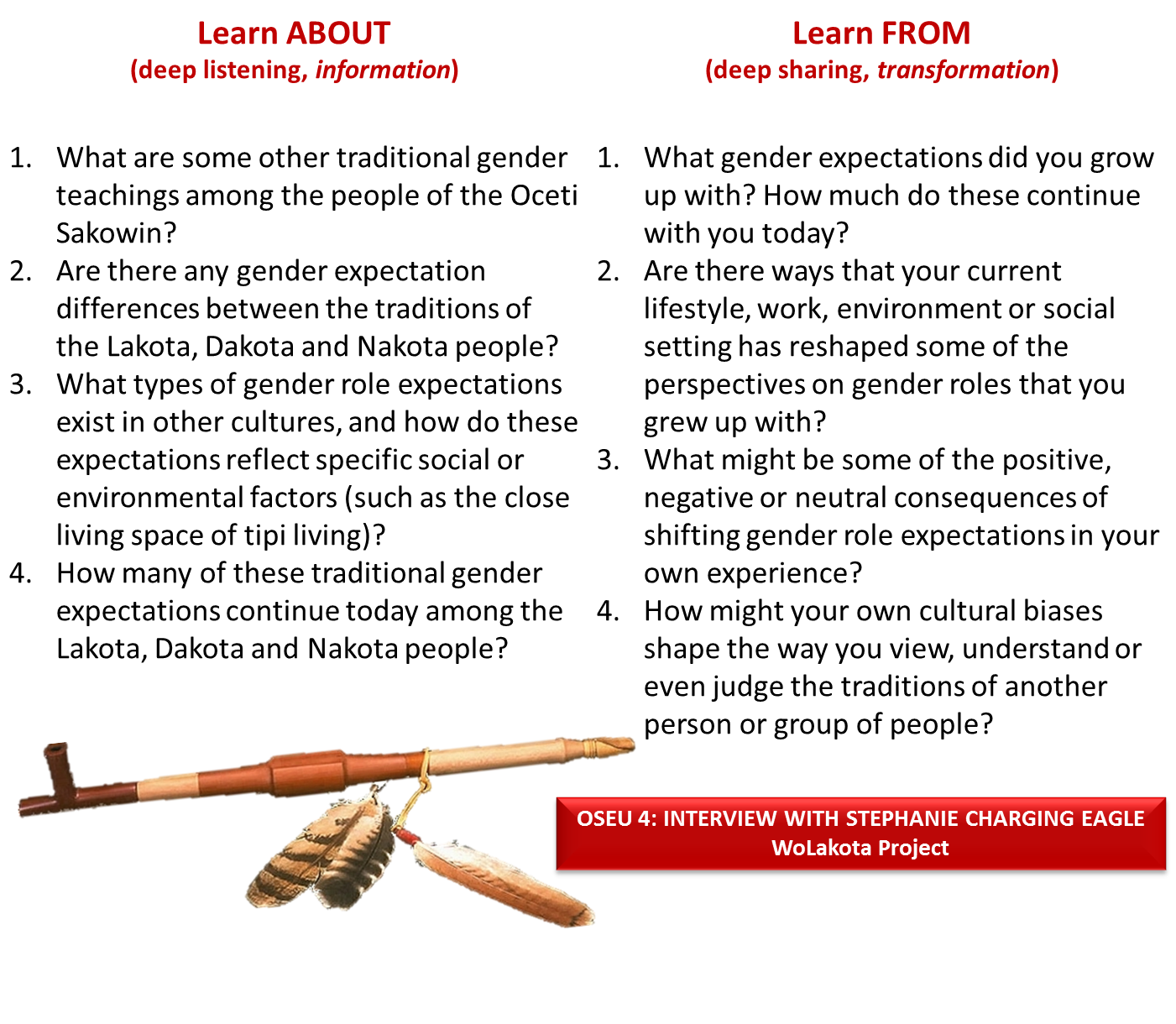
Learn About questions
What are some other traditional gender teachings among the people of the Oceti Sakowin?
Are there any gender expectation differences between the traditions of the Lakota, Dakota and Nakota people?
What types of gender role expectations exist in other coutures, and how do these expectations reflect specific social or environmental factors (such as the close living space of tipi living)?
How many of these traditional gender expectations continue today among the Lakota, Dakota and Nakota people?
Learn From questions
What gender expectations did you grow up with? How much do these continue with you today?
Are there ways that your current lifestyle, work, environment or social setting has reshaped some of the perspectives on gender roles that you grew up with?
What might be some of the positive, negative or neutral consequences of shifting gender role expectations in your ow experience?
How might your own cultural biases shape the way you view, understand or even judge the traditions of another person or group of people?
Transcripts
Traditional Gender Roles - Stephanie Charging Eagle - OSEU #4
Watch this interview on YouTubeAs a Lakota woman, as a girl, as a young girl, I was taught certain things that I could and could not do. And there was always in the group with males or with adults what I could do and couldn't do in the presence of others. And because I grew up in a one room to room house, you know, one area was the sleeping area. But that in itself is a good example of how the Lakota male and female are separated and have their own area, their own roles, responsibilities. But we were never allowed. My sisters and I had our own sleeping area and where we kept our our clothes, everything, our personal belongings. We had an area that was our area. It was understood that we kept our area clean, you know. And then my brothers had their own.
I have an older brother and a young, younger brother. And their area was similar to ours. But what we could not do is go over to their area, especially with the girls. We could not go over to my brothers and lay on the bed or dig around in their stuff, you know, that was forbidden. We were not allowed and they couldn't do that with this. So in a way, I think that that established the boundaries of where you what you could do with the opposite sex. You know, and then my parents had their own sleeping area, but that was where we were all able to go.You know, we could lay on my my parents in bed. You know, we could we can lay there at night if they told stories or different things, you know. So that was kind of the area where we were able to be at. We were allowed to be.
And because of the boundaries, we were told as young children, smart children, we could play with each other, you know, like we could go outside and, you know, go sledding, whatever, as little children together. But as we got a little bit older, especially when we got into puberty, boy, there were some strict boundaries set to what we could do with our male relatives and our. And then with this, we could not at at any time just tease them. You know, we could we had a certain point. We could not tease them in in a way that was often that would be seen as inappropriate. And they couldn't do the same with us. We could not touch them physically. They could not just physically. They could not come into our area or sleeping area and touch, sit on their beds, anything, because the belief, the teaching is that our spirit is different from theirs and our power is different from theirs. To mingle them is is now to to bring something into that power that would not be good.
And, you know, and I and I see the abuse of that today. You know, we we've no longer observed those. So we have so much of what I think is like your our domestic violence, child abuse. You know, we have more cases of that. And I think it's because somewhere we've had a breakdown a while. We do have a breakdown. You know, as a young girl growing up, I had these roles, these responsibilities, to always observe that or else I would be, you know, there with my my mother especially and my my mother, my aunts, they would always correct me. You know, they wouldn't get after me, but they would just you know, there was understood that a certain look commit you can do that or sometimes if it was really not very good, you know, kind of bad, then they would take us aside and tell us or, or sometimes as a whole, with my two sisters and I, they said the maybe tell us a story about, you know, something that could happen or that happened to somebody when they did this.
And so those are the stories we're always a lesson in our story. They were funny, they were entertaining. But at the same time, as you got older, the same stories were told throughout your development. And each time it was told you understood more of that story. It wasn't just to entertain, but there was something in that story that you needed to know and that as a as a cook, the woman that was one of my that is one of my roles is to know those stories for the young women so that I can share them. And when they needed to have maybe some clarification about their roles responsibilities as a female, then I would be able to share stories.
So it's not harsh. I'm not giving down on them. I'm not being critical, but in a good way. I'm teaching them this is the way it should be. This is the way it was, and it should be. And same with the meals they I You would never have a male discipline, a young girl or a young woman. That is not their place. A young woman or myself. I would never discipline one of my young male relatives. I would leave that to one of my male relatives, uncle, older brother, whoever, you know, because that's their world. They understand and they know, you know, how they should talk to that male. And even our language identifies us by gender. We never there are words that women use that men do not use.
So, you know, it's not that it's a segregation type of thing, but it's a respect so that there's no temptation. There's no, you know, anything that could happen if these are not observed.
Resource text
From the current WoLakota source page:
Traditional Gender Roles
Stephanie Charging Eagle
Transcript
(deep listening, information)
(deep listening, information)
Some indexed text was extracted from scanned material. Check the original source for exact wording and spelling.
Source materials
Supplied transcript document. Text preserved as supplied; spellings and transcription uncertainties have not been corrected.
Additional source transcripts
Traditional Gender Roles
Traditional Gender Roles - Stephanie Charging Eagle
- OSEU #4
As a Lakota woman, as a girl, as a young girl, I was taught certain things that I could
and could not do. And there was always in the group with males or with adults what I
could do and couldn't do in the presence of others. And because I grew up in a one
room to room house, you know, one area was the sleeping area. But that in itself is a
good example of how the Lakota male and female are separated and have their own
area, their own roles, responsibilities. But we were never allowed. My sisters and I had
our own sleeping area and where we kept our our clothes, everything, our personal
belongings. We had an area that was our area. It was understood that we kept our area
clean, you know. And then my brothers had their own.
I have an older brother and a young, younger brother. And their area was similar to
ours. But what we could not do is go over to their area, especially with the girls. We
could not go over to my brothers and lay on the bed or dig around in their stuff, you
know, that was forbidden. We were not allowed and they couldn't do that with this. So in
a way, I think that that established the boundaries of where you what you could do with
the opposite sex. You know, and then my parents had their own sleeping area, but that
was where we were all able to go.You know, we could lay on my my parents in bed. You
know, we could we can lay there at night if they told stories or different things, you know.
So that was kind of the area where we were able to be at. We were allowed to be.
And because of the boundaries, we were told as young children, smart children, we
could play with each other, you know, like we could go outside and, you know, go
sledding, whatever, as little children together. But as we got a little bit older, especially
when we got into puberty, boy, there were some strict boundaries set to what we could
do with our male relatives and our. And then with this, we could not at at any time just
tease them. You know, we could we had a certain point. We could not tease them in in a
way that was often that would be seen as inappropriate. And they couldn't do the same
with us. We could not touch them physically. They could not just physically. They could
not come into our area or sleeping area and touch, sit on their beds, anything, because
the belief, the teaching is that our spirit is different from theirs and our power is different
from theirs. To mingle them is is now to to bring something into that power that would
not be good.
And, you know, and I and I see the abuse of that today. You know, we we've no longer
observed those. So we have so much of what I think is like your our domestic violence,
child abuse. You know, we have more cases of that. And I think it's because somewhere
we've had a breakdown a while. We do have a breakdown. You know, as a young girl
growing up, I had these roles, these responsibilities, to always observe that or else I
would be, you know, there with my my mother especially and my my mother, my aunts,
they would always correct me. You know, they wouldn't get after me, but they would just
you know, there was understood that a certain look commit you can do that or
sometimes if it was really not very good, you know, kind of bad, then they would take us
aside and tell us or, or sometimes as a whole, with my two sisters and I, they said the
maybe tell us a story about, you know, something that could happen or that happened
to somebody when they did this.
And so those are the stories we're always a lesson in our story. They were funny, they
were entertaining. But at the same time, as you got older, the same stories were told
throughout your development. And each time it was told you understood more of that
story. It wasn't just to entertain, but there was something in that story that you needed to
know and that as a as a cook, the woman that was one of my that is one of my roles is
to know those stories for the young women so that I can share them. And when when
they needed to have maybe some clarification about their roles responsibilities as a
female, then I would be able to share stories.
So it's not harsh. I'm not giving down on them. I'm not being critical, but in a good way.
I'm teaching them this is the way it should be. This is the way it was, and it should be.
And same with the meals they I You would never have a male discipline, a young girl or
a young woman. That is not their place. A young woman or myself. I would never
discipline one of my young male relatives. I would leave that to one of my male
relatives, uncle, older brother, whoever, you know, because that's their world. They
understand and they know, you know, how they should talk to that male. And even our
language identifies us by gender. We never there are words that women use that men
do not use.
So, you know, it's not that it's a segregation type of thing, but it's a respect so that
there's no temptation. There's no, you know, anything that could happen if these are not
observed.