Interview · South Dakota · Donald Montileaux · OSEU 5
Themes: Language & revitalization, Kinship & family, Storytelling & oral tradition, Spirituality & ceremony, Values & generosity, Culture & continuity, Arts & expression, Listening & observation
Learn About questions
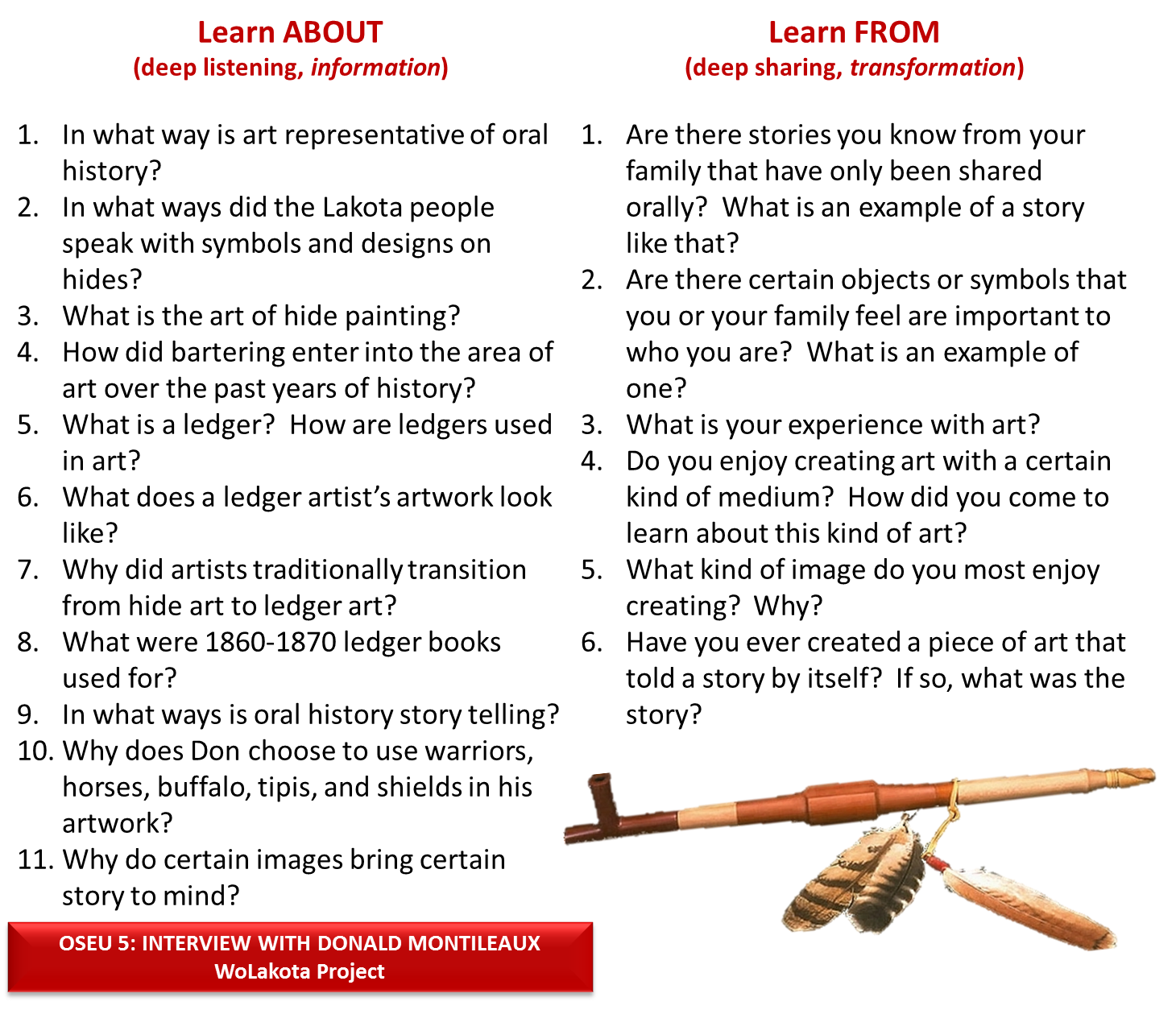
In what way is art representative of oral
history?
In what ways did the Lakota people speak with symbols and designs on hides?
What is the art of hide painting?
How did bartering enter into the area of art over the past years of history?
What is a ledger? How are ledgers used in art?
What does a ledger artist’s artwork look like?
Why did artists traditionally transition from hide art to ledger art
What were 1860-1870 ledger books used for?
In what ways is oral history story telling?
Why does Don choose to use warriors, horses, buffalo, tipis, and shields in his artwork?
Why do certain images bring certain story to mind?
Learn From questions
Are there stories you know from your family that have only been shared orally? What is an example of a story like that?
Are there certain objects or symbols that you or your family feel are important to who you are? What is an example of one?
What is your experience with art?
Do you enjoy creating art with a certain kind of medium? How did you come to learn about this kind of art?
What kind of image do you most enjoy creating? Why?
Have you ever created a piece of art that told a story by itself? If so, what was the story?
Transcripts
Oral History & Ledger Art - Donald Montileaux - OSEU 5
Watch this interview on YouTubeMy whole art that I do is oral, because the Lakota people had no language, and so they put everything down on hides with symbols and designs, and then they would tell stories about what those symbols and designs meant. And once the buffalo were gone, they had to find a new way to put those down, so they started bartering with soldiers and storekeepers for their ledger books, to put those same designs and retain that history and that culture and those ceremonies through those symbols on books. Well, that's where I come in as an artist.
My mentor taught me how to hide paint, but he was too good and I had an ego, and I thought, no, this isn't going to happen. I'm not going to get honorable mention as long as he's alive, you know. So I learned about the bartering system, I learned about ledgers, and I started being a ledger artist. I knew all the symbols, all the designs, what their meanings were, so the transition was fairly easy, and it's a traditional transition, too.
So I transitioned from a hide painter to a ledger artist, and I don't care who the canvas painters are, the watercolor artists, or whatever, I'm the ledger artist. And I use simple tools, I use the tools that were available back then, I use pencils, colored pencils, and inks, you know, they had Indian inks, so I used those, and I do find, I find ledger books that are 1860, 1870s, they're hard to acquire, but I do have them.
And so oral history is very big for me, I mean, oral history is storytelling, and every time I show my piece of artwork, I have oral history, because all my drawings represent Lakota way of life, and especially warriors, and especially their horses that they have, their buffalo that they had, you know, that's my main gig, is horses, buffalo, and warriors, and tipis, you know, but shields now. But they're all oral, and the drawing itself is just an image that brings that story to mind, so we are all people.
Resource text
OSEU 5: INTERVIEW WITH DONALD MONTILEAUX
WoLakota Project
From the current WoLakota source page:
Oral History & Ledger Art
Donald Montileaux
Transcript
(deep listening, information)
(deep listening, transformation)
Some indexed text was extracted from scanned material. Check the original source for exact wording and spelling.
Source materials
Supplied transcript document. Text preserved as supplied; spellings and transcription uncertainties have not been corrected.
Additional source transcripts
Oral History & Ledger Art
Oral History & Ledger Art - Donald Montileaux -
OSEU 5
My whole art that I do is oral, because the Lakota people had no language, and so they
put everything down on hides with symbols and designs, and then they would tell stories
about what those symbols and designs meant. And once the buffalo were gone, they
had to find a new way to put those down, so they started bartering with soldiers and
storekeepers for their ledger books, to put those same designs and retain that history
and that culture and those ceremonies through those symbols on books. Well, that's
where I come in as an artist.
My mentor taught me how to hide paint, but he was too good and I had an ego, and I
thought, no, this isn't going to happen. I'm not going to get honorable mention as long
as he's alive, you know. So I learned about the bartering system, I learned about
ledgers, and I started being a ledger artist. I knew all the symbols, all the designs, what
their meanings were, so the transition was fairly easy, and it's a traditional transition,
too.
So I transitioned from a hide painter to a ledger artist, and I don't care who the canvas
painters are, the watercolor artists, or whatever, I'm the ledger artist. And I use simple
tools, I use the tools that were available back then, I use pencils, colored pencils, and
inks, you know, they had Indian inks, so I used those, and I do find, I find ledger books
that are 1860, 1870s, they're hard to acquire, but I do have them.
And so oral history is very big for me, I mean, oral history is storytelling, and every time I
show my piece of artwork, I have oral history, because all my drawings represent Lakota
way of life, and especially warriors, and especially their horses that they have, their
buffalo that they had, you know, that's my main gig, is horses, buffalo, and warriors, and
tipis, you know, but shields now. But they're all oral, and the drawing itself is just an
image that brings that story to mind, so we are all people.