Interview · South Dakota · Joseph Marshall III · OSEU 7
Themes: Language & revitalization, Kinship & family, Education & learning, Treaties & sovereignty, Boarding schools & assimilation, Values & generosity, Culture & continuity, Listening & observation, Children & young people
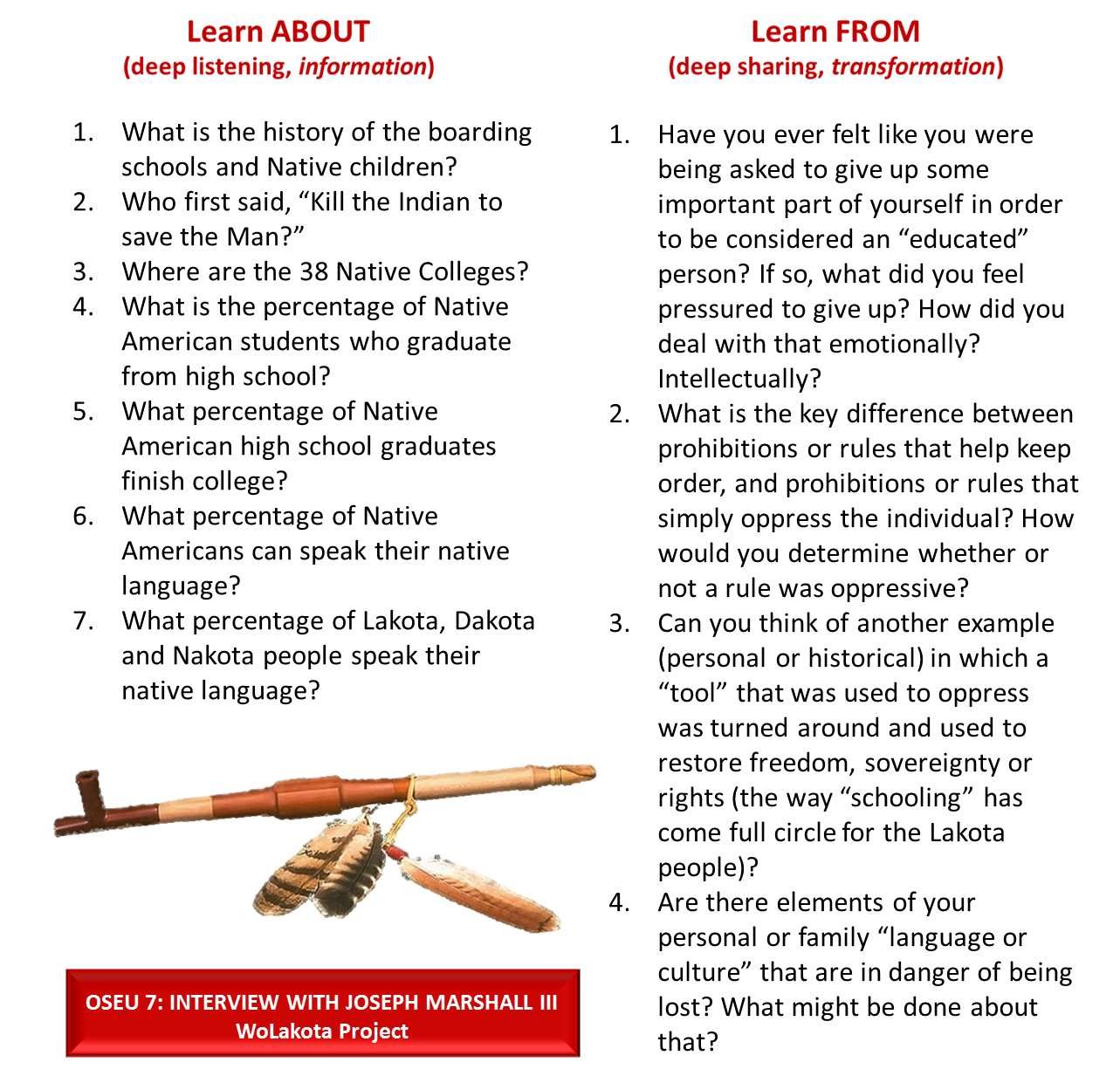
Learn About questions
What is the history of the boarding
schools and Native children?
Who first said, “Kill the Indian to save the Man?”
Where are the 38 Native Colleges?
What is the percentage of Native American students who graduate from high school?
What percentage of Native American high school graduates finish college?
What percentage of Native Americans can speak their native language?
What percentage of Lakota, Dakota and Nakota people speak their native language?
Learn From questions
Have you ever felt like you were
being asked to give up some
important part of yourself in order
to be considered an “educated”
person? If so, what did you feel
pressured to give up? How did you
deal with that emotionally?
Intellectually?
What is the key difference between prohibitions or rules that help keep order, and prohibitions or rules that simply oppress the individual? How would you determine whether or not a rule was oppressive?
Can you think of another example (personal or historical) in which a “tool” that was used to oppress was turned around and used to restore freedom, sovereignty or rights (the way “schooling” has come full circle for the Lakota people)?
Are there elements of your personal or family “language or culture” that are in danger of being lost? What might be done about that?
Transcripts
Saving Language & Culture
Watch this interview on YouTubeSaving Language and Culture - Joseph Marshall III-
OSEU 7
I find it, I don't know how this fits in with that aspect there, that particular one, but I find it
interesting that when boarding schools were started and the government was
attempting to kill the Indian and save the man, that the biggest instrument for that was
education. It was the schools. Native kids were sent to schools who were forbidden to
speak Lakota or any other native language. The boys' hair were cut, we were made to
wear different clothes, all those things happened.
And we began to learn a different history, a different way of doing things. Now you fast
forward to today and there are Lakota language courses, other native language courses
in schools, we're doing what you all are doing. And there are, what now, 38 native
colleges on reservations throughout the country, or so.
And as far as the Lakota colleges are concerned, since I was part of that process with
Sint One of the reasons we did that was, one, to enable, to provide an opportunity for
kids who otherwise wouldn't have, young people who otherwise wouldn't have the
opportunity to gain a college education while at home. And the second, and probably
just as important if not more, was to preserve language and culture. So we were using
the very instrument that was intended and designed to take it away from us to save it.
So we're starting to come full circle.
Resource text
OSEU 7: INTERVIEW WITH JOSEPH MARSHALL III
WoLakota Project
From the current WoLakota source page:
Saving Language & Culture
Joseph Marshall III
Transcript
(deep listening, information)
(deep listening, transformation)
Some indexed text was extracted from scanned material. Check the original source for exact wording and spelling.
Source materials
Transcripts from supplied documents and the current WoLakota source pages. Text preserved as published.