Interview · South Dakota · Ricky Gray Grass · OSEU 1 · OSEU 6
Themes: Land & stewardship, Identity & belonging, Storytelling & oral tradition, Education & learning, Treaties & sovereignty, Healing & resilience, Spirituality & ceremony, Values & generosity, Arts & expression, Economy & livelihoods, Listening & observation, Children & young people, Self-determination & leadership
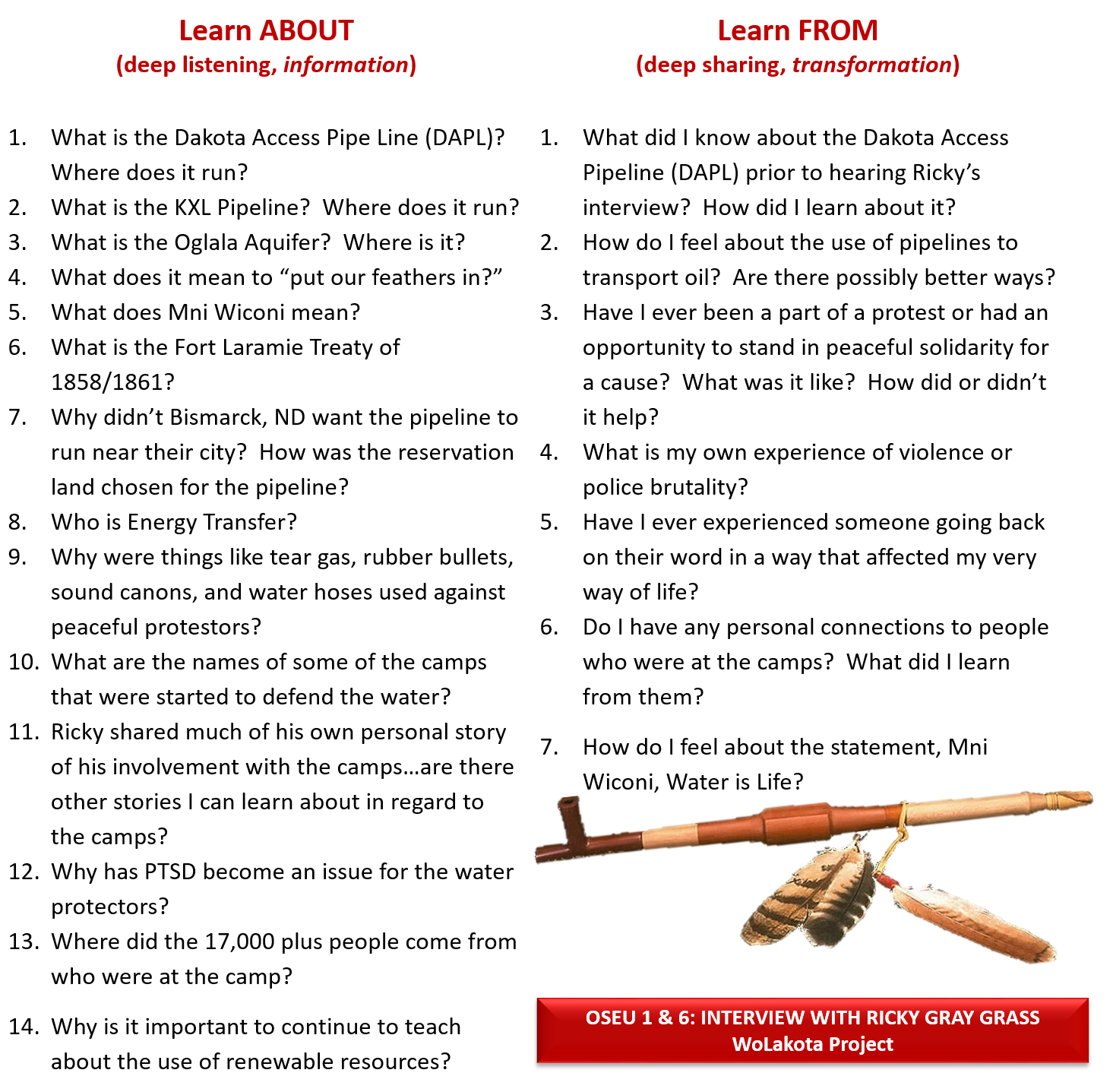
Learn About questions
What is the Dakota Access Pipeline (DAPL)? Where does it run?
What is the KXL Pipeline? Where does it run?
What is the Oglala Aquifer? Where is it?
What does it mean to “put our feathers in”?
What does Mni Wiconi mean?
What is the Fort Laramie Treaty of 1858/1861?
Why didn’t Bismarck, ND want the pipeline to run near their city? How was the reservation land chosen for the pipeline?
Who is Energy Transfer?
Why were things like tear gas, rubber bullets, sound cannons, and water hoses used against peaceful protesters?
What are the names of some of the camps that were started to defend the water?
Mr. Gray Grass shared much of his own personal story of his involvement with the camps…are there other stories I can learn about in regard to the camps?
Why has PTSD become an issue for the water protectors?
Where did the 17,000 plus people come from who were at the camp?
Why is it important to continue to teach about the use of renewable resources?
Learn From questions
What did I know about the Dakota Access Pipeline prior to hearing Ricky’s interview? How did I learn about it?
How do I feel about the use of pipelines to transport oil? Are there possibly better ways?
Have I ever been a part of a protest or had an opportunity to stand in peaceful solidarity for a cause? What was it like? How did or didn’t it help?
What is my own experience of violence or police brutality?
Have I ever experienced someone going back on their word in a way that affected my very way of life?
Do I have any personal connections to people who were at the camps? What did I learn from them?
How do I feel about the statement, Mni Wiconi, Water is Life?
Transcripts
Water Is Life
Watch this interview on YouTubeWater Is Life - Ricky Gray Grass - OSEU #1
The first time I probably got involved in the pipeline movement was after Sundance in July. In August, we were making plans to get up there. I was getting more educated on the pipeline. Years before that, we did the KXL pipeline run from Gordon, Nebraska to Lincoln. The congressional people in the counties of Sheridan County and the counties going towards Lincoln were for the pipeline. But there was some opposition in some of the counties and some of the farmlands from the tribe.
The panhandle in Nebraska is the biggest aquifer, the Ogallala Aquifer, biggest freshwater resource. They were trying to run the pipe through 800,000 gallons per day through a pipeline going through our aquifer. We gathered 20 youth and we ran four days to Lincoln, Nebraska to the state capitol. The governor gave us 15 minutes in front of the capitol building for a little peaceful protest. We had speakers and we talked and educated our youth that ran on that run.
When this Dakota Access pipeline came up, it was the same pipeline that was going to go straight through the United States with no economic structure coming to any counties within the United States, but oil being exported out. I told my girlfriend and I told my sons at that time, we're going to do something. We're going to make a stand. We're going to put our feathers in. We're going to run. We're going to make a prayer and we're going to go to Standing Rock.
I finally got time in August to go up there and to see the camp myself when the camp was at the time getting bigger. We did our run in October. September I was busy and in October we made our run. We made our run that way, but before then I made some visits before. We ran and we got up there and again I educated the youth of what's going on with the pipeline and going under our Missouri River. On the reservations in South Dakota, that Mni Wiconi pipeline, that water comes from the Missouri River.
Right now, probably about maybe 60% of our reservation gets that water through pipeline through the Missouri River with the Army Corps of Engineers. The Army Corps of Engineers is the one that gave approval for the pipeline to go under the Missouri River. We took the stance to come back. There were already tribal members up there. There were tribal members that were already in the fatalities of Morton County Sheriff and law enforcement throughout the various counties.
The land that they were coming on and trespassing on was Indian Territory from the 1858 and 1861 Fort Lemary Treaty. It's treaty land. To this day it's still treaty land where the pipeline is going. But the city of Bismarck didn't want the pipeline to go through the city fearing it would rupture and ruining their natural water drinking source. So they said, okay, we'll just go through Indian land. We'll go under the Missouri River.
That's the largest resource of water that is filtered through many filtering stations that go to the reservations in South Dakota. We all get that water. So the Army Corps, without consulting with the tribes, with the Great Sioux Nation, gave the go-ahead to Dakota Access Pipeline and Energy Transfer to start drilling. So a lot of people took a stance on that. A lot of people got tear gassed, maced, shot with rubber bullets, bean bags, and water hose cannon and sound cannon.
And all the time, as Lakota people, Dakota, Nakota, in the Oceti, Sakowin, the seven council campfires, the treaties, again, not being obligated to. There was a lot of misappropriations that was given.
Go ahead, green lights given to Dakota Access and energy transfer without the consultations.
So later on, whenever the people started, the solidarity that began with Standing Rock when more and more people throughout the world was taking stands and being part of the movement, then finally Army Corps finally started having consultations with the the tribes and some of the tribal presidents and tribal council members of their respective reservations went to jail, you know were targeted and you know, even part of the dog attack what happened and so you know the Consultation was going good, you know, then they Obama back then finally made a decision and And December 4th, December 5th.
They gave the word that they denied the easement of the Pipeline and so there was a premature celebration. I was there at the campfire at Chetti Shaakoni that day and it was a day like this really nice day And so there was a celebration a song and dance and fireworks But I took my boys I took one of my sons and we walked her camp and then we went on top of the hill and I told myself Look around. I said this is the it's it's not over We have a new administration coming in Trump is gonna sign. I Said so the battle is just beginning. It's not over.
We're gonna begin the The fight here on January 20th. The fight is gonna happen. I said so that's when we have to Stand stronger. We need more people to come here.
And so, you know, the veterans came on December 5th We had the blizzard up there And then I came back At that time that they burnt out the fire At the main camp at Oceti Shaakoni camp And so chase iron eyes and a group of women lit up another fire and renamed the camp to the Oceti Oyate camp And so at that time about two weeks later, you know, my son called me said chase wants you up here Can you come and pray at our fire? Can you do a pipe ceremony? Name chase wants to know if you could be the spiritual advisor.
So I went up there met chase iron eyes and his little Entourage that he works with and my son was part of his working group and so, you know, we made that connection and we And so, you know throughout that time Action was going on the front line at the bridge at 18 on 1806 And up on turtle mountain turtle island what was going on there at the?
On top of the hill there's burial site historical sites that you know with no regard to Morton County and dappled, you know, they They... dug anyways and so my sons were up there and they were all there were part of the The November 20th night that Sunday night when they got water holes down, you know And they shot some of my boys got shot. My nephews got shot Um, they all got soaked in water.
They got tear gassed maced And so it was hard it was hard and so, um November december january you know, I was back and forth from the the the pipeline you know and uh The 22nd when they gave the um the deadline to move out You know, um some of the ones that went to jail on uh On the last child camp my son and my nephew was in there And so it was a like a diversion for morton county and Dakota access pipeline To move in so at four o'clock When they made their move back in 76 of the water protectors were in court in mandan at morton county And so they were allowed access back into camp because camp was closed at noon And the raid was supposed to happen at two o'clock.
It happened at four And so my son called me and he said it's it's going down now it's going down now he said the raid's happening um My youngest son was at the last child camp and he called me and he said daddy. He said We need prayers And so, um, I called julian my oldest boy he went to jail and he was at court I asked him. I said where you at? I said what's going on?
I said, uh, kobe's stuck down there He said no, we're kobe's on top He said i'm coming back from mandan And they won't let us in We're at the top of the hill when we're not being allowed in but I had other friends that were down there that were uh, Documenting What was going on down there? And so, you know, they kept in contact with me and my son kobe was with him So, you know, I was okay with it, but I was still uh in stress, you know, so um.
What happened with that is, you know, the fight's still going. You know, the fight never ended. The camps may have been dissolved and, you know, structures were burnt down in Samarino. The yurts, some of the yurts were burned down. The structures were burnt down. Some of the camps were taken down. Some tipis were burnt by North Dakota National Guard and by DAPO security and missionaries that were part of that. A peaceful camp. Peaceful camp. No weapons. You know, nothing. Just prayer. Just prayers in that camp. And a lot of good people.
A lot of good people in that camp. A lot of good hearts in that camp that stood there to the final hour, that went to jail, that were humiliated in doll candles and stripped down naked, you know. But they stood there. They held their ground, you know. Our aunt, our grandma, Regina Brave, elder woman from Oglala, went to jail standing for water and Mother Earth. You know, there's a lot that I could name, that I made friends with up there, that did the sacrifice of, you know, putting themselves on the front line.
So, you know, I have a lot of respect for them, you know, for the courage they showed to stand up to the police brutality, to the inhumane arrest and treatment of transportation to the jails. And, you know, I pray for them all the time. Every morning I remember them. It's similar to a soldier going to war, coming back with PTSD. A lot of these young men and women witnessed that.
You know, they were treated the same way, you know, getting shot at, you know, getting maced, getting tear gassed, sleepless nights because of threats of raid, raiding the camp. So, the fight is still continuing, you know. The Oceti Shako'i camp, the Sacred Stone camp, Rosebud camp may no longer exist, but there's camps throughout United States that are against pipelines, you know, what's going on. And as far as for for us, my son and my nephews that made that stand, you know, we're still standing with what happened at the pipeline.
And so, you know, we still have, we're making plans to do a run around the treaty land to just show awareness that this is our land still, according to the 58 and 61 Treaty for Laramie. And the education that we need to put out there to the people that are out there, that are within the boundaries, is that, you know, this is our land still. Anything that, as long as the grass is green, the river flows, is our land, according to the treaty.
And so, you know, I'm really proud to have been a part of that at the later stages of the movement, but yet at the most powerful part of the movement of what happened at camp, witnessing the brutality of the police force used underwater protectors. And for my sons to witness that for themselves and making that stance as young men to continue to stand for what's right, you know, and to see the abuse of power of authority from the governor, from the mayor, Trump, and all that, you know, they finally got to see that, you know, it's out there.
It's out there. But to just to be a part of it, to witness it, now they know that what is really out there in the open world, what's going on.
And to see the solidarity amongst the human people, the race of mankind, not just the Lakota, Dakota, Lakota people, but through the 500 plus tribal nations in the United States, Canada, you know, and overseas that the people that came, the Norwegians that came, the Czechs that came, the Hawaiians that came, the Europeans that came, the Asians that came, you know, all the race around the world that came to Standing Rock. And I was very proud that day to stand in camp to be amongst the 17,000 plus people that was there to make that stance.
I got to see that, and I got to witness that, and I got to pray with all those people. And so, you know, it's not over. It's not over. And, you know, I think it's time to continue to teach on on the natural resources of clean energy, solar power, wind energy. And so the movement's still there, and, you know, we're very much part of it.
Resource text
au PWN
. Ricky shared much of his own personal story
. Why has PTSD become an issue for the water
. Where did the 17,000 plus people come from
Why is it important to continue to teach OSEU 1 & 6: INTERVIEW WITH RICKY GRAY GRASS
, WoLakota Project
about the use of renewable resources?
Learn ABOUT Learn FROM
(deep listening, information) (deep sharing, transformation)
What is the Dakota Access Pipe Line (DAPL)? 1. What did | know about the Dakota Access
Where does it run? Pipeline (DAPL) prior to hearing Ricky’s
What is the KXL Pipeline? Where does it run? interview? How did | learn about it?
What is the Oglala Aquifer? Where is it? 2. How do! feel about the use of pipelines to
What does it mean to “put our feathers in?” transport oil? Are there possibly better ways?
What does Mni Wiconi mean? 3. Have | ever been a part of a protest or had an
What is the Fort Laramie Treaty of opportunity to stand in peaceful solidarity for
1858/1861? a cause? What was it like? How did or didn’t
Why didn’t Bismarck, ND want the pipeline to it help?
run near their city? How was the reservation 4. What is my own experience of violence or
land chosen for the pipeline? police brutality?
Who is Energy Transfer? 5. Have | ever experienced someone going back
Why were things like tear gas, rubber bullets, on their word in a way that affected my very
sound canons, and water hoses used against way of life?
peaceful protestors? 6. Dol have any personal connections to people
. What are the names of some of the camps who were at the camps? What did | learn
that were started to defend the water? from them?
7. How do! feel about the statement, Mni
of his involvement with the camps...are there
P Wiconi, Water is Life?
other stories | can learn about in regard to
the camps?
protectors?
who were at the camp?
Source alignments
Current site labels this resource OSEU 1. Existing archive labels retained.
Some indexed text was extracted from scanned material. Check the original source for exact wording and spelling.
Source materials
Transcripts from supplied documents and the current WoLakota source pages. Text preserved as published.