Interview · South Dakota · Joseph Marshall III · OSEU 1
Themes: Land & stewardship, Language & revitalization, Kinship & family, Identity & belonging, Education & learning, Spirituality & ceremony, Values & generosity, Culture & continuity, Listening & observation, Intergenerational learning
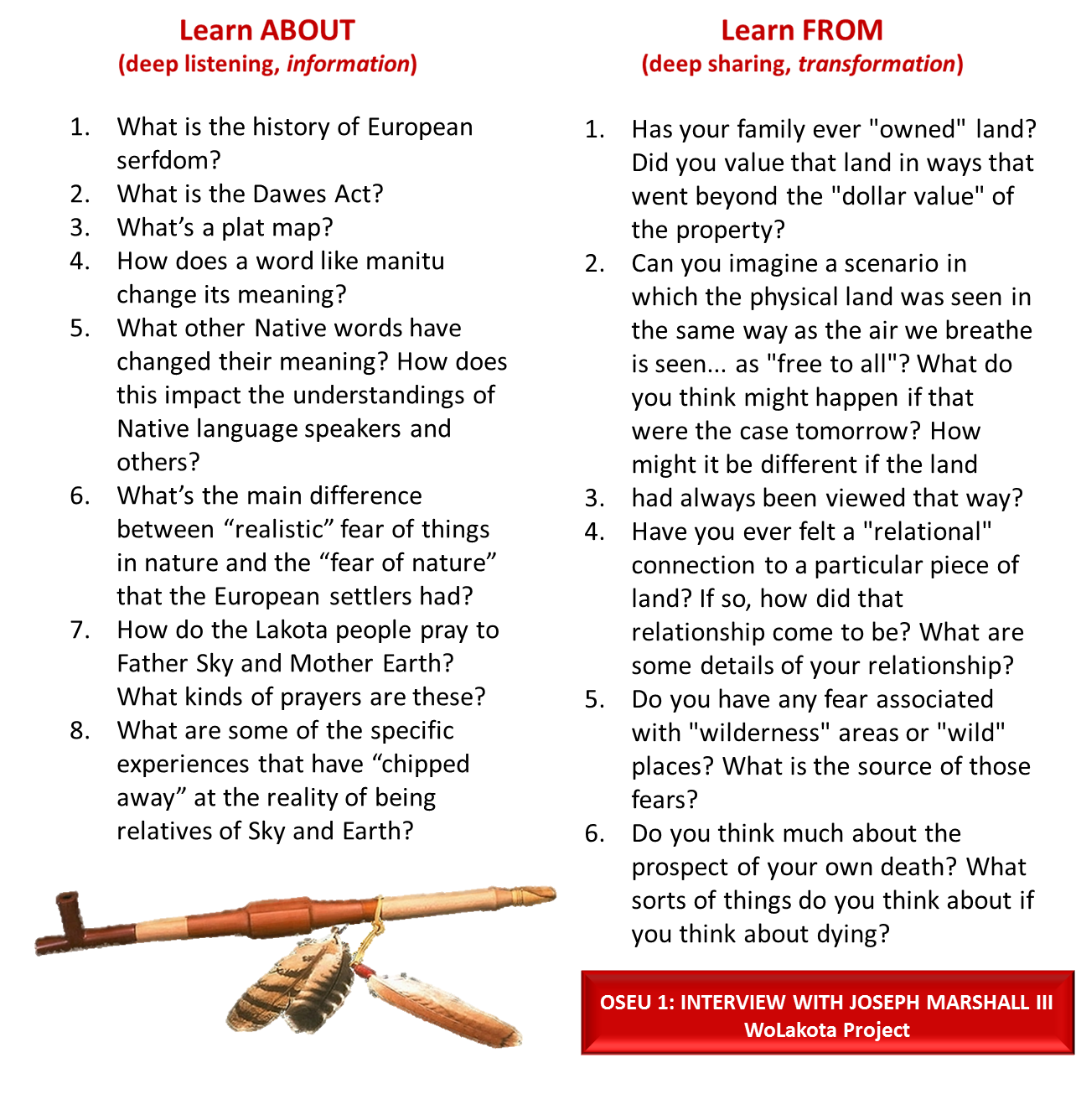
Learn About questions
1. What is the history of European serfdom?
2. What is the Dawes Act?
3. What’s a plat map?
4. How does a word like manitu change its meaning?
5. What other Native words have changed their meaning? How does this impact the understandings of Native language speakers and others?
6. What’s the main difference between “realistic” fear of things in nature and the “fear of nature” that the European settlers had?
7. How do the Lakota people pray to Father Sky and Mother Earth? What kinds of prayers are these?
8. What are some of the specific experiences that have “chipped away” at the reality of being relatives of Sky and Earth?
Learn From questions
1. Has your family ever “owned” land? Did you value that land in ways that went beyond the “dollar value” of the property?
2. Can you imagine a scenario in which the physical land was seen in the same way as the air we breathe is seen… as “free to all”? What do you think might happen if that were the case tomorrow? How might it be different if the land had always been viewed that way?
3. Have you ever felt a “relational” connection to a particular piece of land? If so, how did that relationship come to be? What are some details of your relationship?
4. Do you have any fear associated with “wilderness” areas or “wild” places? What is the source of those fears?
5. Do you think much about the prospect of your own death? What sorts of things do you think about if you think about dying?
Transcripts
Land as Free as Air - Joseph Marshall - OSEU 1
Watch this interview on YouTubeWell, the thing that strikes me first is… obviously… our history with your Americans… Europeans and your Americans… is based on how we looked at the land… the different ways we looked at the same thing. And it's again, I'm a very simple-minded person, so I tend to simplify things as much as I can or to deal with it. There were two divergent viewpoints. Your Americans…Europeans look at land as a commodity… as something to be owned… something to be divided… something to be used for the production of whatever in… it meant enriching themselves. I mean, I remember the history about the European serfdom. The landowners would… have people living on their land and working so many acres… and giving them a house or something like that. And then whenever their crops were done, they gave an overwhelming majority to the landowner and kept a very little of it for themselves. And they had the right to live on the land. But all of it was intended to enrich the landowner. So, in that sense, the land was something to get rich off of. And the opposing viewpoint, here on this continent, among most of the indigenous people, were that we had a… it was a relative, pure and simple. Earth itself was a relative. It was nothing to be owned in the same way we lived on it. We had territories. But we couldn't own it anymore. The sense was we couldn't own it any more than we could own the air in the water. It was that of the four elements, you know, that kind of thing.
So that's where the… that's where a lot of the difference is. I mean we… we have learned the European way. The Dawes Act came along and divided up the land into 160-acre quarter section… an eighty acre… and we were taught what a Platte map was and… that this 80 acres is yours and this 80 acres belongs to your neighbor or your relative or whatever. So, we were forced to learn that we had to go by that because that's just the way things were. But along the way, after a generation or two, then that sense of looking at the land as a relative began to fall by the wayside. So, it seems quaint to some of us to talk about it in that sense because we've… for several generations now… we've been landowners ourselves. You know we… all the allotment process… and then inheriting and the heirship process and all that kind of stuff. So, we're having to function under the rules of, of the authority that prevails. And they tell us this is the way things are. And so, we have to look at land this way. That doesn't mean we can't, you know, relate to the environment the way our ancestors did. I mean. And then the extreme assumption… the assumption that there was an extreme to that. We're like… we're all tree huggers… and we're not. And there were you know… there was no word for environmentalists… that concept in our language at all. And really, if you stop to think about it, there's no word for wilderness in our language because we were part of a whole. We weren't apart from it.
There's a word that's Manitou that has become the word for wilderness, like a lot of other words, have become something else with influence of your American culture. But Manitou just simply meant “where the people were not.” That's all. So, one time the people were not over here, and the next time the people were not over here. But it was all a whole. So, there was not that sense of wildness that the Europeans had about… they were afraid of everything out there that wasn't part of their little village or that part of their enclave. They were totally afraid of it. And that was the difference. I don't think our ancestors were afraid of that environment. One, because they knew it intimately.
They were part of it for so long, the generation after generation after generation. They knew it well. They knew it intimately. There were things to be afraid of. Sure. Mountain lions and bears and floods and prairie fires. You know, we had to be realistic about what was out there, what nature was capable of. But that doesn't mean we know said nature was bad or evil or all the other things that we attach whenever there's a natural disaster or a landslide or something. We come up with all these adjectives that describe how mean or harsh nature is. It isn't any of that in our purview and our ancestors purview.
Nature just does what nature does, and we accept the reality of it.
We don't attach labels of “nature's cruel.” We don't… we didn't do that, but we've learned to do that. But you know, and so that was the difference. Once I looked at it as something to be owned, the other side looked at it as relative because Earth… Earth is the source of life. Grandmother Earth… just I mean… she's so important that we when we pray, she's the second thing we pray to. Father Sky, Grandmother Earth… because she's part of the process. And life comes from Grandmother Earth. And it's obvious that's the reality of it. It isn't. Anything that we made up is not a myth. It's a reality. You look around and life comes from the earth. And we go back to the earth when we're done with our life. So, she is also our repository. To you, we shall return. It's part of the prayer. Grandmother Earth, to you we shall return. So, in that simple phrase, we're acknowledging this profound and realistic relationship we have. That's just the way things were. That's just the way things are. But unfortunately, again, the forced influence began to sort of chip away at our attitudes regarding that reality… that then we've been taught to let go of that reality and accept this other one over here. So, in some of us… and there are people who are ranchers and farmers who may or may not accept the new way of thinking. I'm sure some of them don't. But we all still talk about Grandmother Earth and that special relationship.
Land as Free as Air
Watch this interview on YouTubeLand as Free as Air - Joseph Marshall - OSEU 1
Well, the thing that strikes me first is… obviously… our history with your Americans…
Europeans and your Americans… is based on how we looked at the land… the different
ways we looked at the same thing. And it's again, I'm a very simple-minded person, so I
tend to simplify things as much as I can or to deal with it. There were two divergent
viewpoints. Your Americans…Europeans look at land as a commodity… as something
to be owned… something to be divided… something to be used for the production of
whatever in… it meant enriching themselves. I mean, I remember the history about the
European serfdom. The landowners would… have people living on their land and
working so many acres… and giving them a house or something like that. And then
whenever their crops were done, they gave an overwhelming majority to the landowner
and kept a very little of it for themselves. And they had the right to live on the land. But
all of it was intended to enrich the landowner. So, in that sense, the land was something
to get rich off of. And the opposing viewpoint, here on this continent, among most of the
indigenous people, were that we had a… it was a relative, pure and simple. Earth itself
was a relative. It was nothing to be owned in the same way we lived on it. We had
territories. But we couldn't own it anymore. The sense was we couldn't own it any more
than we could own the air in the water. It was that of the four elements, you know, that
kind of thing.
So that's where the… that's where a lot of the difference is. I mean we… we have
learned the European way. The Dawes Act came along and divided up the land into
160-acre quarter section… an eighty acre… and we were taught what a Platte map was
and… that this 80 acres is yours and this 80 acres belongs to your neighbor or your
relative or whatever. So, we were forced to learn that we had to go by that because
that's just the way things were. But along the way, after a generation or two, then that
sense of looking at the land as a relative began to fall by the wayside. So, it seems
quaint to some of us to talk about it in that sense because we've… for several
generations now… we've been landowners ourselves. You know we… all the allotment
process… and then inheriting and the heirship process and all that kind of stuff. So,
we're having to function under the rules of, of the authority that prevails. And they tell us
this is the way things are. And so, we have to look at land this way. That doesn't mean
we can't, you know, relate to the environment the way our ancestors did. I mean. And
then the extreme assumption… the assumption that there was an extreme to that. We're
like… we're all tree huggers… and we're not. And there were you know… there was no
word for environmentalists… that concept in our language at all. And really, if you stop
to think about it, there's no word for wilderness in our language because we were part of
a whole. We weren't apart from it.
There's a word that's Manitou that has become the word for wilderness, like a lot of
other words, have become something else with influence of your American culture. But
Manitou just simply meant “where the people were not.” That's all. So, one time the
people were not over here, and the next time the people were not over here. But it was
all a whole. So, there was not that sense of wildness that the Europeans had about…
they were afraid of everything out there that wasn't part of their little village or that part
of their enclave. They were totally afraid of it. And that was the difference. I don't think
our ancestors were afraid of that environment. One, because they knew it intimately.
They were part of it for so long, the generation after generation after generation. They
knew it well. They knew it intimately. There were things to be afraid of. Sure. Mountain
lions and bears and floods and prairie fires. You know, we had to be realistic about what
was out there, what nature was capable of. But that doesn't mean we know said nature
was bad or evil or all the other things that we attach whenever there's a natural disaster
or a landslide or something. We come up with all these adjectives that describe how
mean or harsh nature is. It isn't any of that in our purview and our ancestors purview.
Nature just does what nature does, and we accept the reality of it.
We don't attach labels of “nature's cruel.” We don't… we didn't do that, but we've
learned to do that. But you know, and so that was the difference. Once I looked at it as
something to be owned, the other side looked at it as relative because Earth… Earth is
the source of life. Grandmother Earth… just I mean… she's so important that we when
we pray, she's the second thing we pray to. Father Sky, Grandmother Earth… because
she's part of the process. And life comes from Grandmother Earth. And it's obvious
that's the reality of it. It isn't. Anything that we made up is not a myth. It's a reality. You
look around and life comes from the earth. And we go back to the earth when we're
done with our life. So, she is also our repository. To you, we shall return. It's part of the
prayer. Grandmother Earth, to you we shall return. So, in that simple phrase, we're
acknowledging this profound and realistic relationship we have. That's just the way
things were. That's just the way things are. But unfortunately, again, the forced influence
began to sort of chip away at our attitudes regarding that reality… that then we've been
taught to let go of that reality and accept this other one over here. So, in some of us…
and there are people who are ranchers and farmers who may or may not accept the
new way of thinking. I'm sure some of them don't. But we all still talk about Grandmother
Earth and that special relationship.
Resource text
NEW!!!
“Self Timing” version of this interview with built-in instructions and “Learn From” questions for classroom circle activities:
Some indexed text was extracted from scanned material. Check the original source for exact wording and spelling.
Source materials
Transcripts from supplied documents and the current WoLakota source pages. Text preserved as published.