Interview · South Dakota · Lydia Whirlwind Soldier · OSEU 4
Themes: Land & stewardship, Kinship & family, Education & learning, Boarding schools & assimilation, Values & generosity, Culture & continuity, Listening & observation, Children & young people
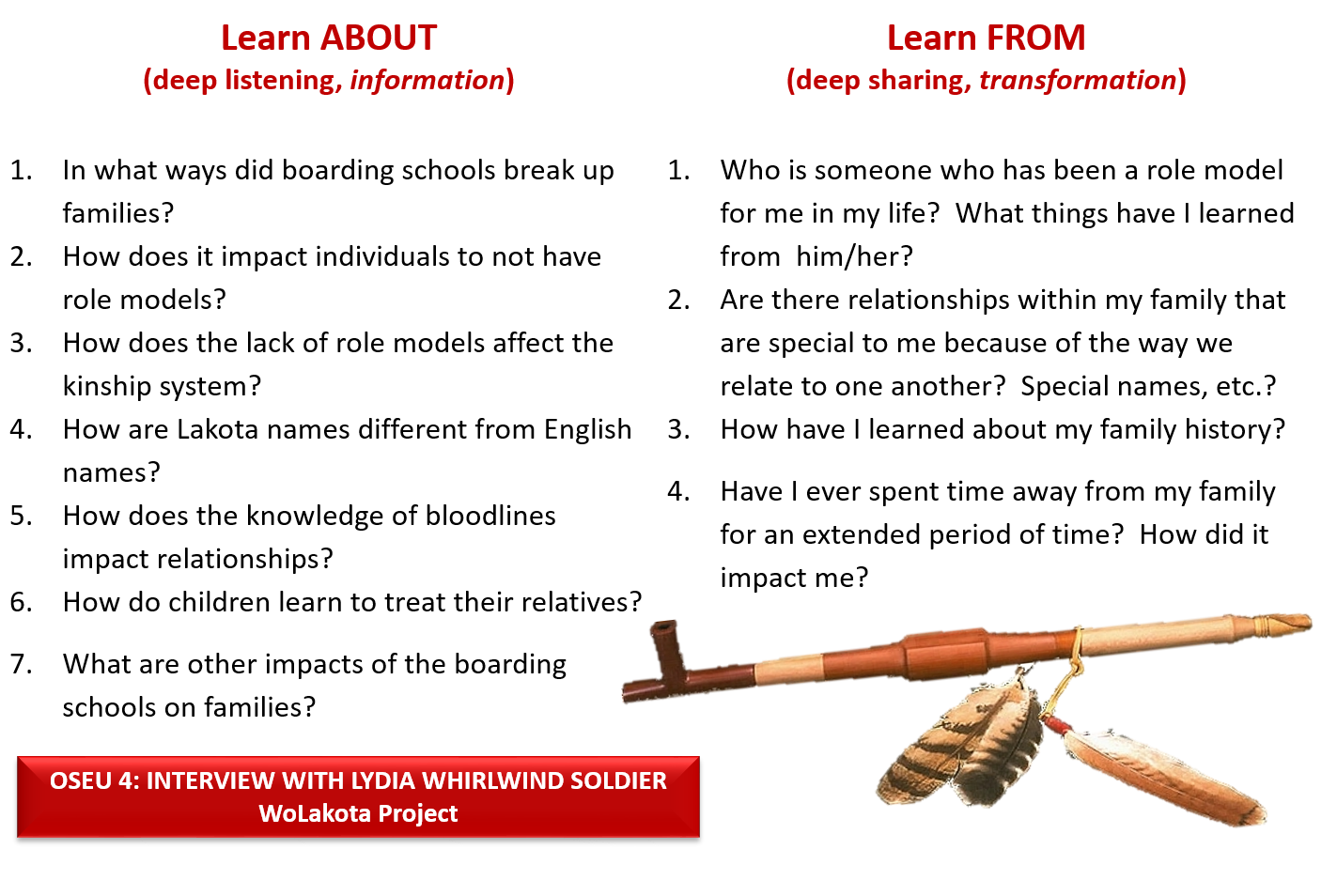
Learn About questions
In what ways did boarding schools break up families?
How does it impact individuals to not have role models?
How does the lack of role models affect the kinship system?
How are Lakota names different from English names?
How does the knowledge of bloodlines impact relationships?
How do children learn to treat their relatives?
What are other impacts of the boarding schools on families?
Learn From questions
Who is someone who has been a role model for me in my life? What things have I learned from him/her?
Are there relationships within my family that are special to me because of the way we relate to one another? Special names, etc.?
How have | learned about my family history?
Have | ever spent time away from my family for an extended period of time? How did it impact me?
Transcripts
Lydia Whirlwind Soldier - Kinship Systems OSEU #4
Watch this interview on YouTubeYeah, one of the really damaging things about the boarding school system was that it broke up our families. And when you're away from your family, I was in boarding schools for twelve years, and when you're in a completely different and foreign environment, you don't have role models. We didn't have role models of how to be a mother, how to be a father. We lost that kinship system. And of course, we went home for three months and were able to – my family was really strong, strong in tradition and strong in kinship.
And all growing up, I knew all the people by their Lakota names. We all have Lakota names. The majority of us have an English name and a Lakota name. And I knew all the elders by their Lakota names. And so, every time we met somebody, they'd tell us who they were. You know, this is your relative. Even if it's like three or four generations back, they were cousins. They still named all the generations back to that, how you're connected to them through blood. And our tradition is that you don't cross bloodlines.
You can't marry a relative.
And we didn't have first cousins, second cousins, nothing like that. They were cousins. So, they could be third cousins, but in English society, you could marry your first or second cousin, but we couldn't do that. As long as there was a connection by blood, there was no way that we could marry into that family. And we really believe strongly in that because of birth defects and all of that, all the negative things that come from inbreeding. So, the Lakota knew about inbreeding, the consequences of inbreeding.
And so, we had a really strong taboo on crossing bloodlines. And so, we want our children to know those things. We want our children to know their relatives, how to treat their relatives, you know, with respect and to be kind and, you know, to be there for them. And we thought that was really important because many families lost that because of boarding schools. Some of the kids at the boarding school didn't even go home for that three months. And so, they were there 12 months a year, I mean, 12 months, yeah, a year for 12 years, you know.
So, they lost that family kinship system.
Resource text
OSEU 4: INTERVIEW WITH LYDIA WHIRLWIND SOLDIER
WoLakota Project
From the current WoLakota source page:
Kinship Systems
Lydia Whirlwind Soldier
Transcript
(deep listening, information)
(deep listening, information)
Some indexed text was extracted from scanned material. Check the original source for exact wording and spelling.
Source materials
Supplied transcript document. Text preserved as supplied; spellings and transcription uncertainties have not been corrected.
Additional source transcripts
Kinship Systems
Lydia Whirlwind Soldier - Kinship Systems OSEU #4
Yeah, one of the really damaging things about the boarding school system was that it
broke up our families. And when you're away from your family, I was in boarding schools
for twelve years, and when you're in a completely different and foreign environment, you
don't have role models. We didn't have role models of how to be a mother, how to be a
father. We lost that kinship system. And of course, we went home for three months and
were able to – my family was really strong, strong in tradition and strong in kinship.
And all growing up, I knew all the people by their Lakota names. We all have Lakota
names. The majority of us have an English name and a Lakota name. And I knew all the
elders by their Lakota names. And so, every time we met somebody, they'd tell us who
they were. You know, this is your relative. Even if it's like three or four generations back,
they were cousins. They still named all the generations back to that, how you're
connected to them through blood. And our tradition is that you don't cross bloodlines.
You can't marry a relative.
And we didn't have first cousins, second cousins, nothing like that. They were cousins.
So, they could be third cousins, but in English society, you could marry your first or
second cousin, but we couldn't do that. As long as there was a connection by blood,
there was no way that we could marry into that family. And we really believe strongly in
that because of birth defects and all of that, all the negative things that come from
inbreeding. So, the Lakota knew about inbreeding, the consequences of inbreeding.
And so, we had a really strong taboo on crossing bloodlines. And so, we want our
children to know those things. We want our children to know their relatives, how to treat
their relatives, you know, with respect and to be kind and, you know, to be there for
them. And we thought that was really important because many families lost that
because of boarding schools. Some of the kids at the boarding school didn't even go
home for that three months. And so, they were there 12 months a year, I mean, 12
months, yeah, a year for 12 years, you know.
So, they lost that family kinship system.