Interview · South Dakota · Victor Douville · OSEU 3
Themes: Land & stewardship, Language & revitalization, Kinship & family, Education & learning, Healing & resilience, Values & generosity, Listening & observation, Self-determination & leadership
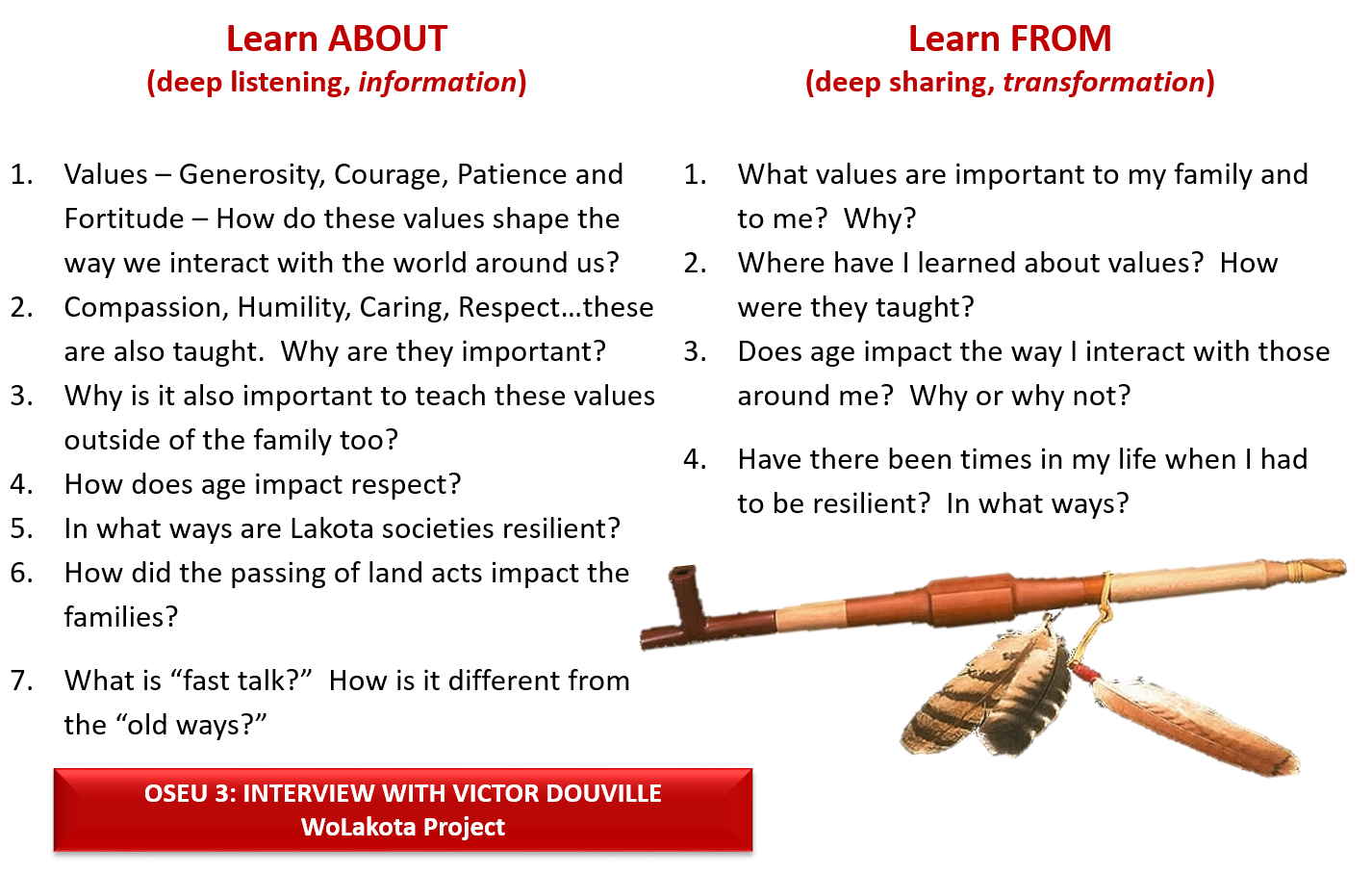
Learn About questions
Values – Generosity, Courage, Patience and Fortitude – How do these values shape the way we interact with the world around us?
Compassion, Humility, Caring, Respect…these are also taught. Why are they important?
Why is it also important to teach these values outside of the family too?
How does age impact respect?
In what ways are Lakota societies resilient?
How did the passing of land acts impact the families?
What is “fast talk?” How is it different from the “old ways?”
Learn From questions
What values are important to my family and to me? Why?
Where have I learned about values? How were they taught?
Does age impact the way I interact with those around me? Why or why not?
Have there been times in my life when I had to be resilient? In what ways?
Transcripts
Our Four Values - Victor Douville - OSEU #6
Watch this interview on YouTubeVictor Douville: [00:00:00] They have to know their values. We have four major ones that universities try to teach the students. And that’s the idea of generosity, courage, patience, and fortitude. So those values…like generosity is wowacintanka…is to…from the heart, to give. CANT UNDERSTAND. We expect these in return. Woohitika…bravery. Then we’ve got the other two values…LAKOTA WORD is courage and endurance, wowacintanka…is your strong-willed. You have fortitude to stand up to a lot of problems we have and not back off. So the values are the things we are trying to teach. There are several others that are not on our college logo like compassion, waohola, which is…they have to have humility and caring. So those are taught. And most importantly, respect comes from that. We seemed to have lost a lot of respect because the crime rates have gone high and the family values have been tossed aside. So we have to go back and rebuild those. And along the horizon, social reform is coming. And eventually we will be able to teach values. The family system was the centerpiece of our lifestyle. It is also the centerpiece of our tribal government. In fact, our tribal government system was based on the protocol of the
Victor Douville: [00:02:00] first seven tiospayes that formed. It’s the older and the youngest…and respect is commanded by how old you are. So the template was the family and the tribal governments followed the same lead. So that’s what we are trying to do…rebuild those…reteach those so that they can be long-lasting. And resiliency…we are a resilient society because we never lost that. We continued to battle the government for almost over a hundred…up to the 1770s when the government came. They tried to WORD our people…make them into their image.
They attacked these values that we had like the Dawes Act which was to convert land into individual properties. It changed the whole family structure. So far, we are resilient because we are still standing. The government is a failed policy that they had to back off from and eventually let us continue. They gave us programs that were supposed to help us speak English better. But we are kind of losing the language slowly. First, I think we lost most were the guttural sounds and most glottal stops. We’re losing them. We must go back and rebuild them. And we also did another thing…contract our language…which means we are having fast talk which is not speaking to original ways. We are cutting it. The program we got this to that the students learn about the old way so then they can begin to contract them. Then they will understand. Otherwise, when you contract a word, you don’t know the meaning of it. So that’s one of the things we are trying to do. It’s going to be a really hard way that we are going to go
Victor Douville: [00:04:00] because it will return the government their policies and their practices are against that. So we have to make it compatible. We are the only ones that can change it. But we’re weakened because the family structures aren’t there. So that is…we are trying to figure out how to move those and begin to change.
Resource text
Learn ABOUT Learn FROM
(deep listening, information) (deep sharing, transformation)
Values — Generosity, Courage, Patience and 1. What values are important to my family and
Fortitude — How do these values shape the to me? Why?
way we interact with the world around us? 2. Where have | learned about values? How
Compassion, Humility, Caring, Respect...these were they taught?
are also taught. Why are they important? 3. Does age impact the way | interact with those
Why is it also important to teach these values around me? Why or why not?
i i ?
outside of the family too! 4. Have there been times in my life when | had
How does age impact respect?
to be resilient? In what ways?
In what ways are Lakota societies resilient?
How did the passing of land acts impact the
families?
What is “fast talk?” How is it different from
the “old ways?” ; Se,
OSEU 3: INTERVIEW WITH VICTOR DOUVILLE
WoLakota Project
From the current WoLakota source page:
Our Four Values
Victor Douville
Transcript
(deep listening, information)
(deep listening, information)
Source alignments
Source labels differ: archive / video listing OSEU 3; transcript heading OSEU 6. Archive / video listing labels retained.
Some indexed text was extracted from scanned material. Check the original source for exact wording and spelling.
Source materials
Supplied transcript document. Text preserved as supplied; spellings and transcription uncertainties have not been corrected.