Interview · South Dakota · Duane Hollow Horn Bear · OSEU 5
Themes: Kinship & family, Storytelling & oral tradition, Education & learning, Spirituality & ceremony, Values & generosity, Arts & expression, Community & responsibility, Listening & observation, Children & young people, Humor & play
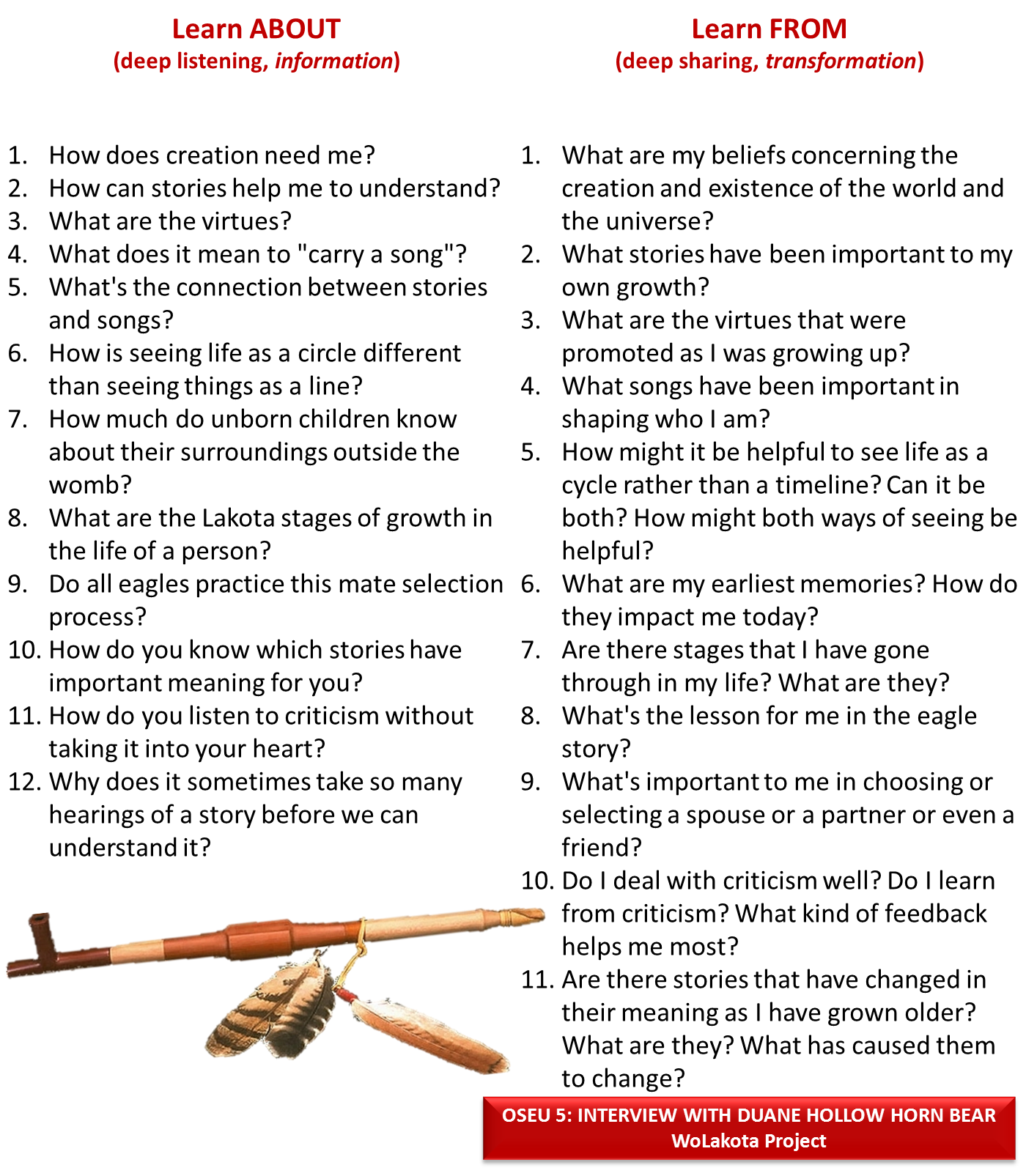
Learn About questions
How does creation need me?
How can stories help me to understand?
What are the virtues?
What does it mean to “carry a song”?
What’s the connection between stories and songs?
How is seeing life as a circle different than seeing things as a line?
How much do unborn children know about their surroundings outside the womb?
What are the Lakota stages of growth in the life of a person?
Do all eagles practice this mate selection process?
How do you know which stories have important meaning for you?
How do you listen to criticism without taking it into your heart?
Why does it sometimes take so many hearings of a story before we can understand it?
Learn From questions
What are my beliefs concerning the creation and existence of the world and the universe?
What stories have been important to my own growth?
What are the virtues that were promoted as I was growing up?
What songs have been important in shaping who I am?
How might it be helpful to see life as a cycle rather than a timeline? Can it be both? How might both ways of seeing behelpful?
What are my earliest memories? How do they impact me today?
Are there stages that I have gone through in my life? What are they?
What’s the lesson for me in the eagle story?
What’s important to me in choosing or selecting a spouse or a partner or even a friend?
Do I deal with criticism well? Do I learn from criticism? What kind of feedback helps me most?
Are there stories that have changed in their meaning as I have grown older? What are they? What has caused them to change?
Transcripts
The Importance of Stories - Duane Hollow Horn Bear - OSEU 5
Watch this interview on YouTubeStories, stories as the origin stories will take you back to understanding that you are just but a mere speck in the vastness of all of creation. You feel, sometimes you feel unimportant, but to creation you are important. Creation needs you and you need creation and the stories guide you and help you, help you to learn, help you to understand the relationships between the past, what happened in the past and there's times when we have to grieve.
We have to grieve our past and we have to be able to practice the virtues of perseverance and be able to pick our head up and say our prayer and to go on. There's times, many times we will grieve, we will be hurt, but the important thing is always to get back up, to get back up and to remember the prayer. To carry a song, a song will always get you through. Learn a song for times when you are sad, you are lonely. Sing your song even when you are happy and there's joyous times. Sing your song even when you are alone or sing it to your children.
Tell your children stories, teach your children to sing, it's better to sing than to use your words in a negative way. We talk about things that always go around in a circle. When you start something, it will grow. Maybe it will come back just as the same upon you or it will grow twice, four times, ten times, a hundred times, but everything goes back in a circle and will come back to you. So understanding the meaning of life as you grow from your infancy, when you were born, you were a spirit.
You were a spirit that was decided to come into this family and you go through these stages of life as that little spirit and as you're growing in your mother's womb, you hear the sounds around you, outside of your mother's womb, the singing, the laughter, or you can sense anger, negative feelings outside and when you're born, these little ceremonies that help you to understand as you grow through life, you're welcomed into this world.
It doesn't matter what gender you are right at the beginning, but when your gender is identified, you become a hokshila or a wichinchala and then as you grow, you reach that stage of life in your puberty. When you become a young man or a young woman, we tell stories, particularly to the young girls, to be like the eagle as she soars so beautifully up there in the sky.
She's riding on the wind, and then suddenly this young male would come flying, and he would fly around, trying to win her over. She would fly down to the earth and pick up a stick, and take that stick up very high, and she would drop it, and she instructs that young male, catch it, and bring it back to the earth, and put it down, very gently, and she continues to do this, and the female is larger than the male, and so those sticks, they get larger and larger, and larger.
If he should miss one, or if he should drop one, she will fly away, and have nothing to do with this male, because she knows that if she is to start a family with this young male, someday there's going to be baby eaglets, and someday they will have to take them out and teach them to fly, and if one should falter and fall from the sky, he must be there to catch that baby eagle, and bring it back to the earth, or to the nest, and put it down, very gently. So be like the eagle. What are those sticks for that young man? Will he be there?
Will he be there when you bring his child into this world, when your child needs him, when your child falls? Be like the eagle. What are those sticks for that young man who courts you? Stories like this are important too, they're teaching, they're teaching tools to our young to remind them how hard life can be. It can be very pleasant, but it can be very harsh too. So we need stories, so listen to the stories, hear them. People will share many, many stories with you, and if they have meaning for you in your life, use them.
But if they don't mean anything for you, put them back in the wind and let them go. People watch you and how you live. People will talk about you. Many will criticize. Many will compliment you. Those that criticize you, listen to them, but don't put them in here. Because if you begin to put them in here, in time, you will become what they say about you. Hear them, but throw them back into the wind. People will know you and judge you for who you are and what you do, that's all.
As we learn from our stories, always, always listen when someone tells something that may sound meaningless, or maybe you've heard it before. Don't just say, oh, I've heard that already. It took me many times, hearing and hearing something in my life before I finally understood what it meant. I might have heard it a hundred times, then I finally realized there's truth to this. It has meaning in my life, and I was ignoring it. Maybe my life could have been different, or maybe that's the way that my life was destined to be.
But we make decisions in our lives, and we have to be responsible for those decisions. So hear the stories, be open to them. Thank you.
Resource text
VW PWNnNr
OSEU 5: INTERVIEW WITH DUANE HOLLOW HORN BEAR
WoLakota Project
From the current WoLakota source page:
The Importance of Stories
Duane Hollow Horn Bear
Transcript
(deep listening, information)
(deep listening, transformation)
Some indexed text was extracted from scanned material. Check the original source for exact wording and spelling.
Source materials
Supplied transcript document. Text preserved as supplied; spellings and transcription uncertainties have not been corrected.
Additional source transcripts
The Importance of Stories
The Importance of Stories - Duane Hollow Horn Bear
- OSEU 5
Stories, stories as the origin stories will take you back to understanding that you are just
but a mere speck in the vastness of all of creation. You feel, sometimes you feel
unimportant, but to creation you are important. Creation needs you and you need
creation and the stories guide you and help you, help you to learn, help you to
understand the relationships between the past, what happened in the past and there's
times when we have to grieve.
We have to grieve our past and we have to be able to practice the virtues of
perseverance and be able to pick our head up and say our prayer and to go on. There's
times, many times we will grieve, we will be hurt, but the important thing is always to get
back up, to get back up and to remember the prayer. To carry a song, a song will always
get you through. Learn a song for times when you are sad, you are lonely. Sing your
song even when you are happy and there's joyous times. Sing your song even when
you are alone or sing it to your children.
Tell your children stories, teach your children to sing, it's better to sing than to use your
words in a negative way. We talk about things that always go around in a circle. When
you start something, it will grow. Maybe it will come back just as the same upon you or it
will grow twice, four times, ten times, a hundred times, but everything goes back in a
circle and will come back to you. So understanding the meaning of life as you grow from
your infancy, when you were born, you were a spirit.
You were a spirit that was decided to come into this family and you go through these
stages of life as that little spirit and as you're growing in your mother's womb, you hear
the sounds around you, outside of your mother's womb, the singing, the laughter, or you
can sense anger, negative feelings outside and when you're born, these little
ceremonies that help you to understand as you grow through life, you're welcomed into
this world.
It doesn't matter what gender you are right at the beginning, but when your gender is
identified, you become a hokshila or a wichinchala and then as you grow, you reach that
stage of life in your puberty. When you become a young man or a young woman, we tell
stories, particularly to the young girls, to be like the eagle as she soars so beautifully up
there in the sky.
She's riding on the wind, and then suddenly this young male would come flying, and he
would fly around, trying to win her over. She would fly down to the earth and pick up a
stick, and take that stick up very high, and she would drop it, and she instructs that
young male, catch it, and bring it back to the earth, and put it down, very gently, and she
continues to do this, and the female is larger than the male, and so those sticks, they
get larger and larger, and larger.
If he should miss one, or if he should drop one, she will fly away, and have nothing to do
with this male, because she knows that if she is to start a family with this young male,
someday there's going to be baby eaglets, and someday they will have to take them out
and teach them to fly, and if one should falter and fall from the sky, he must be there to
catch that baby eagle, and bring it back to the earth, or to the nest, and put it down, very
gently. So be like the eagle. What are those sticks for that young man? Will he be
there?
Will he be there when you bring his child into this world, when your child needs him,
when your child falls? Be like the eagle. What are those sticks for that young man who
courts you? Stories like this are important too, they're teaching, they're teaching tools to
our young to remind them how hard life can be. It can be very pleasant, but it can be
very harsh too. So we need stories, so listen to the stories, hear them. People will share
many, many stories with you, and if they have meaning for you in your life, use them.
But if they don't mean anything for you, put them back in the wind and let them go.
People watch you and how you live. People will talk about you. Many will criticize. Many
will compliment you. Those that criticize you, listen to them, but don't put them in here.
Because if you begin to put them in here, in time, you will become what they say about
you. Hear them, but throw them back into the wind. People will know you and judge you
for who you are and what you do, that's all.
As we learn from our stories, always, always listen when someone tells something that
may sound meaningless, or maybe you've heard it before. Don't just say, oh, I've heard
that already. It took me many times, hearing and hearing something in my life before I
finally understood what it meant. I might have heard it a hundred times, then I finally
realized there's truth to this. It has meaning in my life, and I was ignoring it. Maybe my
life could have been different, or maybe that's the way that my life was destined to be.
But we make decisions in our lives, and we have to be responsible for those decisions.
So hear the stories, be open to them. Thank you.