Interview · South Dakota · Pearl Kennedy-Colombe · OSEU 3
Themes: Land & stewardship, Kinship & family, Values & generosity, Culture & continuity, Arts & expression, Economy & livelihoods, Listening & observation, Children & young people
Learn About questions
What are examples of Lakota/Dakota/Nakota artwork?
How are animal parts used in this artwork?
How is hand stitching used in native craftwork?
How do people create art from seeing others’ work?
What is a lazy stitch?
What is the process of curing hides? Why is this process needed?
How are porcupine quills used in native crafts?
How are they prepared to be used?
Learn From questions
Do you have a familiarity with Lakota/Dakota/Nakota crafts? What do you know about them?
Have you learned about crafts from your own heritage? What kinds of crafts would be from your heritage?
Are there ways you connect creatively with the natural world? What are some examples?
Have you ever worked with your family to create a project? If so, what is your experience with creating with your family?
Transcripts
Lakota, Dakota, Nakota Crafts - Pearl Kennedy-Colombe - OSEU #3
Watch this interview on YouTubeMy interest, mainly, is Lakota/Dakota/Nakota artwork. It was the way of life. I brought some loom work and some deer legs to show you of some of the things that I do. I always wondered…they do…they always talk about how the Native American uses every part of the buffalo…or the deer…the animal…and I’ve seen some really good things in my life. Somebody made some gloves…they beaded all this…had a floral design…and they had a rabbit’s skin here…the length of a cuff. Really neat. This lady came to me and said, “I’ve got to show you something.” And here she brought me this little purse made out of deer legs. I can look at anything and reproduce it…of the native…see how it’s put together.
So I looked at those and it was made of canvas…it had a canvas bag in it. All
hand-stitched…everything was hand-stitched. I started saving deer legs. And I started making cloth bags with it. But now we’ve got this real beautiful material, quilted material…and print…so I made some with some prints. I made some with white leather. In my mind I could see this…after I learned how to put that bag together…in my mind I could see this. So I beaded the whole flap on top. I put it on canvas so it would be strong. I took and put a cloth on there and I sewed it on…and you have to put a UNKNOWN WORD around so you could sew it on…and I finished it. And then I found out how to make a handle. I lazy-stitched a strip. I wrapped it around a cord so it’s all stitched in. And I attached it to that. So I finished my bag. They said, “What price would that be?” I said, “About $240.”
In order for this purse to be done, I had to cure the hides for a year. You leave them sit for a whole year because those dew claws could rot or the bugs could get in them. I had to make sure that didn’t happen. I made the…I had to wait a whole year until I sew that together. So that’s how long it takes for each bag to get done. So I thought, “$240? That doesn’t sound so bad.” So I made two of them. Since that, I made several different ones with cloth. The cloth ones are like $125 because I have to wait and I have to design how
I’m going to put that cloth in there. In my life, I come across a time…I wanted to do porcupine work. So I seen some earrings…and I started doing earrings. I made up my own little design. I started doing earrings…and St. Joe’s started taking my stuff. And they opened up a gift shop…no first they made flyers with little earrings in…and Fr. Tom Westhoven would call me and say, “Pearl, I need about four dozen red earrings.”
So I had my children working with me. We would take all these porcupine quills off the animal, sort them out, and then my little boys…they’re big boys now… they would sort them out…the big quills from the small…get them all in different sizes. And I would wash them…I would take a gallon jar and put them all in there and put some warm water and soap and a dash of Clorox…and I’d swish that around. And I’d wash all the quills off. And then I found out it was easier to cut them when they were wet. So then I would cut all the black tips off. I would sew them…I would measure them and then cut them.
Then I taught my two daughters how to do the top part of the earring…and then I would finish them. It was a good system because we made $10,000. Whatever I made…I got
$6 for a pair of earrings. And they sold them for $12.98…so they got more than 100% of what I made for them…which helped make that big building they got up there. That’s where that money went…toward that big building.
Resource text
Hear and see more about Pearl’s craft work in this video:
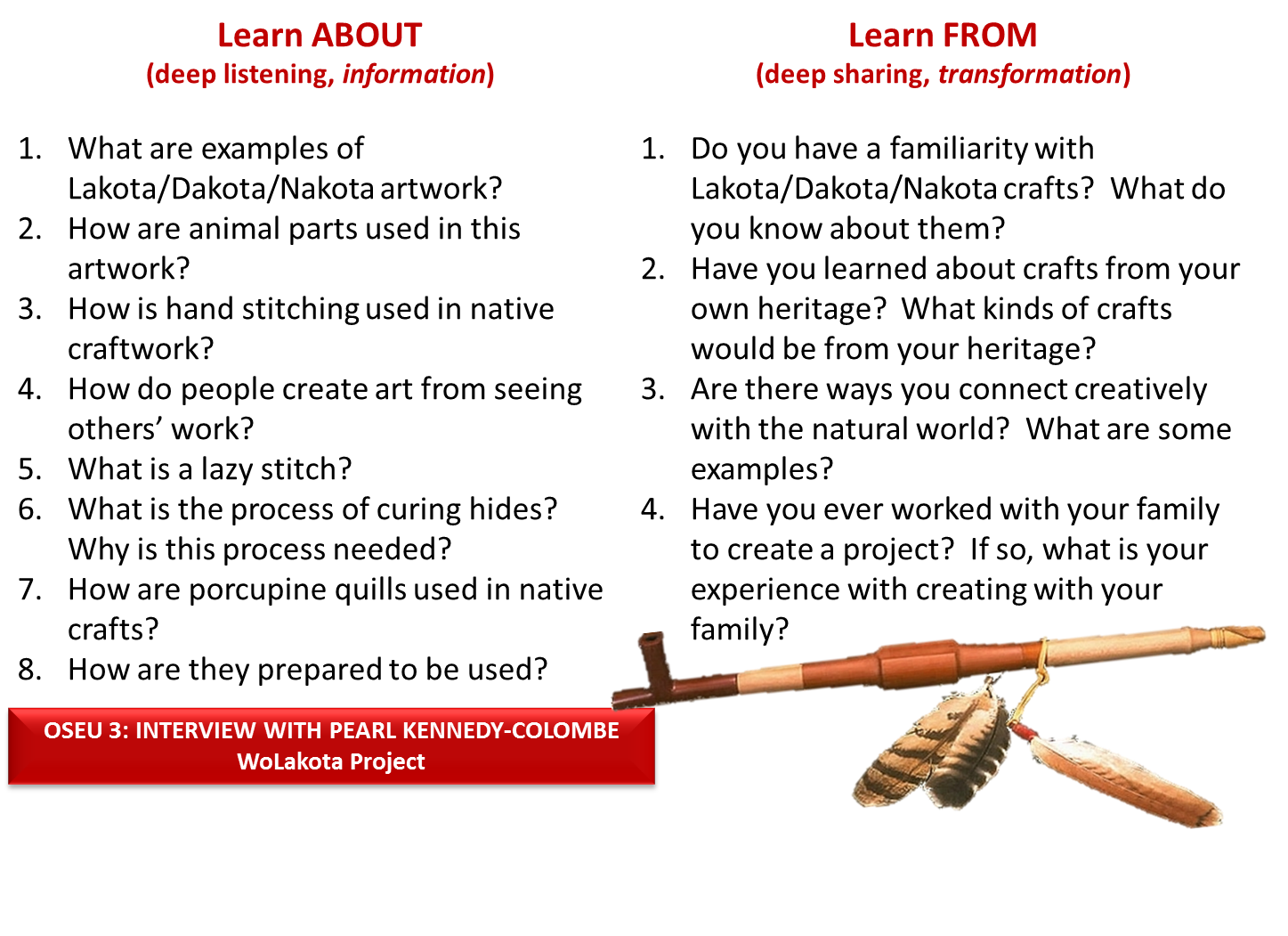
Learn ABOUT Learn FROM
(deep listening, information) (deep sharing, transformation)
1. What are examples of 1. Do you have a familiarity with
Lakota/Dakota/Nakota artwork? Lakota/Dakota/Nakota crafts? What do
2. How are animal parts used in this you know about them?
artwork? 2. Have you learned about crafts from your
3. Howis hand stitching used in native own heritage? What kinds of crafts
craftwork? would be from your heritage?
4. How do people create art from seeing 3. Are there ways you connect creatively
others’ work? with the natural world? What are some
5. Whatisa lazy stitch? examples?
6. What is the process of curing hides? 4. Have you ever worked with your family
Why is this process needed? to create a project? If so, what is your
7. How are porcupine quills used in native experience with creating with your
crafts? family?
How are they prepared to be used?
OSEU 3: INTERVIEW WITH PEARL KENNEDY-COLOMBE
WoLakota Project >
From the current WoLakota source page:
Lakota, Dakota, Nakota Crafts
Pearl Kennedy-Colombe
Transcript
(deep listening, information)
(deep listening, information)
Some indexed text was extracted from scanned material. Check the original source for exact wording and spelling.
Source materials
Supplied transcript document. Text preserved as supplied; spellings and transcription uncertainties have not been corrected.