Interview · South Dakota · Victor Douville · OSEU 4
Themes: Kinship & family, Values & generosity, Arts & expression, Listening & observation, Humor & play
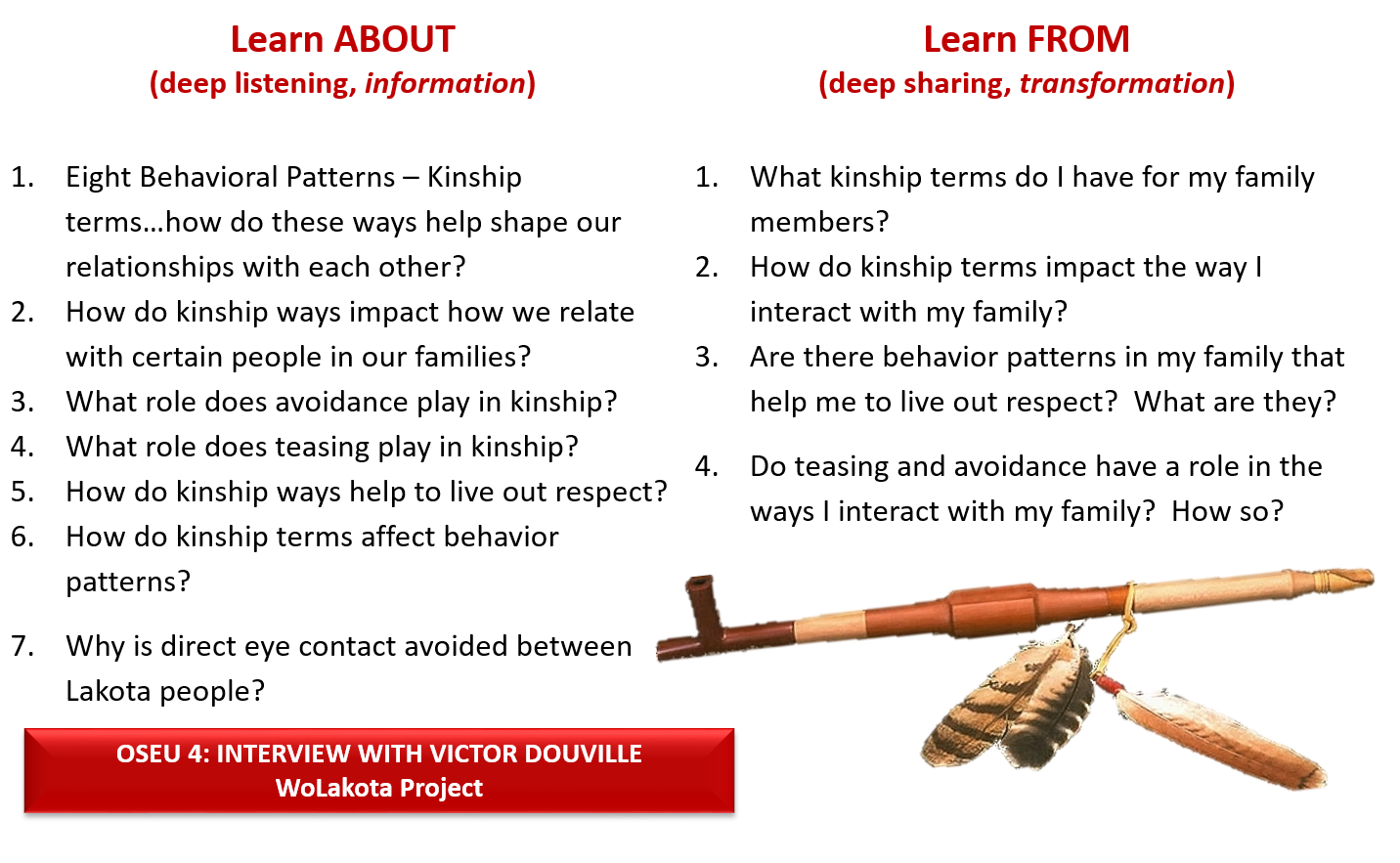
Learn About questions
Eight Behavioral Patterns – Kinship terms…how do these ways help shape our relationship with each other?
How do kinship ways impact how we relate with certain people in our families?
What role does avoidance play in kinship?
What role does teasing play in kinship?
How do kinship ways help to live out respect?
How do kinship terms affect behavior patterns?
Why is direct eye contact avoided between Lakota people?
Learn From questions
What kinship terms do I have for my family members?
How do kinship terms impact the way I interact with my family?
Are there behavior patterns in my family that help me to live out respect? What are they?
Do teasing and avoidance have a role in the ways I interact with my family? How so?
Transcripts
Kinship Ways - Victor Douville - OSEU #4
Watch this interview on YouTubeKinship structure, we should be able to go back to learn the behavioral patterns. There are about eight of them, and they're all addressed interrelationship between siblings, parents, in-laws, collateral relatives. So, that was a core of our society we call a wāʻohula, which is to respect, but I use these terms. So, these kinship terms spell out what you should do, behave towards your relatives. We lost a lot of that. Myself, I've grown up in that world of the behavioral patterns and kinship system.
I knew all of my relatives, and we go by anthropological term, which is a bifurcate marriage system where we have a second set of parents, which evolves into a second pair of brothers, sisters, siblings. And the interrelationship between them is close. But the wildest thing is that we have two separate kinship behavioral terms. One is complete avoidance, and the other one is a lot of interaction between brother-in-laws and
sister-in-laws.
And that's to promote a levering, which if your wife dies, and if you make an arrangement, her sister would become the mother, and same thing with when the husband dies, the same thing there. So, you have a sorority there, so that's what this avoidance is, and also teasing and joking with your relatives, your brother-in-law and sister-in-law. You joke with the brother-in-laws to see how far they go for the
sister-in-law's possible marriage. So, you have to understand a lot of that, so that plays a large role in how you do that.
And you also try to avoid yourself, like I avoid my mother-in-law. I don't talk to her. I don't look at her. That's a sign of deepest respect. Same thing with my wife. She never talks to my father. So she always says, I really got a good daughter, because she never talks to me, and she cooks for me. She's nice. So, we're always trying to play jokes to get them to talk, to break that taboo. And that's there to prevent parental interference in the marriage, initially. So those are some of the things in the kinship system that we have to go back to.
Also, the idea of sharing, the idea of these related families connected into the clan system. So the core of that, of course, is respect, how you address somebody. Whoever you address usually carry out the behavioral patterns within her. So for instance, my sister-in-law, what we call hunka, that's your female cross-cousin. But your parallel cousin, your sister-in-law, of course, is your term you use, hunka.
Hunkashi is, you put the she at the end, which means taboo, which is your cross-cousin, female cousin, because you can't have no relationship with her. You sort of have partial avoidance, which you can joke with your sister-in-law. So I grew up in a world doing that. So a lot of those have to be brought back to formally respect, and you can't, in the system, you can't look anybody straight in the eye. You have to kind of look at a distance. His term is, he's looking at me with a white smile, which means angry.
So those are things that are part of the respect that we have with regard to relationships. So those are some things that I really feel should be brought back, some that can work. Of course, we have to talk to our in-laws, our father-in-laws. We understand that change has to be made. If we have this idea of respect, we'll be able to form a close relationship as it extends in linkage and networking.
And so that's what we really want is to, the kinship system has to be developed where we'll go back to terms, the behavioral patterns, and the interrelationships that occur.
Resource text
OSEU 4: INTERVIEW WITH VICTOR DOUVILLE
WoLakota Project
From the current WoLakota source page:
Kinship Ways
Victor Douville
Transcript
(deep listening, information)
(deep listening, information)
Some indexed text was extracted from scanned material. Check the original source for exact wording and spelling.
Source materials
Supplied transcript document. Text preserved as supplied; spellings and transcription uncertainties have not been corrected.
Additional source transcripts
Kinship Ways
Kinship Ways - Victor Douville - OSEU #4
Kinship structure, we should be able to go back to learn the behavioral patterns. There
are about eight of them, and they're all addressed interrelationship between siblings,
parents, in-laws, collateral relatives. So, that was a core of our society we call a
wāʻohula, which is to respect, but I use these terms. So, these kinship terms spell out
what you should do, behave towards your relatives. We lost a lot of that. Myself, I've
grown up in that world of the behavioral patterns and kinship system.
I knew all of my relatives, and we go by anthropological term, which is a bifurcate
marriage system where we have a second set of parents, which evolves into a second
pair of brothers, sisters, siblings. And the interrelationship between them is close. But
the wildest thing is that we have two separate kinship behavioral terms. One is complete
avoidance, and the other one is a lot of interaction between brother-in-laws and
sister-in-laws.
And that's to promote a levering, which if your wife dies, and if you make an
arrangement, her sister would become the mother, and same thing with when the
husband dies, the same thing there. So, you have a sorority there, so that's what this
avoidance is, and also teasing and joking with your relatives, your brother-in-law and
sister-in-law. You joke with the brother-in-laws to see how far they go for the
sister-in-law's possible marriage. So, you have to understand a lot of that, so that plays
a large role in how you do that.
And you also try to avoid yourself, like I avoid my mother-in-law. I don't talk to her. I
don't look at her. That's a sign of deepest respect. Same thing with my wife. She never
talks to my father. So she always says, I really got a good daughter, because she never
talks to me, and she cooks for me. She's nice. So, we're always trying to play jokes to
get them to talk, to break that taboo. And that's there to prevent parental interference in
the marriage, initially. So those are some of the things in the kinship system that we
have to go back to.
Also, the idea of sharing, the idea of these related families connected into the clan
system. So the core of that, of course, is respect, how you address somebody. Whoever
you address usually carry out the behavioral patterns within her. So for instance, my
sister-in-law, what we call hunka, that's your female cross-cousin. But your parallel
cousin, your sister-in-law, of course, is your term you use, hunka.
Hunkashi is, you put the she at the end, which means taboo, which is your cross-cousin,
female cousin, because you can't have no relationship with her. You sort of have partial
avoidance, which you can joke with your sister-in-law. So I grew up in a world doing
that. So a lot of those have to be brought back to formally respect, and you can't, in the
system, you can't look anybody straight in the eye. You have to kind of look at a
distance. His term is, he's looking at me with a white smile, which means angry.
So those are things that are part of the respect that we have with regard to
relationships. So those are some things that I really feel should be brought back, some
that can work. Of course, we have to talk to our in-laws, our father-in-laws. We
understand that change has to be made. If we have this idea of respect, we'll be able to
form a close relationship as it extends in linkage and networking.
And so that's what we really want is to, the kinship system has to be developed where
we'll go back to terms, the behavioral patterns, and the interrelationships that occur.