Interview · South Dakota · Jace DeCory · OSEU 4
Themes: Land & stewardship, Kinship & family, Storytelling & oral tradition, Education & learning, Healing & resilience, Spirituality & ceremony, Values & generosity, Culture & continuity, Arts & expression, Community & responsibility, Listening & observation, Children & young people, Intergenerational learning
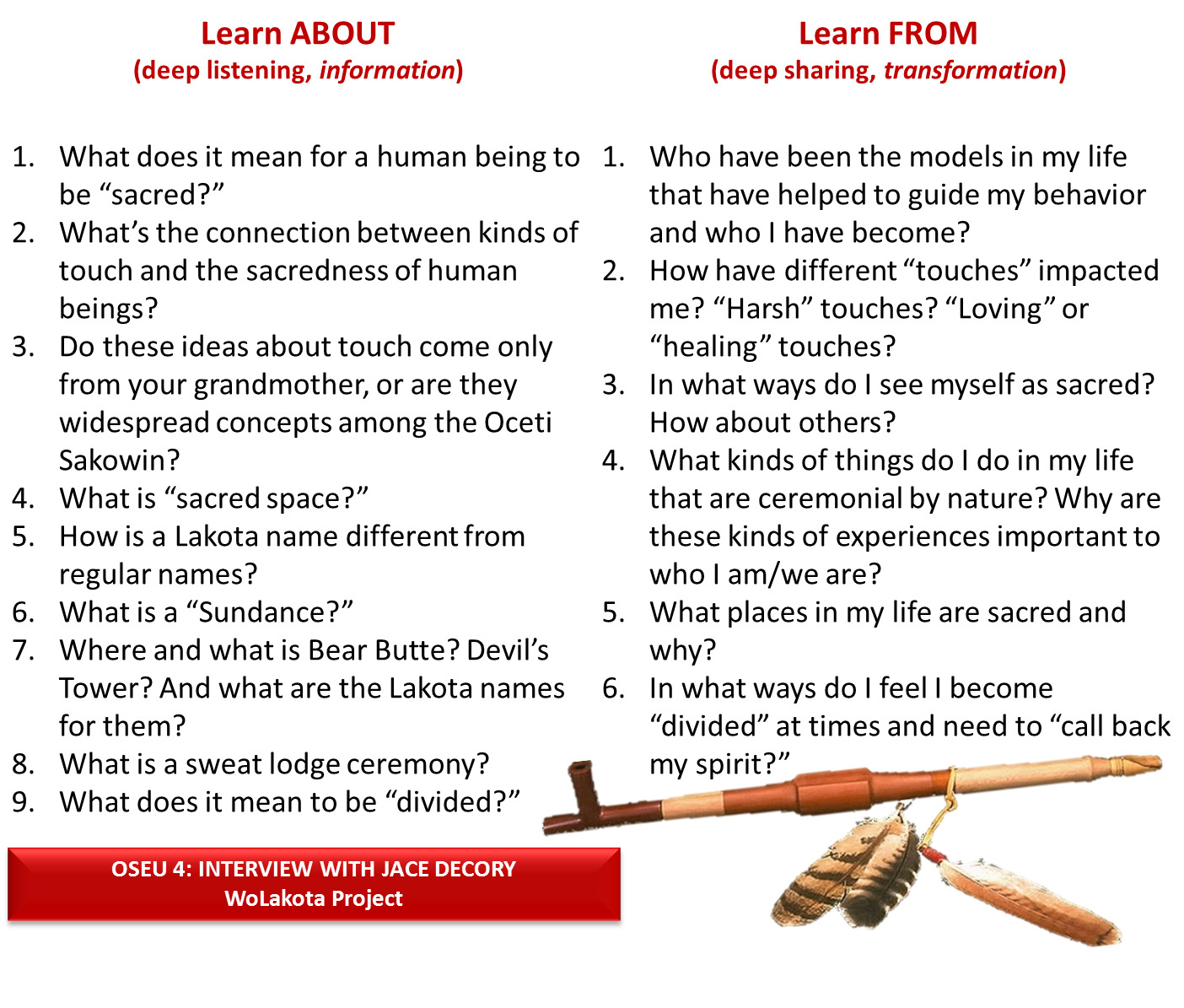
Learn About questions
What does it mean for a human being to be “scared?”
What’s the connection between kinds of touch and the sacredness of human beings?
Do these ideas about touch come only from your grandmother, or are they widespread concepts among the Octi Sakowin?
What is “sacred space?”
How is a Lakota name different from regular names?
What is a “Sundance?”
Where and what is Bear Butte? Devil’s Tower? And what are the Lakota names for them?
What is a sweat lodge ceremony?
What does it mean to be divided?”
Learn From questions
Who have been the models in my life that have helped to guide my behavior and who I have become?
How have different “touches” impacted me? “Harsh” touches? “Loving” or “healing” touches?
In what ways do I see myself as sacred? How about others?
What kinds of things do i do in my life that are ceremonial by nature? Why are these kinds of experiences important to who I am/we are?
What places in my life are sacred and why?
In what ways do I feel I become “divided” at times and need to “call back my spirit?’
Transcripts
Sacredness & Children - Jace DeCory - OSEU 4
Watch this interview on YouTubeOne of the most important parts of relative and kinship is that our elders modeled appropriate behavior.
It's not so much that they said, now this is, you know, as they were doing it, this is how you do. We saw what they were doing. We saw how they interacted with one another, how they were respectful, how my grandmother, you know, I never saw her say a harsh word to anyone. I never heard her cuss, you know, even though maybe she was cursing. I don't think there's any cuss words in Wakota. But anyway, she, you know, she was a very, very respectable and respectful woman.
And so I learned responsible behavior from her, that you never hit children.
I never spank my kids. I didn't hit them. I didn't slap them. Sometimes I talked loudly to them, but I would explain things to them.
And that's what I saw her do. And that's what I saw my mother do. My mother never, didn't spank us either.
After that, that's just how we were taught. In fact, my grandma said one time to another lady, I had big ears, I was listening. And this other woman must have been hitting her kids or doing something.
Because she said to her, when you hit your child, she was telling this woman, when you hit your child, it's like spitting them in the face.
And I always kept that visual image in my mind.
You know, spitting a kid, you know, to spit at somebody in the face, horrible, you know, and that, and she likened that to even, you know, laying a hand on them.
You know, we're, we're all, all human beings are sacred.
And that's kind of how I was taught that you don't hit them. You don't, if you're going to touch another human being, you're touching them because you're doctoring them, or you want to pray with them, or you want to love it. You're hugging them because you want to acknowledge that love you have for them. But you don't hit them for any reason. It took me a while to be able to do the pound. You know, because that, you know, that pound, or a high five and all that.
But you know, that's a different culture.
Because we gave individuals their sacred space. And even today, you know, when I'm around some elders, I don't, I shake their hands, you know, I don't shake it real hard, but I shake their hands, and I try to acknowledge them as a human being. I, you know, that deserves to be, have that recognition. But I won't hug them or anything like that, unless they initiate a hug, because they are the elders. Well, you learn these things through observing, through watching, you know, appropriate behavior.
But, and that's what, that's what your relatives taught you. You know, when, when we were young, we were also taught not to, not, not to, well, I was taught to be home by dark.
Grandmother, you know, the grandma said, you know, you can't be out there because the spirits are out there, and they might harm you. You have to be in the house or, or close to the house when it's dark.
And so when it was starting to get dark, all of us knew that, that we had to make our way back to the house.
And, and then before we would come in, in the house, she said, now turn around and call your spirits.
And so when I was a little kid, I thought that was just weird.
I had to call my name, you know, Jace, Jace, Jace, Jace. Well, later on, when I got my Lakota name, and the elders were talking to us about that.
Now, when you leave a ceremony, remember to call your name. And it hit me again. Oh, yeah. My grandma used to say that.
In other words, you are calling your spirit back to your, your body. You're, you're calling your, to make you whole again, because we're making up of different entities. And sometimes there's part of our spirit leaves us and heads out and go someplace else. And so when you come back, and it's, they're curious. So they go other, when you come back, you call your spirit so that you can be whole again, before you go to sleep at night.
And so I find myself doing that before in the evenings now.
And certainly when we come back from ceremony, like Sundance, or, or Bear Butte, when we've been praying at Bear Butte, or having a sweat lodge ceremony, whatever it is, go to Devil's Tower, Matotipiva, wherever we go, or when we leave that place, we call our spirit four times. We do lots of things in fours and sevens. So we call our spirit four.
But now I call my Lakota name. I say that four times.
So that is something that I learned when I was real little, to call my spirit. But it carries over.
Resource text
From the current WoLakota source page:
Sacredness & Children
Jace DeCory
Transcript
(deep listening, information)
(deep listening, information)
Some indexed text was extracted from scanned material. Check the original source for exact wording and spelling.
Source materials
Supplied transcript document. Text preserved as supplied; spellings and transcription uncertainties have not been corrected.
Additional source transcripts
Sacredness & Children
Sacredness & Children - Jace DeCory - OSEU 4
One of the most important parts of relative and kinship is that our elders modeled
appropriate behavior.
It's not so much that they said, now this is, you know, as they were doing it, this is how
you do. We saw what they were doing. We saw how they interacted with one another,
how they were respectful, how my grandmother, you know, I never saw her say a harsh
word to anyone. I never heard her cuss, you know, even though maybe she was
cursing. I don't think there's any cuss words in Wakota. But anyway, she, you know, she
was a very, very respectable and respectful woman.
And so I learned responsible behavior from her, that you never hit children.
I never spank my kids. I didn't hit them. I didn't slap them. Sometimes I talked loudly to
them, but I would explain things to them.
And that's what I saw her do. And that's what I saw my mother do.
My mother never, didn't spank us either.
After that, that's just how we were taught. In fact, my grandma said one time to another
lady, I had big ears, I was listening. And this other woman must have been hitting her
kids or doing something.
Because she said to her, when you hit your child, she was telling this woman, when you
hit your child, it's like spitting them in the face.
And I always kept that visual image in my mind.
You know, spitting a kid, you know, to spit at somebody in the face, horrible, you know,
and that, and she likened that to even, you know, laying a hand on them.
You know, we're, we're all, all human beings are sacred.
And that's kind of how I was taught that you don't hit them. You don't, if you're going to
touch another human being, you're touching them because you're doctoring them, or
you want to pray with them, or you want to love it. You're hugging them because you
want to acknowledge that love you have for them. But you don't hit them for any reason.
It took me a while to be able to do the pound. You know, because that, you know, that
pound, or a high five and all that.
But you know, that's a different culture.
Because we gave individuals their sacred space. And even today, you know, when I'm
around some elders, I don't, I shake their hands, you know, I don't shake it real hard, but
I shake their hands, and I try to acknowledge them as a human being. I, you know, that
deserves to be, have that recognition. But I won't hug them or anything like that, unless
they initiate a hug, because they are the elders. Well, you learn these things through
observing, through watching, you know, appropriate behavior.
But, and that's what, that's what your relatives taught you. You know, when, when we
were young, we were also taught not to, not, not to, well, I was taught to be home by
dark.
Grandmother, you know, the grandma said, you know, you can't be out there because
the spirits are out there, and they might harm you. You have to be in the house or, or
close to the house when it's dark.
And so when it was starting to get dark, all of us knew that, that we had to make our
way back to the house.
And, and then before we would come in, in the house, she said, now turn around and
call your spirits.
And so when I was a little kid, I thought that was just weird.
I had to call my name, you know, Jace, Jace, Jace, Jace. Well, later on, when I got my
Lakota name, and the elders were talking to us about that.
Now, when you leave a ceremony, remember to call your name.
And it hit me again. Oh, yeah. My grandma used to say that.
Speaker 1 (00:04:04) - In other words, you are calling your spirit back to your, your
body. You're, you're calling your, to make you whole again, because we're making up of
different entities. And sometimes there's part of our spirit leaves us and heads out and
go someplace else. And so when you come back, and it's, they're curious. So they go
other, when you come back, you call your spirit so that you can be whole again, before
you go to sleep at night.
And so I find myself doing that before in the evenings now.
And certainly when we come back from ceremony, like Sundance, or, or Bear Butte,
when we've been praying at Bear Butte, or having a sweat lodge ceremony, whatever it
is, go to Devil's Tower, Matotipiva, wherever we go, or when we leave that place, we call
our spirit four times. We do lots of things in fours and sevens. So we call our spirit four.
But now I call my Lakota name. I say that four times.
So that is something that I learned when I was real little, to call my spirit. But it carries
over.
And I know some adults don't know that. But that's an idea of, you know, we can, we
can teach those things to our young people now that, that this is how, how we relate to
our spirit within our body, ourself, so that we can remain whole.
So just, just a little story.
But that, you know, when I think of relatives and kinship, I think of proper behavior. I
think of role modeling. I also think of, you know, the positive things that they, that they
tried to emulate and share with us.