Interview · South Dakota · Jace DeCory · OSEU 2
Themes: Language & revitalization, Kinship & family, Identity & belonging, Storytelling & oral tradition, Education & learning, Spirituality & ceremony, Values & generosity, Culture & continuity, Food & plants, Listening & observation, Children & young people, Intergenerational learning
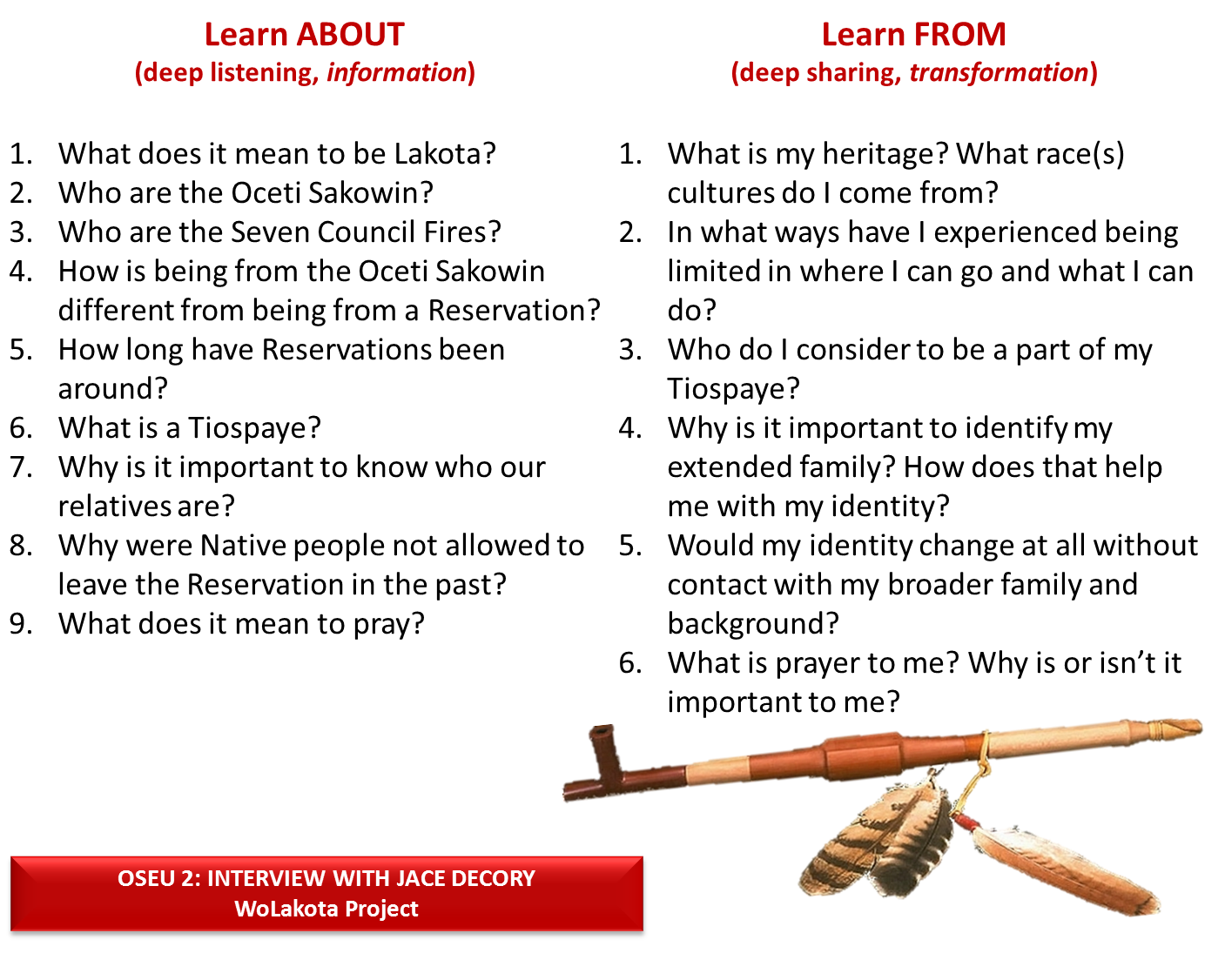
Learn About questions
What does it mean to be Lakota?
Who are the Oceti Sakowin?
Who are the Seven Council Fires?
How is being from Oceti Sakowin different from being from a Reservation?
How long have Reservations been around?
What is a Tiospaye?
Why is it important to know who our relatives are?
Why were Native people not allowed to leave the Reservation in the past?
What does it mean to pray?
Learn From questions
What is my heritage? What race(s) cultures do I come from?
In what ways have I experienced being limited in where I can go and what I can do?
Who do I consider to be part of my Tiospaye?
Why is it important to identify my extended family? How does that help me with my identity?
Would my identity change at all without contact with my broader family and background?
What is prayer to me? Why is or isn’t it important to me?
Transcripts
Tiospaye, Relatives & Prayer - Jace DeCory - OSEU 2
Watch this interview on YouTubeWhen… when young people come up to Black Hills State… and when they introduce themselves, we have an organization called Lakota Omniciye… and it's a student organization of mainly native students that come to the meetings. But it’s also…it's inclusive because we also include the two-legged non-natives, the Wasi'chu
, and other races of people that want to be a part of that. But when kids come in there at first… when they go around and introduce themselves… they'll say, “My name is such and such, and I'm from the Cheyenne River Sioux Tribe.” Or, “I am such and such. I'm from the Rosebud Sioux tribe.” And so that's why I make it a point to say, when I introduce myself, “I am Lakota from the Black Hills, or from the Oceti Sakowin…from the Seven Nations.” The reservations are a very recent phenomenon for us. You know, we…we've not been in reservations most of our thousands of years of existence as a people. So that is a really new thing. So, I try to encourage young people to think about their identity in a more… a bigger way… as part of the seven fireplaces…or else as an individual identity and what language they speak… or you know something…or even their tiospaye, that extended family. Now, back in the day, our extended tiospayes were the most important part of our identity… what tiospaye do you belong to? We didn't ask, you know… we asked who are your relatives. That’s how we identified ourself. Who are your…your relative…who are you related to? Who are your mom and dad? Who is your…who are your grandparents? So even the old ones today…when they introduce themselves…that's what they'll first say. They'll tell you who their relatives are and one of the reasons.
Then they're letting you know that I may be a relative of yours. And that's really important to let somebody know that… that you may be a relative of theirs because that connection is real important. And I think that for young people, it's hard for them to realize… because of this mobility… and people going off and on the reservation back and forth… and even moving thousands of miles away… a lot of young kids don't have that tiospaye, that extended family connection. My husband and I were very conscious of that… and even though we lived in an urban area, we wanted to make sure our kids were connected to their relatives always. And I'm so thankful that we took the time to take them to down to Allen, down to Pine Ridge, down to Rosebud, up to Standing Rock, to Fort Yates and to Wakpala… and to take them to the lands of their ancestors. Where, you know, their relatives grew up on those various reservations… making that connection. But also, having them be able to share with their cousins and so forth… where do you live? Well, I live in the sacred Black Hills. I live where our origin is, you know… and talking about in that way… having that identity with this place here. So, it's okay to have… it's okay to be a Lakota living in Rapid City, South Dakota. You know, my grandparents… my mom too… and my dad used to say, “There are no walls around the reservation.” You know, at one time there were though… not walls… but we weren't allowed to leave without permission. And I have some renegades on my mom's side, particularly.
I was looking at some of the old records of… on reservation records of prison… of jail records I guess. I saw various relatives names on there…”left reservation without permission…” “left reservation without permission…” over and over again. And I said, “Grandma, how come these… what…how come these uncles and stuff…what were they doing? And she, “Oh, Takoja.” We lived out in the country along the Missouri River there before it was flooded by the Pig Sloan, by the Oahe Dam…that’s a whole other story. But…and our bottom lands there were adjacent to the Missouri… lush plant life and all. It was beautiful down there. And I remember that as a kid. I was very young, but I still remember… my grandma said that what they would do is across the way, there's a little town, a non-native town called Pollock…and that’s… it's across from where we lived. And they used to go across on a boat… and they'd go to the trading post there in Pollock…and they left the reservation without permission because that is off the reservation…on the other side of the river. And so that sometimes they, you know… they'd hear about it and they'd say, “Where did…where did you get that?” Whatever they had…you know…trade good or whatever. “Oh, you got it at Pollock at the trading post.” Cuz they knew. And so they would… they would get… and then plus they'd go other places too up to… for hunting and all that. But they weren't supposed to… and they'd get in trouble for that. So nowadays we can… we're mobile… we can go all over. But the main thing… Wherever you go, always know who you are in here. And here, always know who you are… your identity… and who you are to other people. Know who you are as a person and be able to verbalize that. And I always tell my kids… and they're not afraid to pray. And I tell the kids at Lakota Omniciye … when somebody asks you to pray, don't be afraid to do that because what you're doing is you're saying something from your heart. And if you… if you can do that… that's praying
. Cuz that's how we pray. We say something from our heart, and we try to help people and uplift people to do positive things in their life. So don't be afraid to do that. And so, the same thing with identity. Don't be afraid to learn who you are, but also, you know… visiting your relatives… visiting elders… and… but be strong in who you are and work. Sometimes it's work to have to learn your relatives and their names and all that. But it's worth it in the end. I'm so blessed by so many different relatives. Somebody could offer me a million dollars in one hand and all my relatives on the other hand, and I take all my relatives; they mean that much to me.
Resource text
Learn ABOUT Learn FROM
(deep listening, information) (deep sharing, transformation)
1. What does it mean to be Lakota? 1. What is my heritage? What race(s)
2. Who are the Oceti Sakowin? cultures do | come from?
3. Who are the Seven Council Fires? 2. In what ways have | experienced being
4. Howis being from the Oceti Sakowin limited in where | can go and what I can
different from being from a Reservation? do?
5. How long have Reservations been 3. Who dol consider to be a part of my
around? Tiospaye?
6. What is a Tiospaye? 4. Why is it important to identify my
7. Why is it important to know who our extended family? How does that help
relatives are? me with my identity?
8. Why were Native people not allowedto 5. Would my identity change at all without
leave the Reservation in the past? contact with my broader family and
9. What does it mean to pray? background?
6. What is prayer to me? Why is or isn’t it
important to me?
OSEU 2: INTERVIEW WITH JACE DECORY
WoLakota Project
From the current WoLakota source page:
Tiospaye, Relatives, and Prayer
Jace DeCory
Transcript
(deep listening, information)
(deep listening, transformation)
Some indexed text was extracted from scanned material. Check the original source for exact wording and spelling.
Source materials
Supplied transcript document. Text preserved as supplied; spellings and transcription uncertainties have not been corrected.