Interview · South Dakota · Kevin Locke · OSEU 2
Themes: Land & stewardship, Education & learning, Values & generosity, Listening & observation, Children & young people
Learn About questions
How cold does it get in South Dakota in the winter?
What similarities are there in children’s drawings from around the globe? What studies or research has been done in connection with this?
What’s the history of the causes and impacts of the Dustbowl in the US? In South Dakota?
How did the Dustbowl impact the people of the Oceti Sakowin specifically?
What is soil erosion?
What are shelterbelts?
Learn From questions
What things do you remember drawing as a child?
Do you still draw or doodle? What sorts of things do you draw now?
What might someone learn about you from looking at your drawings or doodles-either as a child or now…or both?
Do you believe your purpose is to be a blessing or to provide Beauty? Or do you see your purpose as something else?
What are/is YOUR…
Solid Foundation
Overarching Goals
Light of Knowledge
Warmth of Love
Soft Breezes
Gentle Rains
Has anyone been a “shelterbelt” for you in some of these ways?
Love
Compassion
Truthfulness
Trustworthiness
Continuity
Constancy
Dependability
Who might you be “sheltering” and in what ways?
Transcripts
Crayons and Shelterbelts - Kevin Locke - OSEU #2
Watch this interview on YouTubeWhen I was teaching full time, I had lower elementary…so you know…kindergarten, first and second grade. So…little tiny guys. You can’t really send them out when it gets much more than like twenty-five or thirty below zero. And so then you had to have indoor activities for them. So then I’d always put the paper out…newsprint out...with a little can of crayons. They’d all get their colors and they’d do their drawings. And so, often you’d see…especially little girls…not only the little girls…but especially little girls, they’d do these pictures and you see them on…all over the world…you see them…they have the same pictures…people have them on their refrigerators and their walls.
Basically what it is…you take a rectangular piece of paper…and what they’ll do…they’ll have a little strip of green on the bottom…a little strip of blue at the top. And the centerpiece will be a flower or a tree or it could be a house.
But then if you look at it…maybe the flower has rainbows or stars in it, you see. It might have a little leaf there…and really colorful. It could be really colorful. And then at the upper right hand corner of the paper, is the sun. The sun is there. It might have a smiling face or it might just be a little sun. It could have rays out of it. And then…then it might…usually there could be clouds in there. Sometimes there are birds…and the way they make their birds is like this…like this. And so, and maybe…like I said…a few clouds…and then I see this so often, you know…I wouldn’t just see it only at that school but other places I went…really I saw it all over. So then it just began to puzzle me. It could be a whiteout blizzard…thirty, thirty-five below zero outside.
And they look around the room and there’s nothing that would inspire them to do this picture. And so then I’d get down real close…I’d look at it with them. “That’s really beautiful. Just the colors and the design is really nice. I really like that…your picture.” You know, I’d tell them that. And I’d always ask this question…I said, “Where is this place? Where is this place?” And I’d always get the same response which is a nonverbal response. And they’d look at me…and they’d look like this.. Kind of like that, you know. They’d give you that kind of look. And later on I figured out what that look is communicating. It says, “You dummy. He really doesn’t know, does he.” There not going to say that…maybe they wouldn’t even be able to verbalize that…but that’s what you can tell they’re thinking that. Because…see what they’re really doing, is they are depicting…they are making a self-portrait. That’s who they are, you see. They’re saying, “This is me. And this is how I was created which was to…I’m created to blossom. And to bring forth beauty. And to bring forth blessings…and all good things that I can bring out.” But then you look at the picture…you can see the requirements for that. But I need to have a foundation…something solid…you know that strip of green. I need to have a goal right up in there…I need that goal. And then, you’ve got the sun. I need to have this light of knowledge…I need this. I require this. I need to have that warmth of love and compassion. I need that. Maybe the little birds might indicate “I need to have the nice, soft breeze…the nice soft breeze.” Maybe the little clouds indicate “I need the nice, gentle rain, you see.” And so what they are saying is…when I look at that, I can see…the statement is complete.
They are telling us everything that they need. But…so often, we don’t…we don’t get that message as adults, as caregivers. In this area…around this area…in the twenties and thirties, they had a catastrophic, climactic shift called The Dust Bowl. There was all of this rain cycle…just after the…first they had the Allotment Act and then they had the Homestead…the homesteaders take up claims. There was a rain cycle in there. So these homesteaders deplowed this sod that had never been turned before. And so then, of course…there was millions of bison that were taken off. And so there was a huge ecological shift. I always think…it wasn’t a freak of nature that this Dust Bowl hit. The dramatic change…ecological change…so whatever precipitated it, it was a horrible result. Three years and not even a drop of rain. I interviewed people up there…Army Corps of Engineers asked me to do that…and they described it as just horrendous…the Dust Bowl. And then after that, they put in these real strict measures to…of soil erosion control. So there’s many things…and of course…one of the main things was all of the shelterbelts…you know to protect the crops.
And so I thought about that in regards to little kids…it’s just like…when these little kids do these pictures, they are telling us that they need assistance like a shelterbelt. Like who is going to be a shelterbelt of love for me? Who is going to be a shelterbelt of compassion, of truthfulness, of trustworthiness, of continuity, of constancy, of dependability? Who is going to be there for me, for this? Because they are showing us how fragile… how vulnerable they are, you see. I always reflect on that.
I’ve got four kids myself. And I have seven grandkids. And so I collect those pictures. They’ve all done pictures like that. And I put them up. Just to remind myself of who they are. And you can see that…if you saw those little kids there… you see how shy they are? They are so shy, you know. They can’t even say their name, “Brandy.” But they’ve got all of this beauty waiting to come out, you see. Does that make sense?
Resource text
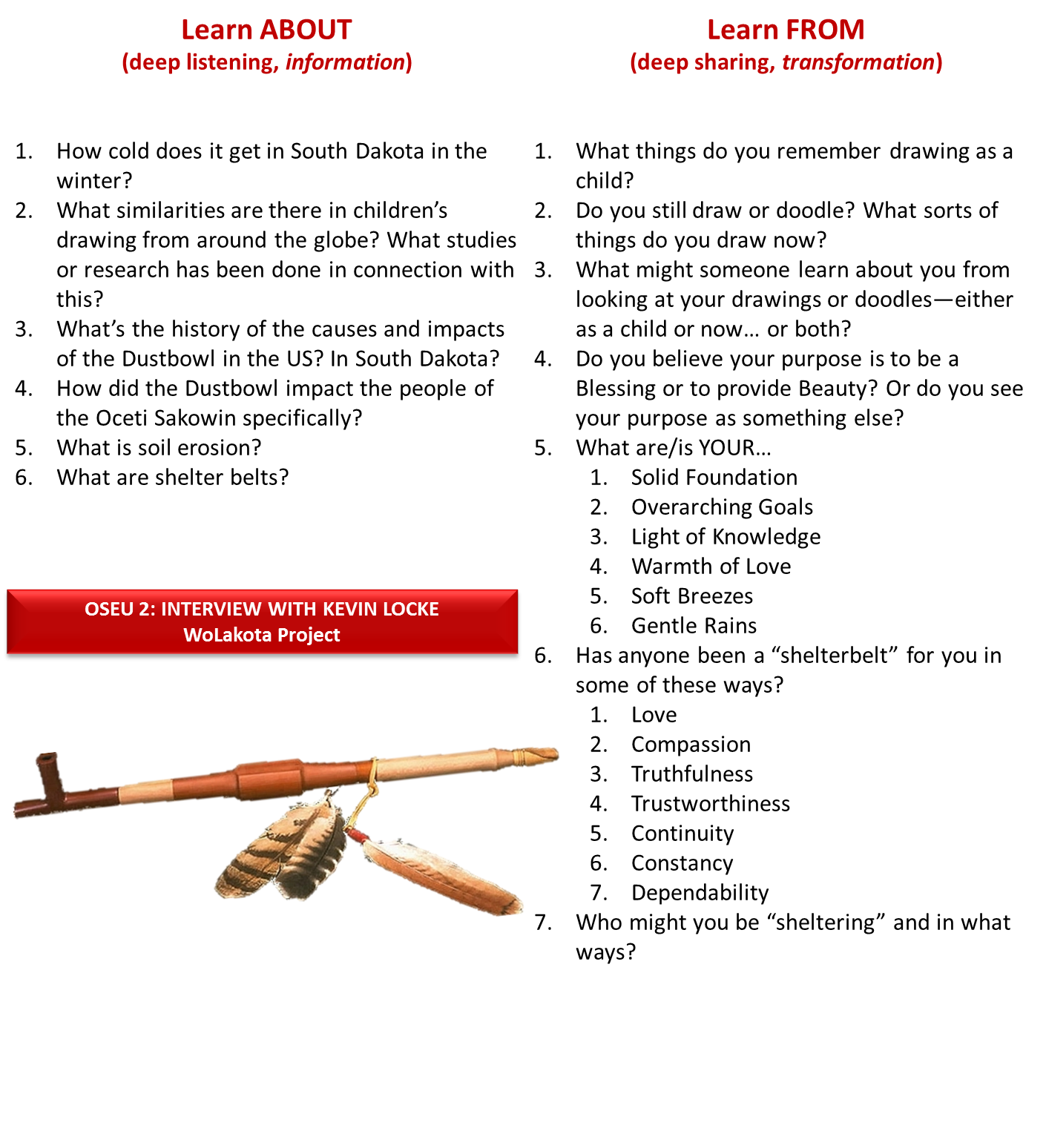
OSEU 2: INTERVIEW WITH KEVIN LOCKE . Soft Breezes
WoLakota Project 6. Gentle Rains
6. Has anyone been a “shelterbelt” for you in
some of these ways?
1. Love
Compassion
Truthfulness
Trustworthiness
Continuity
Constancy
. Dependability
7. Who might you be “sheltering” and in what
ways?
WPwWwner
NOuURWH
From the current WoLakota source page:
Crayons & Shelterbelts
Kevin Locke
Transcript
(deep listening, information)
(deep listening, transformation)
Some indexed text was extracted from scanned material. Check the original source for exact wording and spelling.
Source materials
Supplied transcript document. Text preserved as supplied; spellings and transcription uncertainties have not been corrected.