Interview · South Dakota · Cheryl Medearis · Dottie LeBeau · OSEU 7
Themes: Land & stewardship, Language & revitalization, Storytelling & oral tradition, Education & learning, Treaties & sovereignty, Boarding schools & assimilation, Healing & resilience, Spirituality & ceremony, Values & generosity, Culture & continuity, Racism & representation, Economy & livelihoods, Self-determination & leadership
Learn About questions
Addressing OSEU 5
1. What is the book “Lies My Teacher Told Me” about?
2. What does the research tell us concerning the value of exposure to multiple perspectives in Social Studies?
3. How might story and even fiction help learners grasp important ideas concerning history?
Addressing OSEU 6
1. Where do we look to find out how treaties impacted different tribes differently?
2. What treaties have been violated or broken in our region? In our nation?
3. What has or hasn’t been done in response to these violations?
4. In what ways is trauma impacting the Oceti Sakowin people today?
Addressing OSEU 7
1. What’s the history of the Tribal College Movement?
2. Did all tribal colleges start out under the oversight of other state universities?
3. How many “Non-Indian” students attend tribal colleges?
4. What degree programs are being offered by tribal colleges?
5. What economic development programs are working well on the reservations? Among tribal people in general?
Learn From questions
Addressing OSEU 5
1. Have you every found yourself feeling required to teach something you didn’t feel gave the full or true picture? How did / do you deal with this?
2. What is approach to understanding something when there are multiple even contradictory accounts or explanations? Do you approach this differently for yourself that for your students? Why or why not?
3. What role has story or storytelling played in your learning? In your classroom?
Addressing OSEU 6
1. Have you ever experienced a law, policy or “agreement” that served someone else a lot better than it served you? How did that come about? What did you do about it?
2. Has some trauma ever motivated you to move forward productively? Tell that story.
3. Has some trauma ever stopped you in your tracks and kept you from moving forward? Tell that story.
Addressing OSEU 7
1. Who was responsible for helping YOU get a college education? How did that happen?
2. Are there any unique understandings that YOU bring to your work as a result of specific people, events or specialties you encountered at the school(s) where you got your training?
3. Have you experienced economic or financial struggles at some point in your life? How did / do you deal with those?
Transcripts
Addressing OSEU 7 with Cheryl Medearis
Watch this interview on YouTubeI'll speak to that from a perspective of what tribal institutions have done for the people in not just our area, but the tribal college movement is probably, in my perspective, one of the strongest movements that ever occurred. From a personal basis, I may never have gotten a college education. I don't know that. It may have taken me even longer had Sinté not been where it was when it was. And I date back to Sinté-Gleska College when the institution wasn't really trusted to be on its own.
So my diploma reads the University of South Dakota because they proctored and granted the degrees and helped develop the curricula. But that's been one of the strongest impacts that I see. We're able to put teachers into schools that are educated, whether they're non-Indian or non-Indian, into schools with a whole different understanding than the teachers that were there previously, people in businesses, in all different walks of life. So it's been very strong.
Economic development is a continual struggle on the reservation, but one person at a time, one program at a time, again, we have to look forward to that next generation. And that understanding is one that will continue way beyond us. It will continue on and on if we do our job to build what we have today.
Addressing OSEU Six with Cheryl Medearis
Watch this interview on YouTubeIt's been spoken to in many different areas. There is no one way of knowing. As you look at what a treaty did for one tribe, doesn't mean it's the same. Teachers have to be very well prepared to be able to seek out through video, through interviews, through whatever, how has this impacted, how has it impacted your tribe.
And then again, I personally try to say there's been a lot of trauma, but at the same time we have to use that to move forward so it doesn't become a, this makes me less than, I can't become what I need to be because this treaty was violated or this is what has happened. We learn from the past, we live it today the best way we can, and then we see, can we pass on to those next generations that will strengthen that. But there are many ways of knowing and that's a very, very difficult understanding to teach, to live, and to learn about.
Resource text
Unit 5
What are the
Oceti Sakowin
Essential Understandings? (with a focus on 5, 6 & 7)
If you haven’t already, you can download
the OSEU document here!
In this unit, you’ll be getting to know the last 3 Oceti Sakowin Essential Understandings through reading, viewing and reflecting upon the understandings themselves and video interviews with Dottie LeBeau, one of the original authors of the understandings, and Dr Cheryl Medearis, Dean of the College of Education at Sinte Gleska University established in Mission, SD by the Rosebud Sioux Tribe.
After reading each Understanding and its accompanying standards and viewing each set of introductions by Elder Dottie LeBeau and Dr Cheryl Medearis, use the survey links to journal reflectively about your initial sense of each of the Oceti Sakowin Essential Understandings.
Unit 5a:
Click Here to Complete the
“Understanding the OSEU” Survey on OSEU 5
Unit 5b:
Click Here to Complete the
“Understanding the OSEU” Survey on OSEU 6
Unit 5c:
Click Here to Complete the
“Understanding the OSEU” Survey on OSEU 7
To learn even more about each of the understandings, read the extended descriptions for each. These are included in
the OSEU document
itself, and can be found at the bottom of each of the WoLakota Project
OSEU Elder interview main pages
.
Last Unit: Unit 6
Finishing up 3 IDM SD Social Studies / OSEU Lessons.
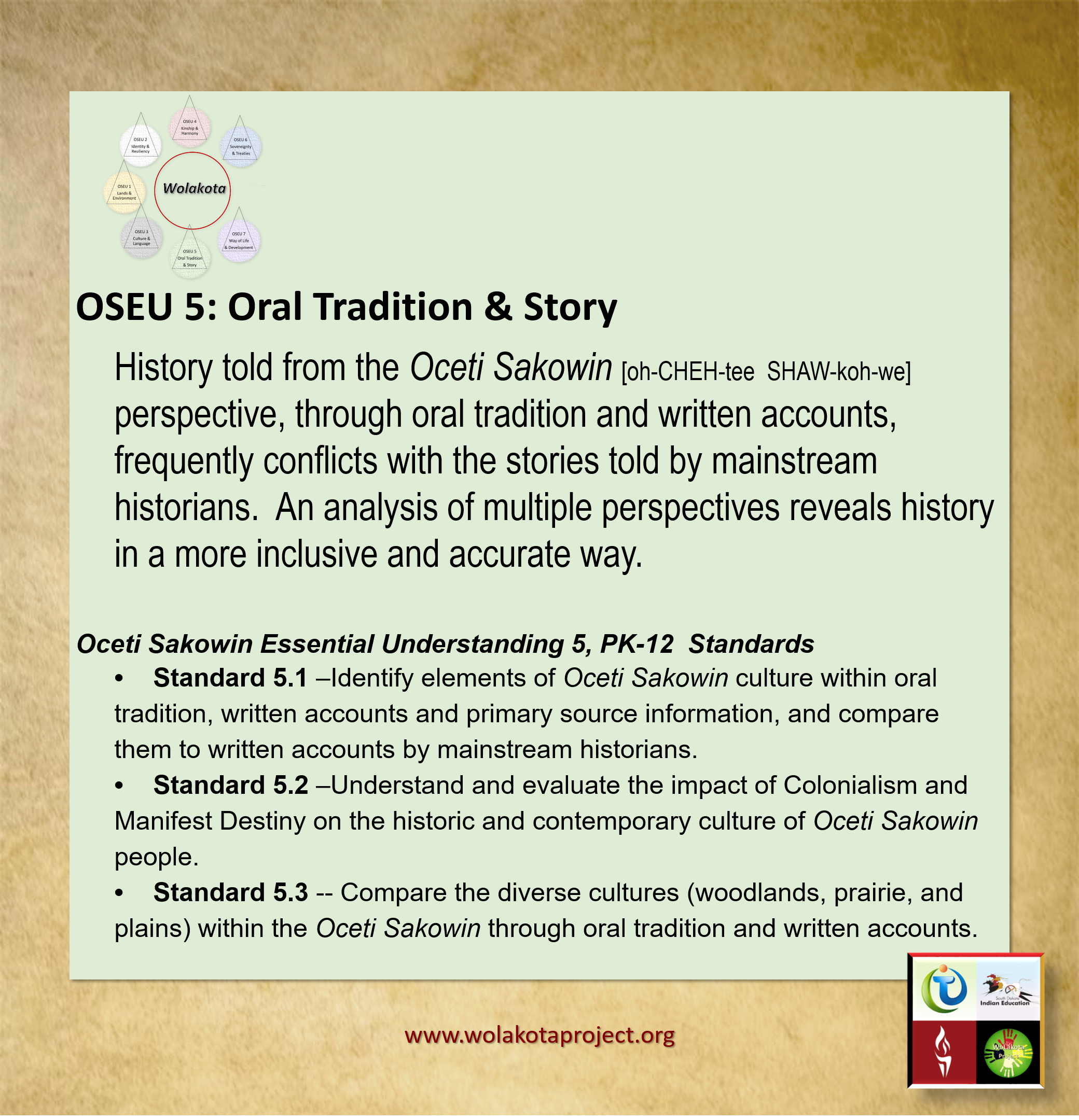
OSEU 5: Oral Tradition & Story
History told from the Oceti Sakowin {oh-CHEH-tee SHAW-koh-we]
perspective, through oral tradition and written accounts,
frequently conflicts with the stories told by mainstream
historians. An analysis of multiple perspectives reveals history
in a more inclusive and accurate way.
Oceti Sakowin Essential Understanding 5, PK-12 Standards
e« Standard 5.1 —Identify elements of Oceti Sakowin culture within oral
tradition, written accounts and primary source information, and compare
them to written accounts by mainstream historians.
¢ Standard 5.2 —Understand and evaluate the impact of Colonialism and
Manifest Destiny on the historic and contemporary culture of Oceti Sakowin
people.
¢ Standard 5.3 -- Compare the diverse cultures (woodlands, prairie, and
plains) within the Oceti Sakowin through oral tradition and written accounts.
Indian Education
www.wolakotaproject.org
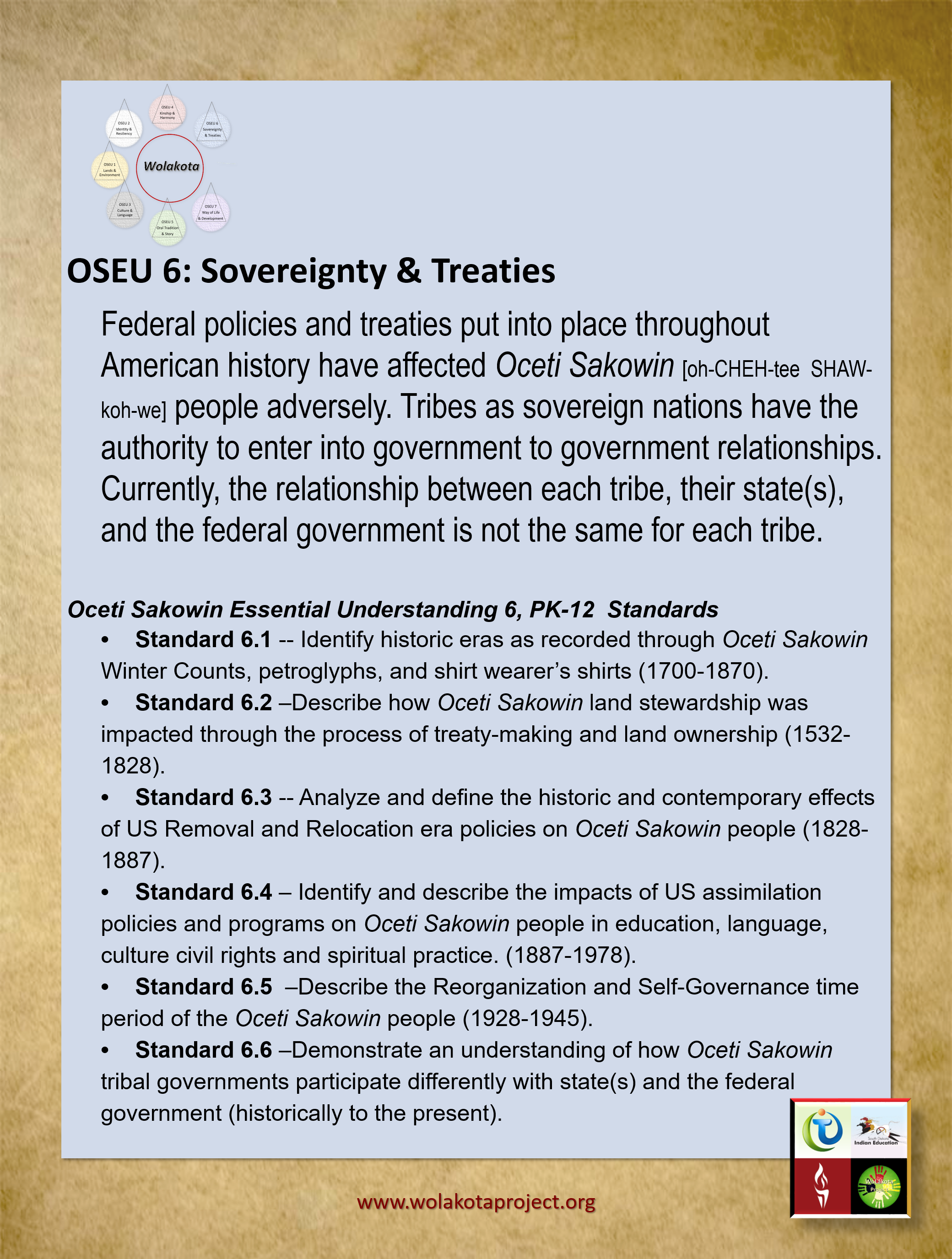
OSEU 6: Sovereignty & Treaties
Federal policies and treaties put into place throughout
American history have affected Oceti Sakowin [oh-cHEH-tee SHAW-
koh-we] people adversely. Tribes as sovereign nations have the
authority to enter into government to government relationships. |
Currently, the relationship between each tribe, their state(s),
and the federal government is not the same for each tribe.
Oceti Sakowin Essential Understanding 6, PK-12 Standards
¢ Standard 6.1 -- Identify historic eras as recorded through Oceti Sakowin
Winter Counts, petroglyphs, and shirt wearer’s shirts (1700-1870).
¢ Standard 6.2 —Describe how Oceti Sakowin land stewardship was
impacted through the process of treaty-making and land ownership (1532-
1828).
e Standard 6.3 -- Analyze and define the historic and contemporary effects
of US Removal and Relocation era policies on Oceti Sakowin people (1828-
1887).
¢ Standard 6.4 — Identify and describe the impacts of US assimilation
policies and programs on Oceti Sakowin people in education, language,
culture civil rights and spiritual practice. (1887-1978).
¢ Standard 6.5 —Describe the Reorganization and Self-Governance time
period of the Oceti Sakowin people (1928-1945).
e« Standard 6.6 —-Demonstrate an understanding of how Oceti Sakowin
tribal governments participate differently with state(s) and the federal
government (historically to the present).
|
|
Indian Education
www.wolakotaproject.org
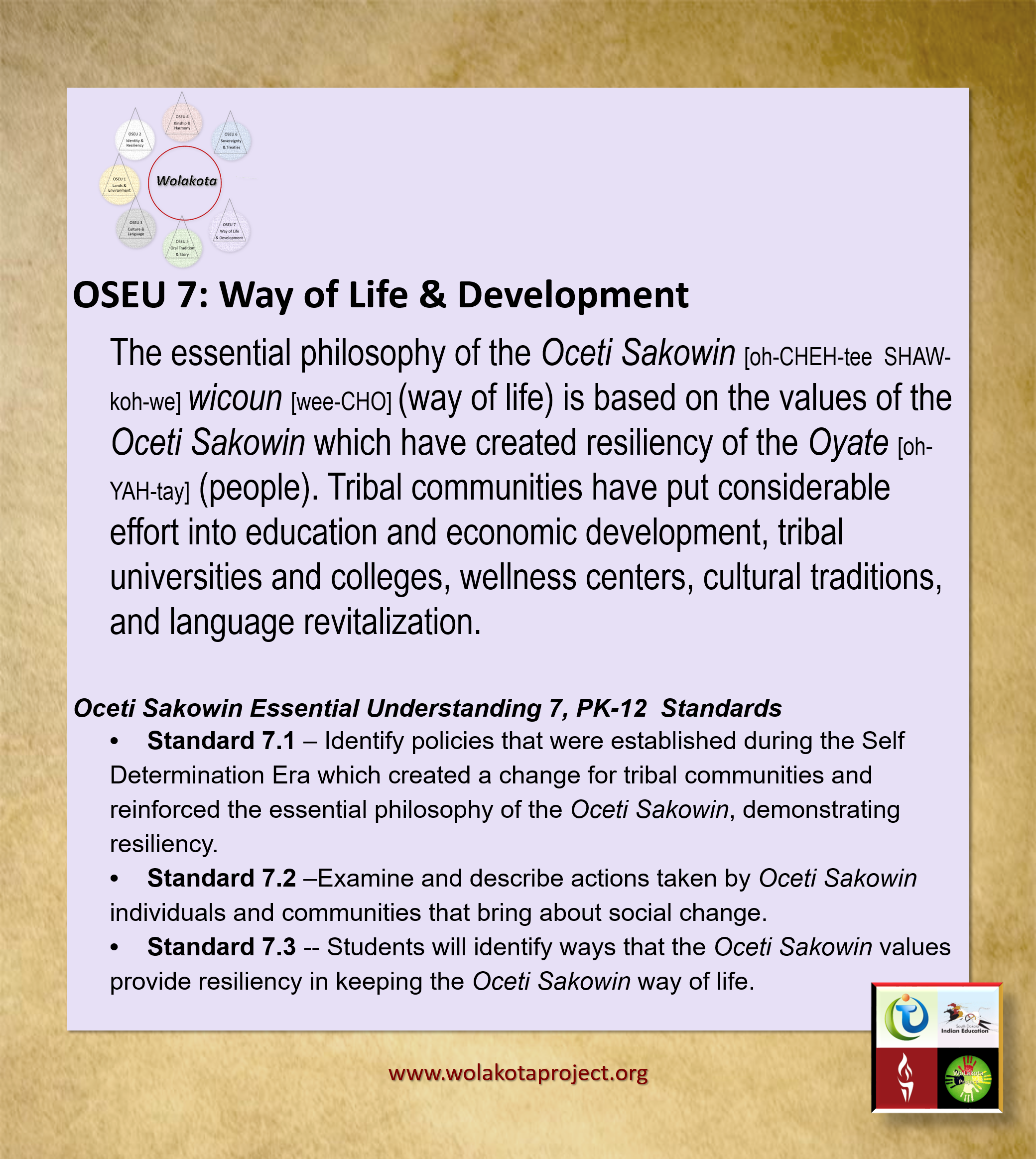
OSEU 7: Way of Life & Development
The essential philosophy of the Oceti Sakowin [oh-CHEH-tee SHAW-
koh-we] WICOUN [wee-CHO] (way Of life) is based on the values of the
Oceti Sakowin which have created resiliency of the Oyate {oh-
YAH-tay] (people). Tribal communities have put considerable
effort into education and economic development, tribal
universities and colleges, wellness centers, cultural traditions,
and language revitalization.
Oceti Sakowin Essential Understanding 7, PK-12 Standards
e« Standard 7.1 — Identify policies that were established during the Self
Determination Era which created a change for tribal communities and
reinforced the essential philosophy of the Oceti Sakowin, demonstrating
resiliency.
¢ Standard 7.2 —Examine and describe actions taken by Oceti Sakowin
individuals and communities that bring about social change.
¢ Standard 7.3 -- Students will identify ways that the Oceti Sakowin values
provide resiliency in keeping the Oceti Sakowin way of life.
www.wolakotaproject.org
Some indexed text was extracted from scanned material. Check the original source for exact wording and spelling.
Source materials
- the OSEU document here!
- Open source material
- Click Here to Complete the
- Open source material
- Click Here to Complete the “Understanding the OSEU” Survey on OSEU 6
- Open source material
- Click Here to Complete the
- the OSEU document
- OSEU Elder interview main pages
- Last Unit: Unit 6
- Finishing up 3 IDM SD Social Studies / OSEU Lessons.
- Watch Addressing OSEU 7 with Cheryl Medearis on YouTube
- Watch Addressing OSEU Six with Cheryl Medearis on YouTube
- Addressing OSEU 5 — original questions
- Addressing OSEU 6 — original questions
- Addressing OSEU 7 — original questions
Supplied transcript document. Text preserved as supplied; spellings and transcription uncertainties have not been corrected.