Interview · North Dakota · South Dakota · Gladys Hawk · OSEU 2 · NDNAEU 5
Themes: Identity & belonging, Education & learning, Values & generosity, Culture & continuity, Listening & observation, Children & young people, Intergenerational learning
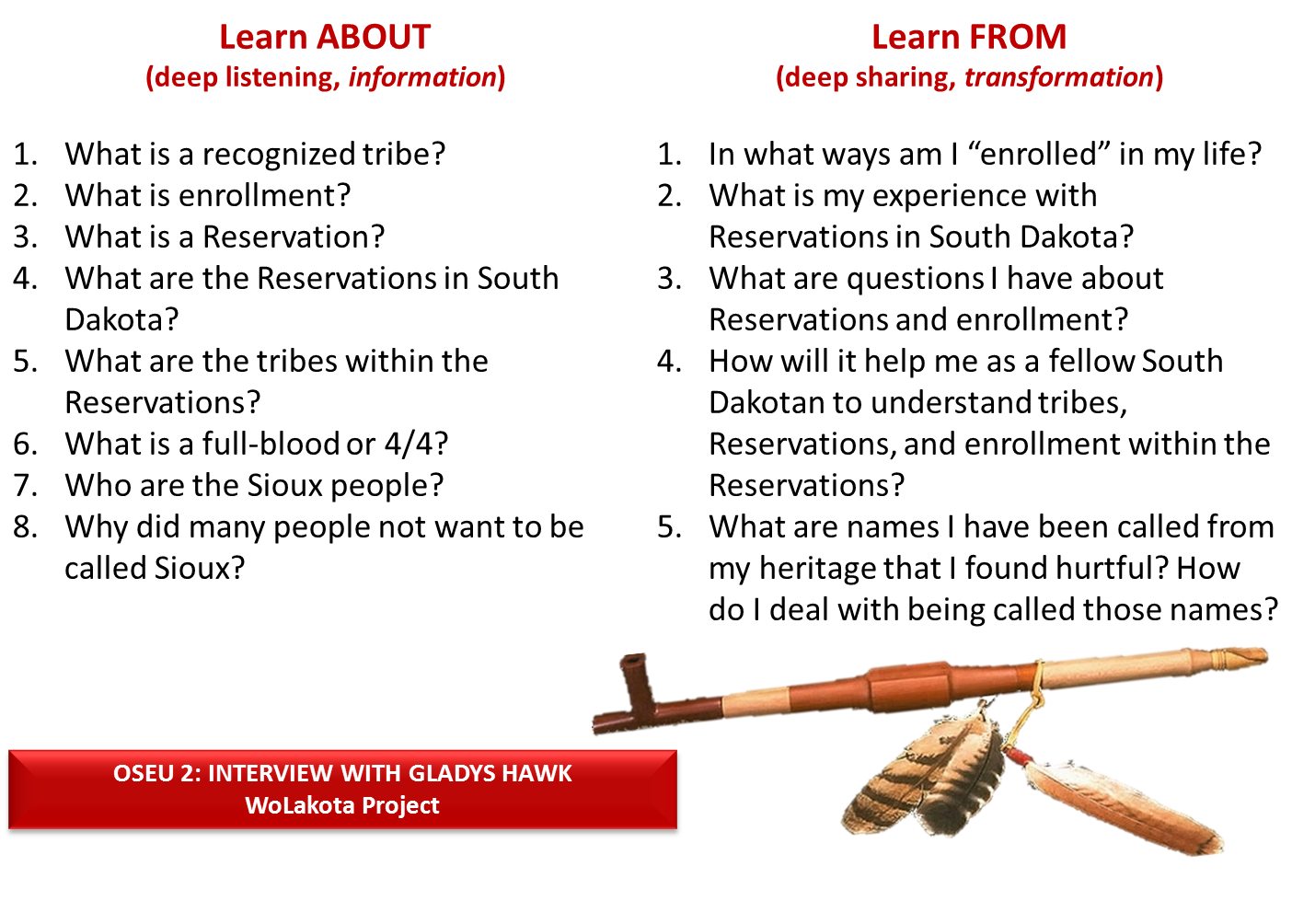
Learn About questions
1. What is a recognized tribe?
2. What is enrollment?
3. What is a Reservation?
4. What are the Reservations in North Dakota?
5. What are the tribes within the Reservations?
6. What is a full-blood or 4/4?
7. Who are the Sioux people?
8. Why did many people not want to be called Sioux?
Learn From questions
1. In what ways am I “enrolled” in my life?
2. What is my experience with Reservations in North Dakota?
3. What are questions I have about Reservations and enrollment?
4. How will it help me as a fellow North Dakotan to understand tribes, Reservations and enrollment within the Reservations?
5. What are names I have been called from my heritage that I found hurtful? How do I deal with being called those names?
Transcripts
Enrollment, Reservations & the name Sioux - Gladys Hawk - OSEU 2
Watch this interview on YouTubeThe only difference there is that some of us are called the “recognized tribe.” And by that, that means we all have to be enrolled somewhere. Enrollment means that we are a part of a reservation. For example, now I can only speak for Standing Rock, if your parents are enrolled, that’s identifying you as a member of a recognized tribe. And so… we have to explain that in some…in a softer way…I guess if I could use that word. To say that…we are Lakota people by our blood quantum, for example. That might be one way where if our parents are…we call them fullbloods which means they are
four-fourths of the Lakota…or…in probably…we were called the “Sioux” people. In later years, a lot of them didn’t like to be called that, so they changed it to “Lakota.” And the dialect would make that difference in who we are. And the Dakota are the ones who are enrolled with the Sisseton tribes and so forth. And so we were enrolled at the Standing Rock Agency. That’s where our whole form of government…that’s where they are…tribal and the bureau. And so that’s who we go to to get our children and grandchildren enrolled. If they possess…or if they can prove they are one-fourth degree of Indian.
Resource text
PWNP
ND
OSEU 2: INTERVIEW WITH GLADYS HAWK
WolLakota Project
From the current WoLakota source page:
Enrollment, Reservations & The Name Sioux
Gladys Hawk
Transcript
(deep listening, information)
(deep listening, transformation)
Teachings of Our Elders resource text:
<span data-mce-type="bookmark" style="display: inline-block; width: 0px; overflow: hidden; line-height: 0;" class="mce_SELRES_start"></span>
NDNAEU Alignment:
Some indexed text was extracted from scanned material. Check the original source for exact wording and spelling.
Source materials
Supplied transcript document. Text preserved as supplied; spellings and transcription uncertainties have not been corrected.
Additional source transcripts
Enrollment, Reservations & The Name Sioux
Enrollment, Reservations & the name Sioux - Gladys
Hawk - OSEU 2
The only difference there is that some of us are called the “recognized tribe.” And by
that, that means we all have to be enrolled somewhere. Enrollment means that we are a
part of a reservation. For example, now I can only speak for Standing Rock, if your
parents are enrolled, that’s identifying you as a member of a recognized tribe. And so…
we have to explain that in some…in a softer way…I guess if I could use that word. To
say that…we are Lakota people by our blood quantum, for example. That might be one
way where if our parents are…we call them fullbloods which means they are
four-fourths of the Lakota…or…in probably…we were called the “Sioux” people. In later
years, a lot of them didn’t like to be called that, so they changed it to “Lakota.” And the
dialect would make that difference in who we are. And the Dakota are the ones who are
enrolled with the Sisseton tribes and so forth. And so we were enrolled at the Standing
Rock Agency. That’s where our whole form of government…that’s where they
are…tribal and the bureau. And so that’s who we go to to get our children and
grandchildren enrolled. If they possess…or if they can prove they are one-fourth degree
of Indian.