Interview · North Dakota · South Dakota · Gladys Hawk · OSEU 4 · NDNAEU 7
Themes: Kinship & family, Education & learning, Values & generosity, Culture & continuity, Community & responsibility, Economy & livelihoods, Listening & observation, Children & young people, Intergenerational learning
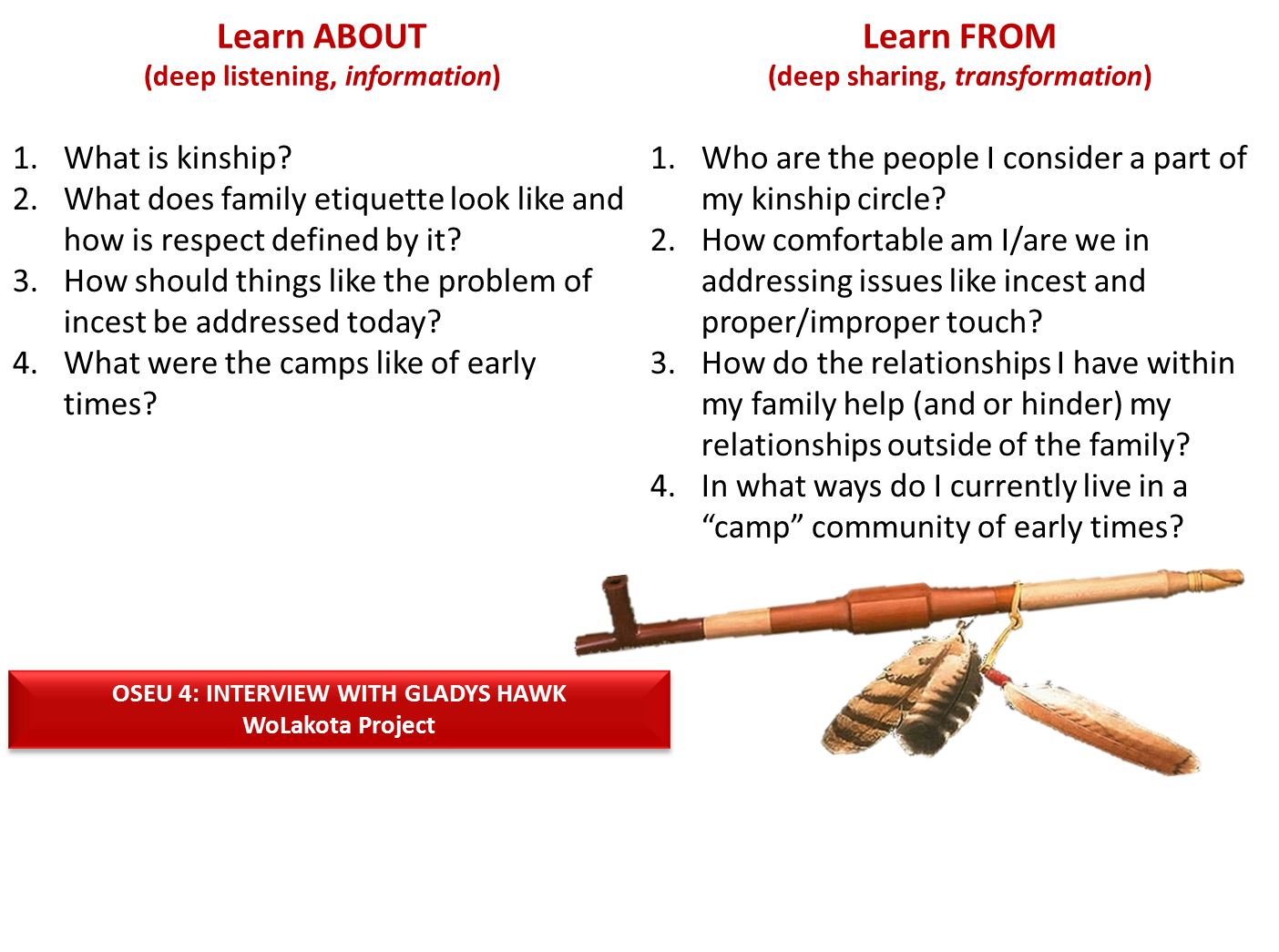
Learn About questions
1. What is kinship?
2. What does family etiquette look like and how is respect defined by it?
3. How should things like the problem of incest be addressed today?
4. What were the camps like of early times?
Learn From questions
1. Who are the people I consider a part of my kinship circle?
2. How comfortable am I/are we in addressing issues like incest and proper/improper touch?
3. How do the relationships I have within my family help (and or hinder) my relationships outside of the family?
4. In what ways do I currently live in a “camp” community of early times?
Transcripts
Kinship and Etiquette - Gladys Hawk - OSEU 4
Watch this interview on YouTubeWell, Ella DeLoria really put it across. So simple. She said kinship is the all-important matter, she said. And that says a whole lot because you came up with respect. For example, and this is probably, you might have heard this already, but like in-laws, like our son-in-laws, they couldn't speak to us but through another person. Or we couldn't speak directly, you know, to or tease our brothers like they do today. You know, that was not very, a very good etiquette, you know, within the household. And so that's called respect.
And our grandmothers and our mothers, they used to kind of scold us if we stepped out of line. You know, they'd say, you don't teach your, you don't, you don't treat your brother like that, you know. They'll say something like that, oh sorry, you know. So it's kind of a way of respecting just within our households. And then pretty soon it goes out into that community or to the church where you respect the men folks and they respect the women. And they don't do a lot of teasing, except if that's your brother-in-law or your sister-in-law.
For some reason, that part of our culture, there was some, a break there, maybe. So anyway, that's been a part of the culture that started when, back in the early, early times when people had camps, you know, there was that respect. And they had many, many camps. And I think the one thing that stands out in my mind is that you don't want your children to marry into your, your brother's children, you know. I think there was a control there. So you could go to another camp where we're not related.
Maybe they could go courting there or somebody from there can come courting over here. You know, that's such a common thing anymore. There's a lot of intermarriages that, and there could be such thing as incest that kids don't know that's not being taught in homes anymore, what the way we were taught. So that's probably going to be a problem. In fact, it is a problem. A lot of money is being poured into the special needs programs in schools, and nobody questions why.
Maybe it's because kids are related by blood, and there's that HD, whatever they call it, ADHD problems there. Or they could be kids of alcoholics, and so forth. And there's no control. And so we, as Lakota people, we need to really get on the ball and start, you know, teaching our teachers to talk about those things, you know. Maybe it's because it's causing suicides. Maybe they can't control their feelings or whatever. Why? Because maybe they're related or something. They're the same blood, you know, running in there.
There's a lot of problems to look at, as far as I'm concerned. Did I touch on that, that one, the other part? The kinship. Kinship.
Resource text
Learn ABOUT Learn FROM
(deep listening, information) (deep sharing, transformation)
1. What is kinship? 1. Who are the people | consider a part of
2. What does family etiquette look like and my kinship circle?
how is respect defined by it? 2. How comfortable am I/are we in
3. Howshould things like the problem of addressing issues like incest and
incest be addressed today? proper/improper touch?
4. What were the camps like of early 3. How do the relationships | have within
times? my family help (and or hinder) my
relationships outside of the family?
4. In what ways do | currently live ina
“camp” community of early times?
From the current WoLakota source page:
Kinship & Etiquette
Gladys Hawk
Transcript
(deep listening, information)
(deep listening, information)
Teachings of Our Elders resource text:
NDNAEU Alignment:
Some indexed text was extracted from scanned material. Check the original source for exact wording and spelling.
Source materials
Supplied transcript document. Text preserved as supplied; spellings and transcription uncertainties have not been corrected.