Interview · South Dakota · Joseph Marshall III · OSEU 3
Themes: Identity & belonging, Boarding schools & assimilation, Values & generosity, Culture & continuity, Arts & expression, Listening & observation
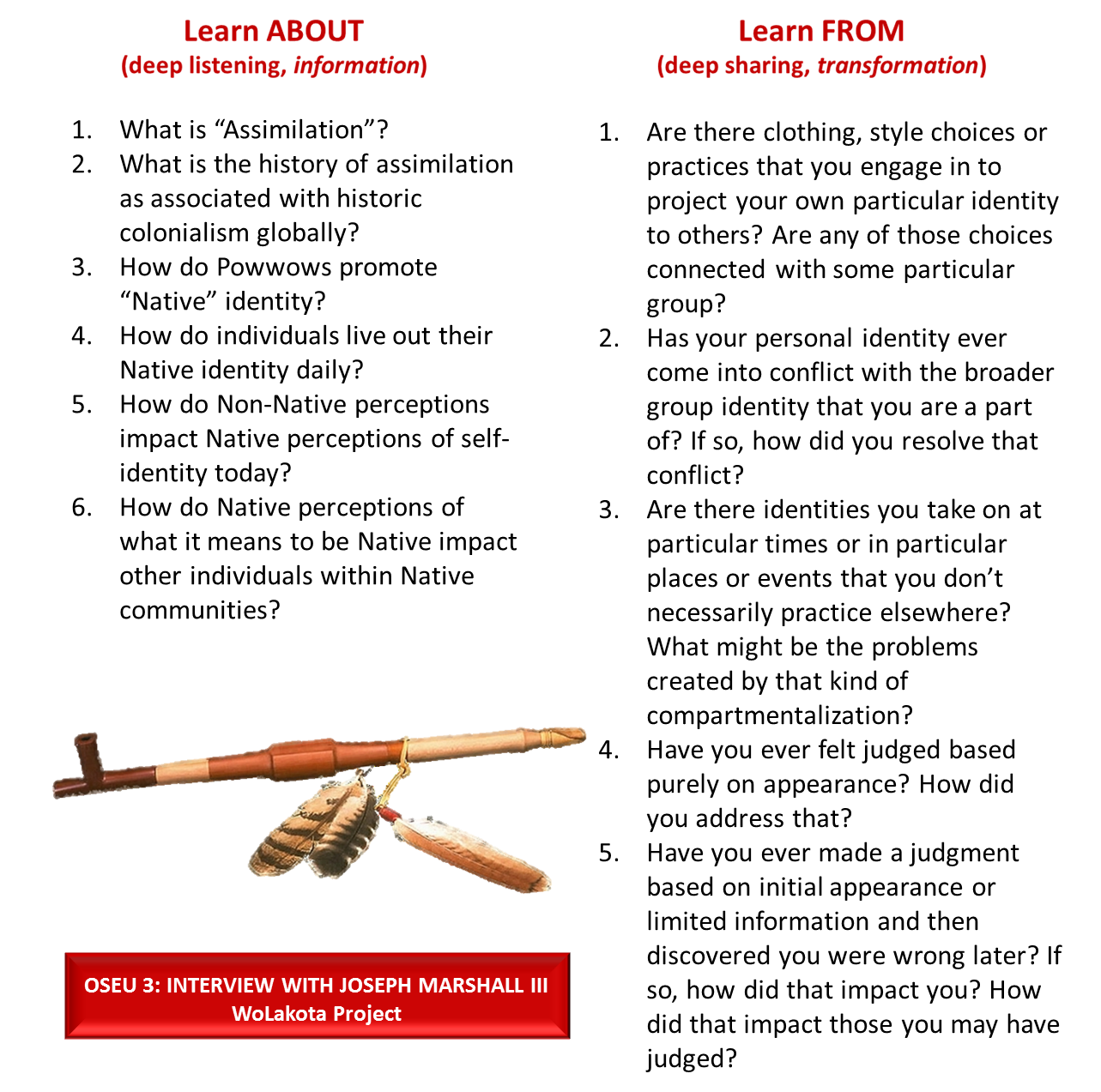
Learn About questions
What is “Assimilation”?
What is the history of assimilation as associated with historic colonialism globally?
How do Powwows promote “Native” identity?
How do individuals live out their Native identity daily?
How do Non-Native perceptions impact Native perceptions of self-identity today?
How do Native perceptions of what it means to be Native impact other individuals within Native communities?
Learn From questions
Are there clothing, style choices or practices that you engage in to project your own particular identity to others? Are any of those choices connected with some particular group?
Has your personal identity ever come into conflict with the broader group identity that you are a part of? If so, how did you resolve that conflict?
Are there identities you take on at particular times or in particular places or events that you don’t necessarily practice elsewhere? What might be the problems created by that kind of compartmentalization?
Have you ever felt judged based purely on appearance? How did you address that?
Have you ever made a judgement based on initial appearance or limited information and then discovered you were wrong later? If so, how did that impact you? How did that impact those you may have judged?
Transcripts
Lakota Every Day - Joseph Marshall III- OSEU 3
Watch this interview on YouTubeIt’s interesting to me that we, today, separate what is Lakota culture from what our everyday life is. I mean, we’re Lakota…we’ve adapted to what the realities are today. We live in square houses and drive cars…our clothing is different. Those things change. Cultures evolve. Who knows what we would have been like if we were allowed to evolve without being assimilated with the rest of the world. We would have chosen to…the convenience…to use phones and those things on our own if we had been given the opportunity. Today, I think…it’s sad to me…I’m glad it happens…it’s sad to me we set aside a certain few days to every year to be Indian…like the powwows…we put on our costumes and we watch the dancing and hear the songs. For our ancestors, it was a daily… every day…just a normal course of life…to be what they were. But that’s what life is now. We’re in the here and now. We’re just as dependent on our cell phones as any other person in the world is. That’ part of what life is…and we’ve adjusted. The physical aspects of culture…the obvious aspects of culture come up now and then. We are…we look like what we look like. Some of us are more native than others. We obviously are native. I’ve seen people driving down the road pulling a horse trailer with six horses in it…and then you see the people walking down the road with their backpack. And we’re all native. We have to adjust to whatever our situation is in this contemporary lifestyle. I think deep inside, we can incorporate what our sense of self is…what we believe in…what our values are…every day…we don’t just have to wait for powwow time, for example, to do that. We should do that every day. It should be a part of our lives.
Resource text
OSEU 3: INTERVIEW WITH JOSEPH MARSHALL III
WoLakota Project
From the current WoLakota source page:
Lakota Every Day
Joseph Marshall III
Transcript
(deep listening, information)
(deep listening, information)
Some indexed text was extracted from scanned material. Check the original source for exact wording and spelling.
Source materials
Supplied transcript document. Text preserved as supplied; spellings and transcription uncertainties have not been corrected.
Additional source transcripts
Lakota Every Day
Lakota Every Day - Joseph Marshall - OSEU 3
It’s interesting to me that we, today, separate what is Lakota culture from what our
everyday life is. I mean, we’re Lakota…we’ve adapted to what the realities are today.
We live in square houses and drive cars…our clothing is different. Those things change.
Cultures evolve. Who knows what we would have been like if we were allowed to evolve
without being assimilated with the rest of the world. We would have chosen to…the
convenience…to use phones and those things on our own if we had been given the
opportunity. Today, I think…it’s sad to me…I’m glad it happens…it’s sad to me we set
aside a certain few days to every year to be Indian…like the powwows…we put on our
costumes and we watch the dancing and hear the songs. For our ancestors, it was a
daily… every day…just a normal course of life…to be what they were. But that’s what
life is now. We’re in the here and now. We’re just as dependent on our cell phones as
any other person in the world is. That’ part of what life is…and we’ve adjusted. The
physical aspects of culture…the obvious aspects of culture come up now and then. We
are…we look like what we look like. Some of us are more native than others. We
obviously are native. I’ve seen people driving down the road pulling a horse trailer with
six horses in it…and then you see the people walking down the road with their
backpack. And we’re all native. We have to adjust to whatever our situation is in this
contemporary lifestyle. I think deep inside, we can incorporate what our sense of self
is…what we believe in…what our values are…every day…we don’t just have to wait for
powwow time, for example, to do that. We should do that every day. It should be a part
of our lives.