Interview · South Dakota · Victor Douville · OSEU 6
Themes: Land & stewardship, Kinship & family, Identity & belonging, Education & learning, Treaties & sovereignty, Values & generosity, Community & responsibility, Economy & livelihoods, Listening & observation, Children & young people, Humor & play
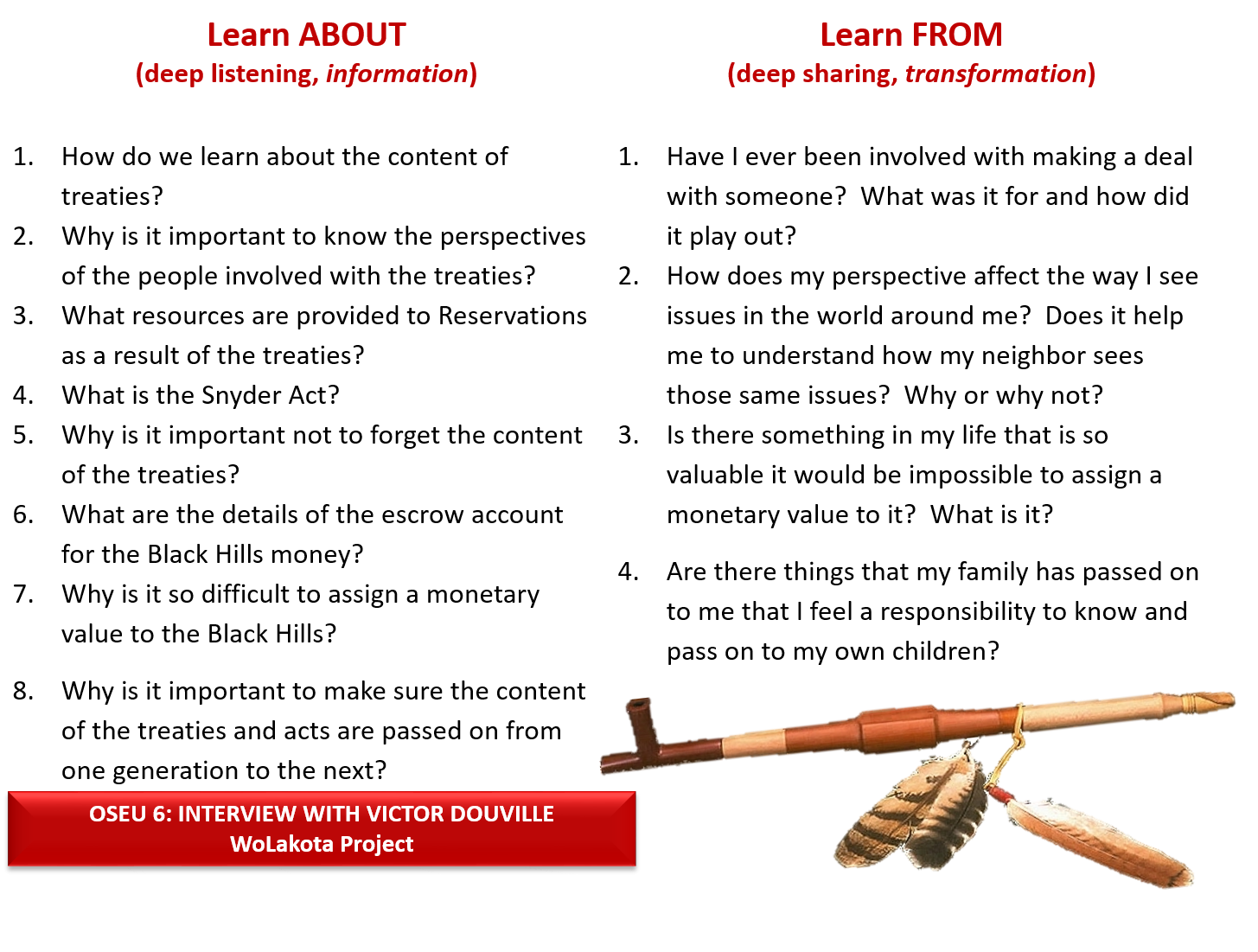
Learn About questions
How do we learn about the content of treaties?
Why is it important to know the perspectives of the people involved with the treaties?
What resources are provided to Reservations as a result of the treaties?
Why is it important not to forget the content of the treaties?
What are the details of the escrow account for the Black Hills money?
Why is it so difficult to assign a monetary value to the Black Hills?
Why is it important to make sure the content of the treaties and acts are passed on from one generation to the next?
Learn From questions
Have I ever been involved with making a deal with someone? What was it for and how did it play out?
How does my perspective affect the way I see issues in the world around me? Does it help me to understand how my neighbor sees those same issues? Why or why not?
Is there something in my life that is so valuable it would be impossible to assign a monetary value to it? What is it?
Are there things that my family has passed on to me that I feel a responsibility to know an pass on to my own children?
Transcripts
More Valuable than Money - Victor Douville - OSEU #6
Watch this interview on YouTubeThe student must know the content, as we understood them, not as the government understood them. Because when the treaties were first made, that's what the government said. The court said they have to understand the meaning from the tribal's perspective, not from the government. They reneged on that. So now we have to know the contents of them and find out how we're funded.
Because we had to give up about 100 million acres, but we brought them to court, our initial lawyer that handled Black Hills case, and then the 40 acres of unceded Indian country, that they gave away 40 million acres in order to get us on DACA for 60 million. So we have to understand that, how those treaties progressed, and what do we get from them? We get education. We get a lump sum for that. And for every 100 people, we should get a doctor. And then for every 40 students, we should get a classroom.
Those are all in the treaties.
Again, they're reneged. And also, they have to know the laws like the Snyder Act that was passed early in 1921, I believe. The Snyder Act finally made a line item for treaties. We never had a line item in there. So anybody could get up and appropriate money for the tribes. But now the line item says you can't, you have to go to the committees. We never used to have this, so the congressmen and the senators abused that money. He was with special interest groups.
So eventually, that became one of the working points in doling out money in lieu of the 100 million acres that we lost. So they took away our lifestyle and the land, so now they owe us. Personally, I don't think the Black Hills case should ever be solved, which should never be completed, because they own, they have the land that still belongs to us, and they owe us. And they should never forget that, that once we, and there's a bill out there, and work is to try to get, give us money for that, and that those Black Hills are priceless.
So treaties, we have to study them. The future generations have become smarter. For instance, when the treaties were first, we brought them to court in 1920s, and then the other in 1946 under the Indian Claims Commission Act, that they allowed for money, monies rather than land. So we have to understand that and look at that. But the initial, when it took the government to court, our lawyer had one brief case with all the contents of what attacked the treaty systems.
As time went, we had, they're advertising, one time, the four semi-trucks full of treaty papers that was to be given to the tribe, and the government said, put a microfiche. But imagine from 1946 to 1980, that was gathered, not only by white lawyers, but non-Indian lawyers, the Lakota lawyers. So it shows that we progressed, that we have Indian lawyers now that are handling the case. In the future, the young ones are going to be smarter.
Because we couldn't evaluate the land on, the price of the land on our terms, the government interpreted it, and theirs, they had their per diem all set up. So they said the black hills were 17.1, because of the pristine shape, it was never formed the way it should be. So 17.1 million acres, with a 5% simple interest, that's what they said, that after 140 years, that's how much the black hills were worth, 110 million.
But we're trying to get the gold, they would not give that up, which is 18 million silver, sterling silver taken out of the black hills, and that amounted to about $6 billion. And that's what the tribe wanted, but we could never, you know, we could never get that back, because of the way the government operated. So we refused the money. So it's still sitting escrow in both of the unceded countries, 40 million, money to get out of 40 million acres that the government took in the black hills, 17.3 million acres.
That's now built up to over a billion dollars. And that's a waiting for time to come down. We know that the government can't move them, so we're just sitting waiting, because Congress cannot afford that. And besides, the case has now gotten out of the court system, no longer can you take in the court, it has to go to Congress. So that, we're just biding time when our young ones will develop how much the black hills were worth, based on all the mathematics that they can put together.
And that's going to be things like when Spott Hill and City Bull said they need 35 buffalo a day in order to feed their camp. So you're talking about 20,000 people in seven big camps. That 35 buffalo will explode into a bigger, and then teepees are made out. How much is the value of that? I think some of our initial treaty people tell it up all that it's equivalent to a middle income family. That's how much, the least, which would be
$100,000 a year. But the government only figures out 18,000. It's a discrepancy.
So our children have to work a way of figuring it out so the government don't have to. The huge government realtors that were only interested in the service of government, that's how much they have. So our children are getting smarter, begin to know, and eventually we'll get to a point where they'll know all that. They'll be scientists and mathematicians and we'll be able to move our tribe in that area. So that's one of our dreams.
Resource text
OSEU 6: INTERVIEW WITH VICTOR DOUVILLE
WoLakota Project
From the current WoLakota source page:
More Valuable than Money
Victor Douville
Transcript
(deep listening, information)
(deep listening, information)
Some indexed text was extracted from scanned material. Check the original source for exact wording and spelling.
Source materials
Supplied transcript document. Text preserved as supplied; spellings and transcription uncertainties have not been corrected.