Interview · South Dakota · Donald Montileaux · OSEU 3
Themes: Land & stewardship, Language & revitalization, Kinship & family, Storytelling & oral tradition, Education & learning, Boarding schools & assimilation, Values & generosity, Arts & expression, Listening & observation, Intergenerational learning
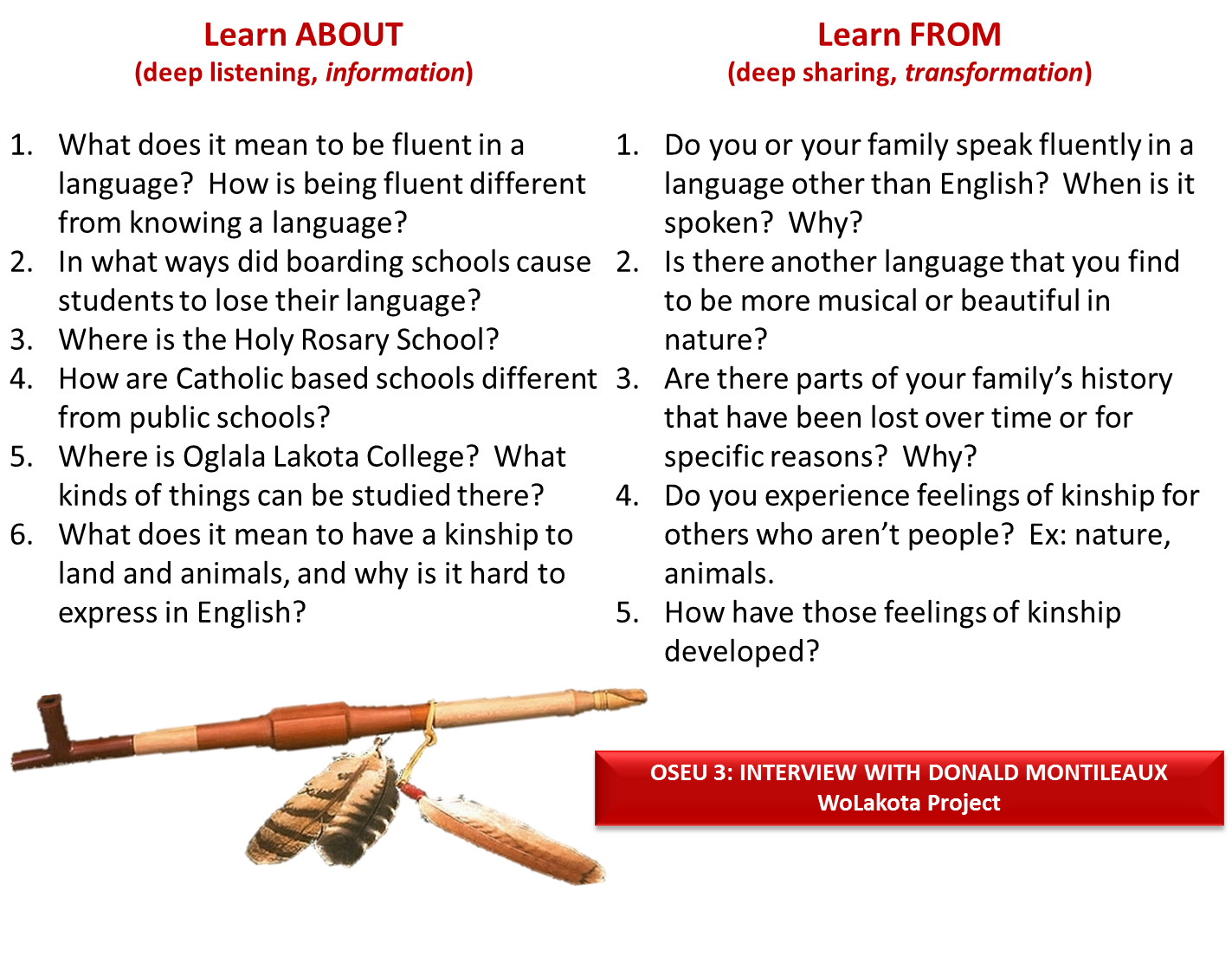
Learn About questions
What does it mean to be fluent in a language? How is being fluent different from knowing a language?
In what ways did boarding schools cause students to lose their language?
Where is the Holy Rosary School?
How are Catholic based schools different from public schools?
Where is Ogalala Lakota College? What kinds of thins can be studied there?
What does it mean to have a kinship to land and animals, and why is it hard to express in English?
Learn From questions
Do you or your family speak fluently in a language other than English? When is it spoken? Why?
Is there another language that you find to be more musical or beautiful in nature?
Are there parts of your family’s history that have been lost over time or for specific reasons? Why?
Do you experience feelings of kinship for others who aren’t people? Ex: nature, animals.
How have those feelings of kinship developed?
Transcripts
The Musicality of the Lakota Language - Donald Montileaux - OSEU 3
Watch this interview on YouTubeOur language…my father was fluent and then went to boarding school…and literally got it whipped out of him. He wouldn’t even speak Lakota anymore. And my grandfather on my mother’s side…he and my grandmother were fluent…and they spoke Lakota. And my mother didn’t because she went to Holy Rosary which was a Catholic school. My father went to a public school. I’m sure that…I don’t know if my mom every picked up the language…she used to tell me stories that my grandma and grandpa would not speak all the time…but when they were mad at each other or they were trying to get a point across real sternly, they would start talking Lakota. So therefore, I don’t have any…I have very very little Lakota that I understand. I wrote a book. In my book, I had a lady translate that, Agnes Gay. She’s the archivist at OLC [Oglala Lakota College].
When she reads those same words that I read in English, those words become musical. They take on a whole different meaning, a whole different flow. I lose myself when she’s reading. I actually lose myself in the language. And I know what she’s saying. But, it’s just more beautiful. It’s just stronger. And she would tell me that some of those words…she’d say, “Don, I can’t translate this word because in order to tell you what this word is, it would make it really long.” So she would do something else. But my book is everyday Lakota. She’s been fluent since she’s been a child. And so she said, “This is everyday Lakota.” There are so many stories.
There’s such a kinship to the land…to the animals. I don’t think we can express that kinship in English, but we can in Lakota. I know I have friends who have that spirit when they talk with those animals. Those animals still understand Lakota.
Resource text
From the current WoLakota source page:
The Musicality of the Lakota Language
Donald Montileaux
Transcript
(deep listening, information)
(deep listening, information)
Some indexed text was extracted from scanned material. Check the original source for exact wording and spelling.
Source materials
Supplied transcript document. Text preserved as supplied; spellings and transcription uncertainties have not been corrected.
Additional source transcripts
The Musicality of the Lakota Language
The Musicality of the Lakota Language - Donald
Montileaux - OSEU 3
Our language…my father was fluent and then went to boarding school…and literally got
it whipped out of him. He wouldn’t even speak Lakota anymore. And my grandfather on
my mother’s side…he and my grandmother were fluent…and they spoke Lakota. And
my mother didn’t because she went to Holy Rosary which was a Catholic school. My
father went to a public school. I’m sure that…I don’t know if my mom every picked up
the language…she used to tell me stories that my grandma and grandpa would not
speak all the time…but when they were mad at each other or they were trying to get a
point across real sternly, they would start talking Lakota. So therefore, I don’t have
any…I have very very little Lakota that I understand. I wrote a book. In my book, I had a
lady translate that, Agnes Gay. She’s the archivist at OLC [Oglala Lakota College].
When she reads those same words that I read in English, those words become musical.
They take on a whole different meaning, a whole different flow. I lose myself when she’s
reading. I actually lose myself in the language. And I know what she’s saying. But, it’s
just more beautiful. It’s just stronger. And she would tell me that some of those
words…she’d say, “Don, I can’t translate this word because in order to tell you what this
word is, it would make it really long.” So she would do something else. But my book is
everyday Lakota. She’s been fluent since she’s been a child. And so she said, “This is
everyday Lakota.” There are so many stories.
There’s such a kinship to the land…to the animals. I don’t think we can express that
kinship in English, but we can in Lakota. I know I have friends who have that spirit when
they talk with those animals. Those animals still understand Lakota.