Interview · South Dakota · Jace DeCory · OSEU 1
Themes: Land & stewardship, Kinship & family, Storytelling & oral tradition, Education & learning, Spirituality & ceremony, Values & generosity, Culture & continuity, Food & plants, Listening & observation, Intergenerational learning
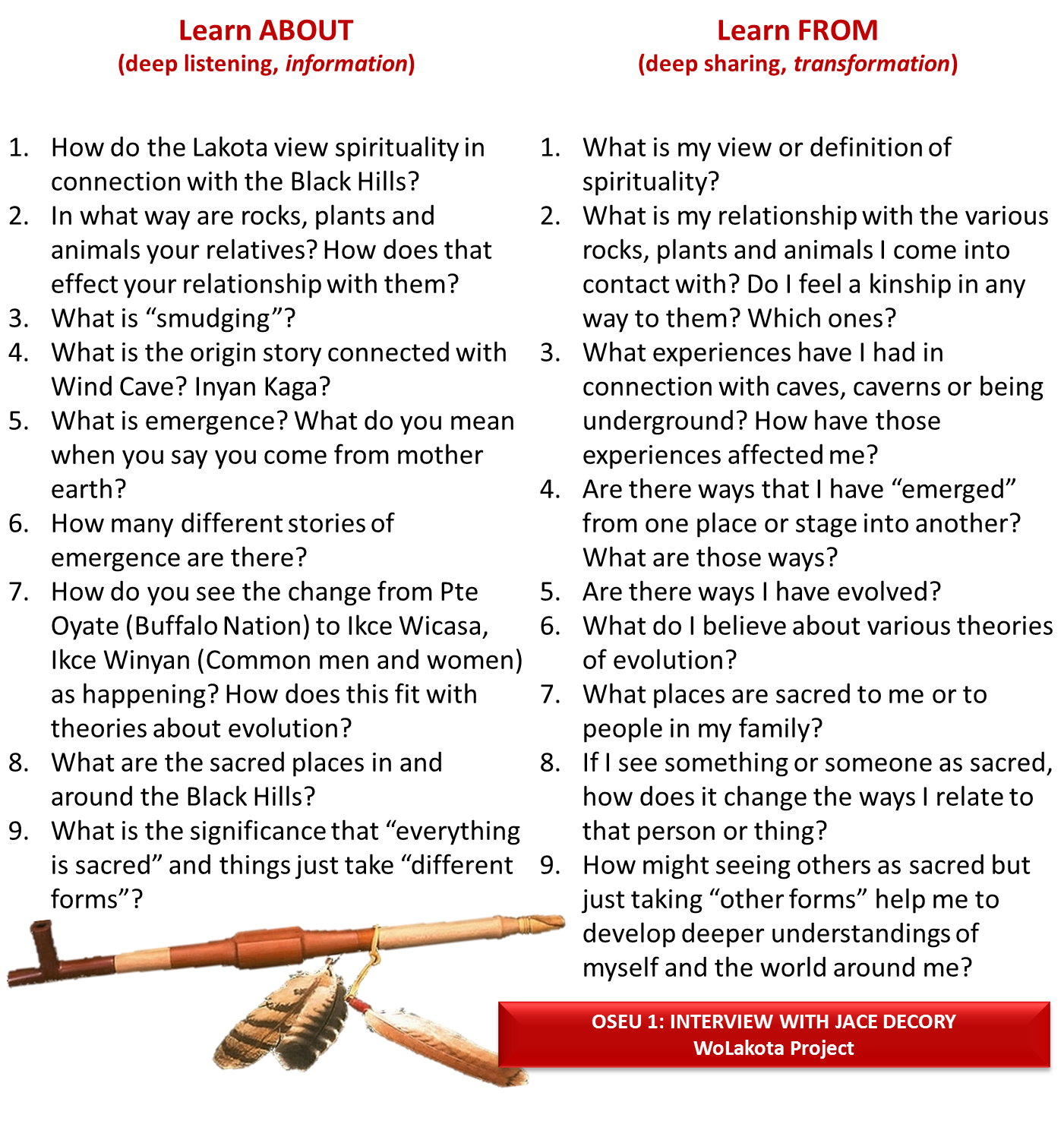
Learn About questions
1. How do the Lakota view spirituality in connection with the Black Hills?
2. In what way are rocks, plants and animals your relatives? How does that effect your relationship with them?
3. What is “smudging”?
4. What is the origin story connected with Wind Cave? Inyan Kaga?
5. What is emergence? What do you mean when you say you come from mother earth?
6. How many different stories of emergence are there?
7. How do you see the change from Pte Oyate (Buffalo Nation) to Ikce Wicasa, |kce Winyan (Common men and women) as happening? How does this fit with theories about evolution?
8. What are the sacred places in and around the Black Hills?
9. What is the significance that “everything is sacred” and things just take “different forms”?
Learn From questions
1. What is my view or definition of spirituality?
2. What is my relationship with the various rocks, plants and animals I come into contact with? Do I feel a kinship in any way to them? Which ones?
3. What experiences have I had in connection with caves, caverns or being underground? How have those experiences affected me?
4. Are there ways that I have “emerged” from one place or stage into another? What are those ways?
5. Are there ways I have evolved?
6. What do I believe about various theories of evolution?
7. What places are sacred to me or to people in my family?
8. If I see something or someone as sacred, how does it change the ways I relate to that person or thing?
9. How might seeing others as sacred but just taking “other forms” help me to develop deeper understandings of myself and the world around me?
Transcripts
Emerging and Evolving as Relatives
Watch this interview on YouTubeEmerging & Evolving as Relatives - Jace DeCory - OSEU 5
What I want to talk today about is my connection and my feelings about the land, Mokoce and the way that the Lakota people look at how we relate to the land and how the land is such an important part of our philosophy and our belief system, how we are connected by many, many different things, not only by where we're born and where we grew up and the history there, but also the spiritual connection that we have, mainly the spiritual connection that we have to the Black Hills. So I kind of want to talk about that. And the most important thing to me, besides my relatives, my human relatives, are my other relatives. My relatives that live in our environment. Here we refer to our relatives, the plants, the rocks, the trees, all of these things, all of these sacred places as our relatives. And so, when we acknowledge our relatives, like I do every morning, I acknowledge the air as my relative that I'm breathing in and out. I can wake up and breathe. I'm still alive. I acknowledge the sage and the sweetgrass that I pray with every morning as my relative. Smudge me off. Help me to think good and to think good thoughts today and to and to teach and to and to do the best that I can today. To be the best teacher and the best mother and grandmother that I can. So, every morning, I guess I greet the universe like I've been taught from my grandparents that each day is a blessing.
So when you wake up in the morning, you acknowledge it as your relative. And so that's what I do every morning. That's my prayers and my meditation and my thankfulness for being here on Mother Earth. Now the Black Hills are very special to us as Lakota people. We come from the Black Hills. We believe we came from a cave. Some people say it's Wind Cave. Some people say it's Inyan Kara over there in Wyoming. That's the cave near there in that area where we came from. Whatever cave it is, whatever…I'm not really into specifics that way. The idea is that we come from Mother Earth, and we made that emergence out from Mother Earth to live this air and breathe this air outside and to live on top of Mother Earth. Now that that's there are different stories regarding our emergence in our oral tradition. But the main thing is that we had to evolve, we had to change. We had to go through being the Pte Oyate, the Buffalo Nation people, and to evolve and to be the Hecetuke Oyate or the two legged to become Hecetuke Oyate common people, LAKOTA WORD, common men and women. But that evolution, what they call evolution in science, I guess we also believe that we evolved and became the human beings that we are today.
Resource text
OSEU 1: INTERVIEW WITH JACE DECORY
WoLakota Project
Some indexed text was extracted from scanned material. Check the original source for exact wording and spelling.
Source materials
Transcripts from supplied documents and the current WoLakota source pages. Text preserved as published.