Interview · South Dakota · David Bald Eagle · OSEU 7
Themes: Kinship & family, Storytelling & oral tradition, Values & generosity, Culture & continuity, Community & responsibility, Economy & livelihoods, Listening & observation, Self-determination & leadership, Intergenerational learning
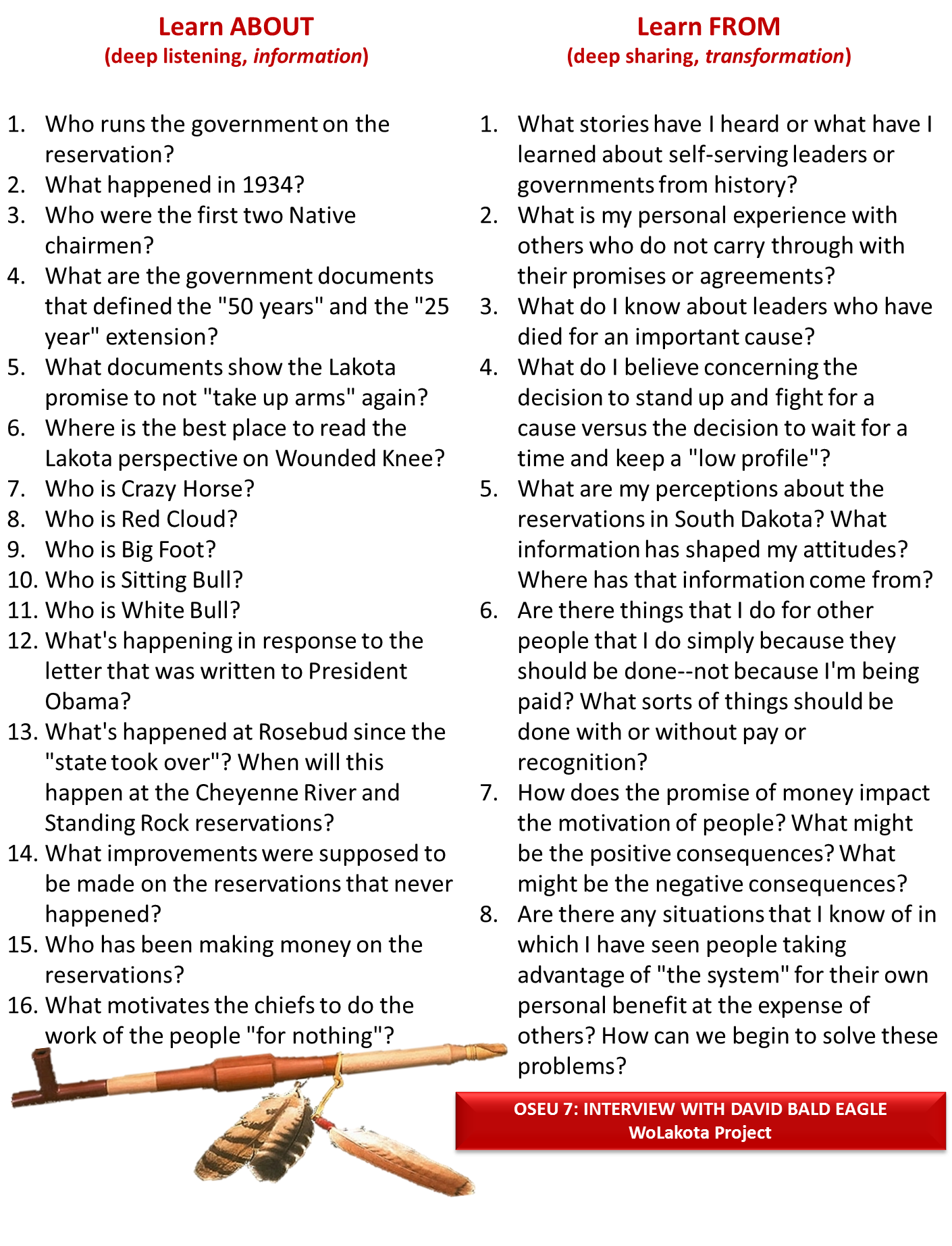
Learn About questions
Who runs the government on the reservation?
What happened in 1934?
Who were the first two Native chairmen?
What are the government documents that defined the “50 years” and the “25 year” extension?
What documents show the Lakota promise to not “take up arms” again?
Where is the best place to read the Lakota perspective on Wounded Knee?
Who is Crazy Horse?
Who is Red Cloud?
Who is Big Foot?
Who is Sitting Bull?
Who is White Bull?
What’s happening in response to the letter that was written to President Obama?
What’s happened at Rosebud since the “state took over”? When will this happen at the Cheyenne River and Standing Rock reservations?
What improvements were supposed to be made on the reservations that never happened?
Who has been making money on the reservations?
What motivates the chiefs to do the work of the people “for nothing”?
Learn From questions
What stories have I heard or what have I learned about self-serving leaders or governments from history?
What is my personal experience with others who do not carry through with their promises or agreements?
What do I know about leaders who have died for an important cause?
What do I believe concerning the decision to stand up and fight for a cause versus the decision to wait for a time and keep a “low profile”?
What are my perceptions about the reservations in South Dakota? What information has shaped my attitudes? Where has that information come from?
Are there things that I do for other people that I do simply because they should be done–not because I’m being paid? What sorts of things should be done with or without pay or recognition?
How does the promise of money impact the motivation of people? What might be the positive consequences? What might be the negative consequences?
Are there any situations that I know of in which I have seen people taking advantage of “the system” for their own personal benefit at the expense of others?How can we begin to solve these problems?
Transcripts
Reservation Governments
Watch this interview on YouTubeReservation Governments - David Bald Eagle - OSEU
#7
The people don't realize that there's about three different ways of life that we're living
here on the reservation. There's a good part of it and there's a bad part of it. And there's
some people who are really not our people that's running the governments. No Indian
president or chairman or were Indians, full-blood Indian people, men. When their time
was up, the non-Indians took over, calling it an Indian government. But we came out of
there and they gave them 50 years to improve these reservations. They gave them 50
years, the government.
Came along and they didn't do anything, just the same old reservation. And they was
going to take that government away from them then. But they begged and begged and
begged, so they gave them 25 more years to upgrade this reservation. If you can't do it,
that's the end. So they, 25 years. It was up last year. It was up, nothing has ever been
done but raise their own wages, the councilmen. That's where all the money went. And
we get 7% of it. And they get 90% of it. So now they're on the edge. The state is
stepping in to take over. I don't blame them.
But if the government really kept their word, we kept ours. We said we'll never take
arms again, fight no more. That's what crazy was. That's what he made. And we're still
living up to it, putting away our weapons. But they took our weapons away from us and
they started killing us. I got a wounded knee. But that's a conspiracy. That's not Red
Cloud's conspirator. They brought that on to kill Bigfoot. They killed Crazy Horse and
they killed Sitting Bull. And they did not kill White Bull, my grandfather, because he was
over here.
He kept a low profile, never talked. So they left him alone. But they're still, after 25
years, they're still there. But the government does not realize, they don't remember, I
don't think they remember that that was a deal that they made. The Obamas don't seem
to know about it. But now, since the Indian people wrote to Obama explaining this from
here, explaining it to them, now he's on to it. So the state took over here in Rosemont.
And next is Standing Rock and Cheyenne River. But nobody tells us about it.
They're keeping it from the Indian people. They know about it, but they think we don't
know what we know about it. Anything they hear. But we're keeping a low profile. We
don't want to bring it out. They can't blame us, the traditional people, because they're
the one that's bringing it on to themselves, by not improving the responsibility that they'd
be given if they didn't do it. So they can't. But they couldn't blame us. If we had it, it
would have been different.
We could have taken care of the people, or we just could have been way down instead
of way up like they got. They're getting $4,000 a month into work four days out of the
month. So that's how much money they're getting. But if we, the chiefs, if we had it, we
never did get any money for what we do. Instead, we do what the people want us to do.
So we still do that for nothing. We don't get paid for it.
Resource text
Additional Related Resources
Lakota Chief Biographies
From the current WoLakota source page:
Reservation Governments
David Bald Eagle
Transcript
(deep listening, information)
(deep listening, transformation)
Some indexed text was extracted from scanned material. Check the original source for exact wording and spelling.
Source materials
Transcripts from supplied documents and the current WoLakota source pages. Text preserved as published.