Interview · South Dakota · Faith Spotted Eagle · OSEU 4
Themes: Land & stewardship, Kinship & family, Identity & belonging, Education & learning, Treaties & sovereignty, Healing & resilience, Spirituality & ceremony, Values & generosity, Culture & continuity, Food & plants, Arts & expression, Community & responsibility, Listening & observation, Children & young people, Intergenerational learning
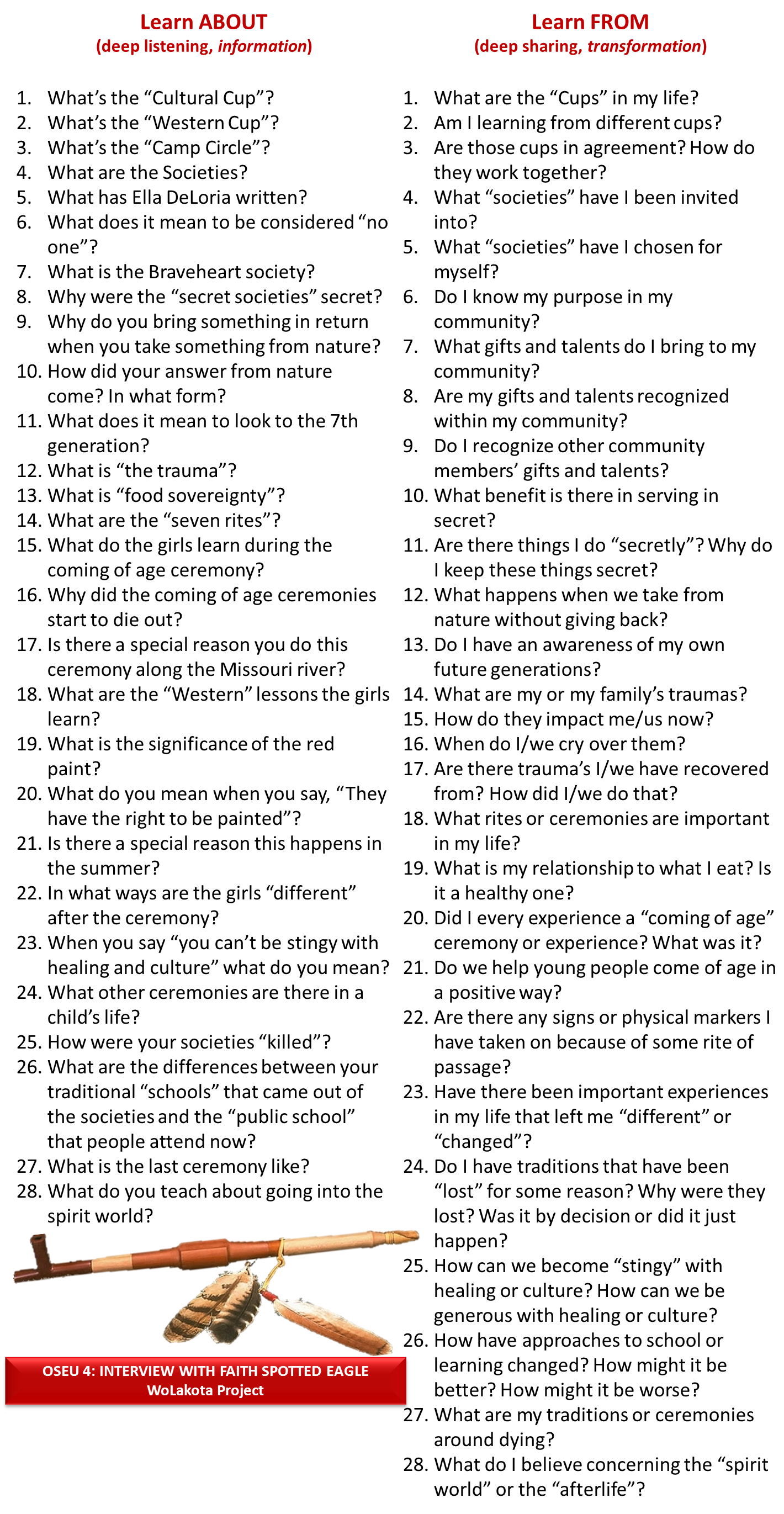
Learn About questions
What’s the “Cultural Cup”?
What’s the “Western Cup”?
What’s the “Camp Circle”?
What are the Societies?
What has Ella DeLoria written?
What does it mean to be considered “no one”?
What is the Braveheart society?
Why were the “secret societies” secret?
Why do you bring something in return when you take something from nature?
How did your answer from nature come? In what form?
What does it mean to look to the 7th generation?
What is “the trauma”?
What is “food sovereignty” ?
What are the “seven rites”?
What do the girls learn during the coming of age ceremony?
Why did the coming of age ceremonies start to die out?
Is there a special reason you do this ceremony along the Missouri river?
What are the “Western” lessons the girls learn?
What is the significance of the red paint?
What do you mean when you say, “They have the right to be painted”?
Is there a special reason this happens in the summer?
In what ways are the girls “different” after the ceremony?
When you say “you can’t be stingy with healing and culture” what do you mean?
What other ceremonies are there in a child’s life?
How were your societies “killed”?
What are the differences between your traditional “schools” that came out of the societies and the “public school” that people attend now?
What is the last ceremony like?
What do you teach about going into the spirit world?
Learn From questions
What are the “Cups” in my life?
Am I learning from different cups?
Are those cups in agreement? How do they work together?
What “societies” have I been invited into?
What “societies” have I chosen for myself?
Do I know my purpose in my community?
What gifts and talents do I bring to my community?
Are my gifts and talents recognized within my community?
Do I recognize other community members’ gifts and talents?
What benefit is there in serving in secret?
Are there things Ido “secretly”? Why do I keep these things secret
What happens when we take from nature without giving back?
Do I have an awareness of my own future generations?
What are my or my family’s traumas?
How do they impact me/us now?
When do I/we cry over them?
Are there trauma’s I/we have recovered from? How did I/we do that?
What rites or ceremonies are important in my life?
What is my relationship to what I eat? Is it a healthy one?
Did I every experience a “coming of age” ceremony or experience? What was it?
Do we help young people come of age in a positive way?
Are there any signs or physical markers I have taken on because of some rite of passage?
Have there been important experiences in my life that left me “different” or “changed”?
Do I have traditions that have been “lost” for some reason? Why were they lost? Was it by decision or did it just happen?
How can we become “stingy” with healing or culture? How can we be generous with healing or culture?
How have approaches to school or learning changed? How might it be better? How might it be worse?
What are my traditions or ceremonies around dying?
What do | believe concerning the “spirit world” or the “afterlife”?
Transcripts
Braveheart Society - Faith Spotted Eagle - OSEU #4
Watch this interview on YouTubeSo there's the cultural cup, which I learned from my grandmother that was 104 when she left, and that cultural cup dictated that when you saw your relatives you were friendly, you shook their hand, and you most assuredly talked to them from your heart. And so that was a kinship rule that there was nobody that was left out in the camp, and so you always had a place within the camp.
And I think the the order that you talked about in the camp circle, and we have this concept of the camp circle now that we're trying to bring back, and it can be either in your house, it could be in your community, but in the camp circle it said that every individual in the camp had a responsibility in a place, and one of the places that they stepped into were called societies.
And in my case it would be a woman's society, and my relative Ella Deloria, who was a well-known writer among our people, was born where I come from, and she stated that if you did not belong to a society in the camp circle then you were considered to be no one. And it wasn't that you were less than, it's just that you didn't have a responsibility to help the people. And so as you grew older you would be either recruited or you would be encouraged to go into a certain society that served a purpose in the camp.
They even had secret societies where a secret society would help somebody who didn't have food. Maybe their husband was killed and they didn't have somebody to shoot game, and somebody would, and this must have been really hard to do in a camp that was so small, or even in a neighborhood, but somebody would secretly put some food in front of her teepee, and that would really be hard to do without being known. And so they had, and in my case, I'm a member of the, what we call the Chante Ohitika Okoda Kichiya, or the Brave Heart Society.
And we were able to, through our own healing and learning, we were able to revive a traditional society on the Ihontoan Reservation called the Brave Heart Society. And we revived that in 1994. And we came to the Black Hills where we are right now. And we laid down, when we ask for something from nature, which is a natural law, we don't ask for it by just taking it, we give something in return. So we brought tobacco up here.
And we offered it to the natural world and asked for guidance on how we could take healing home, and what we could do to restore a traditional structure. And then we spent four days in the Black Hills crying about our traumas and trying to heal from them. And once we left, we knew that the whole world looked different. We went back to the reservation and along the Missouri River, and things began to happen. We, as grandmas, did this really interesting thing.
We rented a houseboat and we went down the Missouri River, and we came up with a 50-year strategic plan, which is kind of in the Western Cup, but it's kind of in the Cultural Cup too, because we always look to the seventh generation. And so we decided by the year, whatever it was, 50 years from then, that we would have a community of
Dakota-speaking people who would be claiming some of those cultural things that were lost in the trauma. So what we do every year is we look at that strategic plan and we say, okay, this is what we got to work on.
And so like right now, what we're working on in our seventh year, we are supposed to be striving to create a grocery store. And so we're supposed to do it within 15 years. So just this year, we wrote our strategic plan. We're supposed to have it done by December 31st, which is next two weeks. And by the 15th year, we're supposed to have food sovereignty by having a grocery store. And we do have gardens. We've started gardens, revived gardens in our community because we did raise corn.
And so in our traditional society, we brought back many of those things.
Probably a primary thing is that we brought back what we call the Ishnati Awichah Doampi. It's one of the seven sacred rites of the Dakota, Lakota, Nakota people. And one of those sacred rites is to have a coming of age ceremony for young girls as soon as they reach their first menses. And once they reach that stage, when their moon time comes, they put them in a separate tipi and the teaching begins for four days. The grandmas and the mothers, the sisters, the aunties come and they sit with her and they do ceremony and they teach her.
And it's probably one of the most important four days of her life where she's gonna learn about the rest of her life and how she's gonna lead it. And so when we went back from our healing in the Black Hills, we thought, what happened to that ceremony? I had it for my grandma, but we would look around and there would be some remnants of it and people would say, well, I did it with my daughter. And then the person next sitting to them would look at them with sadness and think, well, how come I didn't have it?
I don't know how to do it or I don't have the resources. So we made the decision that we would do it in a camp setting once a year. So we have done it now for going into our 16th year and we have had 101 girls go through that ceremony. And so we do it every year along the Missouri River. It's the only four days that we have with them during that sacred time. And so we try to impart as much as we can. They learn many different things that will help cope. They can cope with the rest of their lives. Some are spiritual, traditional, cultural.
Others are very Western to live in this day. And then at the end of those four days, they go through a very special ceremony where they're called out into the camp circle and they're presented to the public. And so at the very end, their forehead is painted red.
They have the right to be painted. And so that's something that we do, like I said, in the summer, and it's had an impact. And we know that those girls are different. We've been asked by three other communities to share this ceremony back to, and gift it back to them. And we've done that.
We've had a couple more communities that have come forward. And like I said earlier, you can't be stingy with healing and culture. So we're making plans to help them revive their coming of age ceremony this coming summer. So we'll be working on that. And then there's other ceremonies in the whole progression of a child's life. Those ceremonies help teach the women what ceremonies you had to impart to your child.
And so when you were part of a certain society, you were always, it was our school.
When our societies were essentially killed, then we stepped into the public school system. So now what we were doing is we're reviving our school and being able to say, this is how you walk as a proud Dakota woman or whatever tribe, because all the tribes had their ceremonies. So when we got together, we thought, okay, what are the first ceremonies? How do we need to do it as they walk all through life? And then the final ceremony of life, of course, is when you go into the spirit world. That's the last ceremony.
Resource text
DAU PWNE
oo ™N
10.
11.
12.
13.
14.
15.
16.
17.
18.
19.
20.
21.
22.
23.
24.
25.
26.
27.
28.
OSEU 4: INTERVIEW WITH FAITH SPOTTED EAGLE
WoLakota Project
27.
From the current WoLakota source page:
Braveheart Society
Faith Spotted Eagle
Transcript
(deep listening, information)
(deep listening, information)
Some indexed text was extracted from scanned material. Check the original source for exact wording and spelling.
Source materials
Supplied transcript document. Text preserved as supplied; spellings and transcription uncertainties have not been corrected.