Interview · South Dakota · Jace DeCory · OSEU 3
Themes: Language & revitalization, Kinship & family, Identity & belonging, Education & learning, Spirituality & ceremony, Values & generosity, Culture & continuity, Arts & expression, Listening & observation, Children & young people
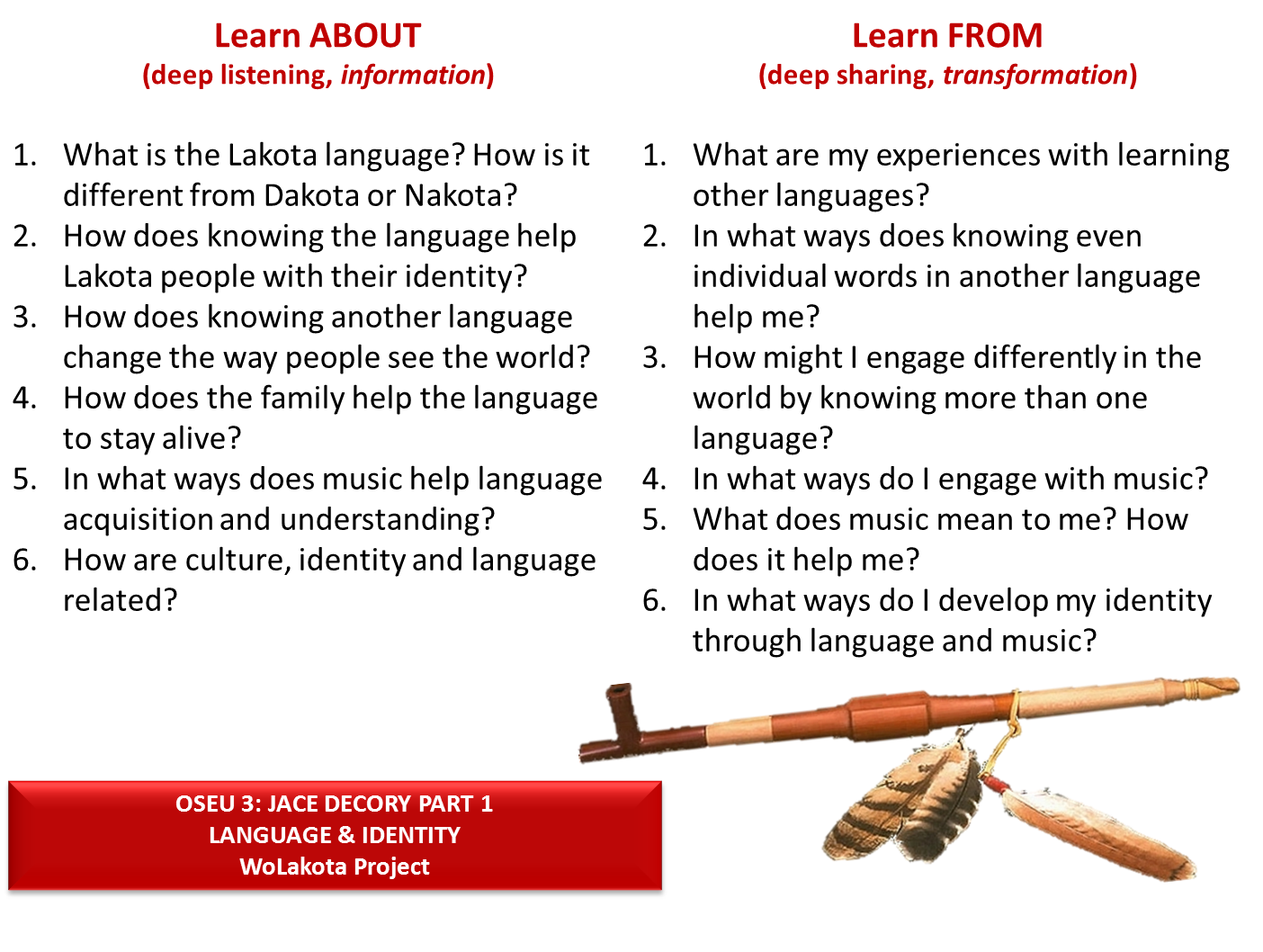
Learn About questions
What is the Lakota language? How is it different from Dakota and Nakota?
How does knowing the language help Lakota people with their identify?
How does knowing another language change the way people see the world?
How does the family help the language to stay alive?
In what ways does music help language acquisition and understanding?
How are culture, identity and language related?
Learn From questions
(deep listening, information
What are my experiences with learning other languages?
In what ways does knowing even individual words in another language help me?
How might I engage differently in the world by knowing more than one language?
In what ways do I engage with music?
What does music mean to me? How does it help me?
In what ways do I develop my identity through language and music?
Transcripts
Language & Identity - Jace DeCory - OSEU 3
Watch this interview on YouTubeWell, when I mentioned identity, I think that’s a big part of who anyone is. Their culture is their way of life…how they look at the world…how they view the world. If you don’t have that philosophical base, a Lakota base of how we look at the world, then there’s a little bit missing from you as a person, your identity. If you don’t know the language, you should try to know at least some of the language. Luckily, a lot of our young people have Lakota language classes now. In fact, Rosie Little Thunder is teaching Lakota language at Black Hills State as I’m sitting here. Half the kids in that class are native, and half are non-native. They're trying to…looking at…knowing another language and seeing the world through that language is different. When I learned different Lakota words…and try to translate them to others in English, it’s not the same. It loses so much. If young people would try it…and I think they are…I think they are trying to learn the language. I hope it’s not a lost language. I hope we don’t lose it. We have people at Tiospaye and other organizations…teachers that are teaching at the colleges and the elementary schools and all that…at the high schools…that are trying to keep the language alive. I think where it’s going to stay…you know maintenance…I think where it’s going to stay alive is with the families at home. I think that’s a real…it has to be encouraged and… I have one friend that lives down in Yankton, or Marty, down there in East River some ways…with her kids and her extended family, they have culture night at their house where everybody comes and they can’t…nobody can speak English.
They have to speak all in Lakota or Dakota. And everything…they all have to communicate in that language. So they are forced to learn it…otherwise they don’t understand what is going on. But…I’m not saying everybody has to do that. If people see the importance of it, then they’ll do what they need to do to keep it alive. My boys are learning the language through the songs, the music…because a lot of our songs are in Lakota. In fact, I’ll be honest with you, I think Junior and Dawson know more Lakota than I do now because of the sacred songs they sing at sundance and the powwow songs that they learned. In fact, they are even learning Cree songs. They really like the Cree language. I think it’s real difficult. But they’re learning that…when they go to powwows and there’s a Cree drum there, they’ll go up there and say, “Can you translate this song for me?” But, that’s something you have to do. And it is part of your identity. If you think it is important to know a language, then do it. The parents…the people around these kids…have to encourage that as well and say, “Yes, that’s valuable. That’s a valuable thing for you to do.” And encourage that kind of behavior…because culture, traditions, language, and identity…it all works together.
Resource text
Additional Related Resources
Dakota Wicohan
Lakota Language
OSEU 3: JACE DECORY PART 1
LANGUAGE & IDENTITY
WolLakota Project
Some indexed text was extracted from scanned material. Check the original source for exact wording and spelling.
Source materials
Supplied transcript document. Text preserved as supplied; spellings and transcription uncertainties have not been corrected.