Interview · South Dakota · Faith Spotted Eagle · OSEU 7
Themes: Land & stewardship, Kinship & family, Spirituality & ceremony, Values & generosity, Culture & continuity, Arts & expression, Community & responsibility, Listening & observation, Intergenerational learning
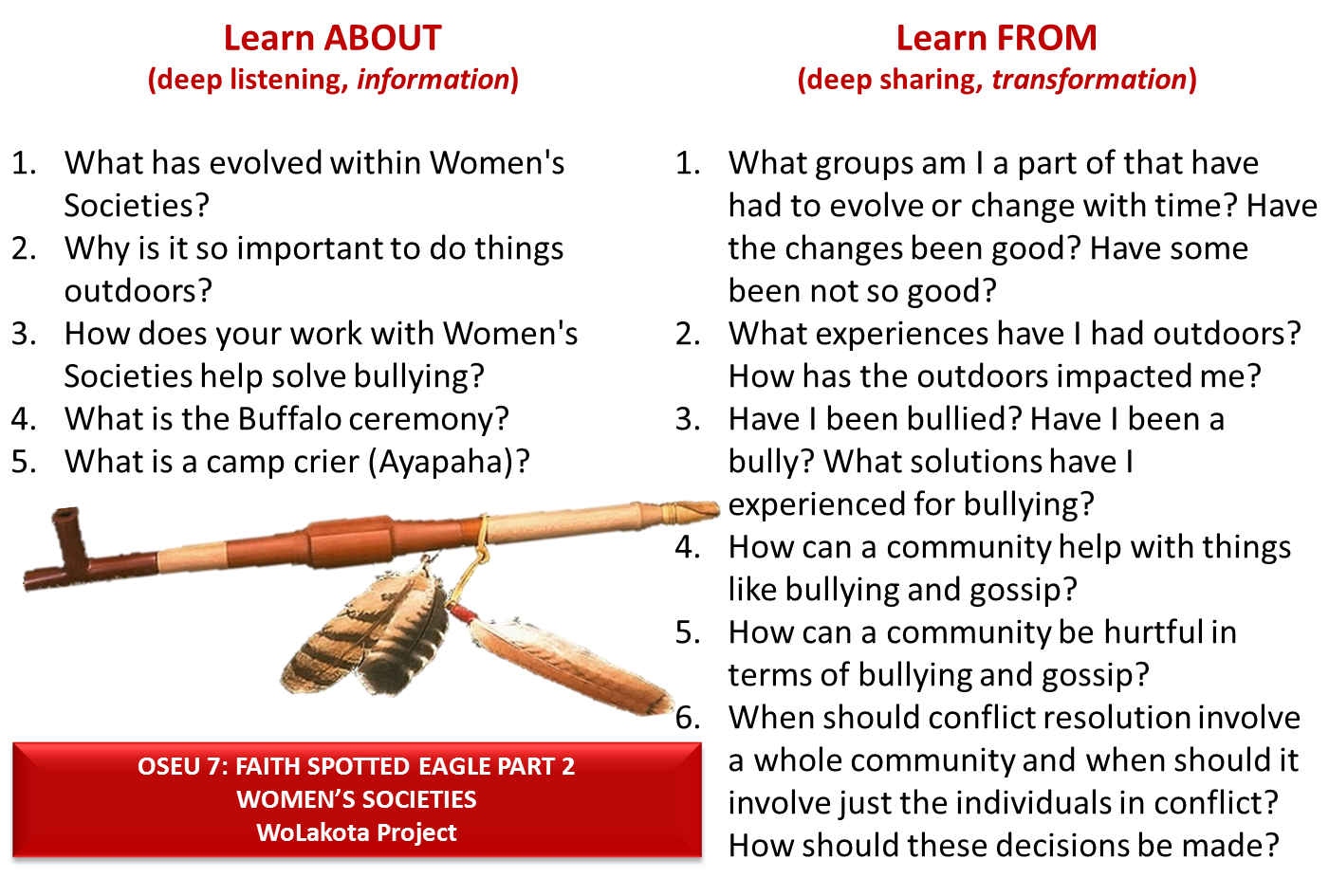
Learn About questions
What has evolved within Women’s Societies?
Why is it so important to do things outdoors?
How does your work with Women’s Societies help solve bullying?
What is the Buffalo ceremony?
What is a camp crier (Ayapaha)?
Learn From questions
What groups am I a part of that have had to evolve or change with time? Have the changes been good? Have some been not so good?
What experiences have I had outdoors? How has the outdoors impacted me?
Have I been bulled? Have I been a bully? What solutions have I experienced for bullying?
How can a community help with things like bullying and gossip?
How can a community be hurtful in terms of bullying and gossip?
When should conflict resolution involve a whole community and when should it involve just the individuals in conflict? How should these descions be made?
Transcripts
Pt 2 Women's Societies - Faith Spotted Eagle - OSEU 7
Watch this interview on YouTubeIn regard to women's society, they also are evolving. So some of the things that may have been true in my grandmother's age and my great-grandmother's age may have evolved to a different place. And that's OK, as long as we are respectful and trying our best. Because we live in a different world, but the thing that will keep us true is the outdoors. So whenever we do any kind of a women's society gathering, we try to do it outdoors so we can listen to the stars and watch them and hear nature speaking to us, because then that keeps us on track.
So a lot of the camps and things that we do or our ceremonies that we practice, like the sun dance, everything is done outside. And so the same thing is true of women's societies. I think that the last thing that I would like to say about the women's societies is that it was probably the most single deterrent to what America calls bullying now, because the girl-on-girl aggression that is happening in America, it was not allowed in camps.
In fact, we had a buffalo ceremony that Auntie Ella describes where if there was somebody in the camp that was gossiping about another girl, or say for an example, sometimes maybe a young man made a statement about a young girl that he had relations with her. And it was entirely unfounded, and the girl knew it. She could go back and tell her mother that he was saying things that were untrue. And so what the mother would do is she would send a camp crier out, El Ayapaha.
And he would go through the camp, and he'd say, everybody, you need to come out here in the camp circle, and we're going to put a buffalo robe out here. And what would happen is that the mother would talk to her daughter, and she would say, are you sure now? Are you certain that this is just, he's just not, this is a lie? And if she said, yes, I'm certain, then she would take her daughter out there, and she would put her on that buffalo robe, and she would say, here, behold, is my daughter. I love her. She is pure.
And if any of you have cause to step forth, you do that now. And if you don't, from this day forward, you have no right to say anything about my daughter. And the whole camp would be standing there. And everybody would agree, including the elders and everybody, that that individual or any individual would have no right to say anything about it. And of course, the girl would better hope that that is the truth, because it would be out in the whole camp circle. And so that was the way that they dealt with the gossip.
And on the girl-on-girl violence, which I know is a problem in America, the aunties and the sisters would intervene. And I've experienced that in the camps that we've had in the last 18 years in working with Brave Heart Society. That will come up, and the girls will do it, because they've been influenced by Western society, that's just what you do to other girls. And then we will grab them and we'll say, Takoja, this is so non-Dakota. This is not what we do. And so we're able to address that in our society.
And so I think that is a really impactful thing, because really, bullying is a rule of a violent culture. And it's something that is promoted in violent countries. And so those societies can address it on a smaller scale.
Resource text
4.
5.
Learn ABOUT Learn FROM
(deep listening, information) (deep sharing, transformation)
What has evolved within Women's 1. What groups am | a part of that have
Societies? had to evolve or change with time? Have
Why is it so important to do things the changes been good? Have some
outdoors? been not so good?
How does your work with Women's 2. What experiences have | had outdoors?
Societies help solve bullying? How has the outdoors impacted me?
What is the Buffalo ceremony? 3. Havel been bullied? Have | beena
What is a camp crier (Ayapaha)? bully? What solutions have |
experienced for bullying?
Ls How can a community help with things
if) like bullying and gossip?
a, 5. Howcan a community be hurtful in
_ terms of bullying and gossip?
6. When should conflict resolution involve
OSEU 7: FAITH SPOTTED EAGLE PART 2 a whole community and when should it
WOMEN’S SOCIETIES involve just the individuals in conflict?
WSLS 3a: How should these decisions be made?
From the current WoLakota source page:
Women’s Societies
Faith Spotted Eagle
Transcript
(deep listening, information)
(deep listening, transformation)
Some indexed text was extracted from scanned material. Check the original source for exact wording and spelling.
Source materials
Supplied transcript document. Text preserved as supplied; spellings and transcription uncertainties have not been corrected.
Additional source transcripts
Women’s Societies
Pt 2 Women's Societies - Faith Spotted Eagle - OSEU
7
In regard to women's society, they also are evolving. So some of the things that may
have been true in my grandmother's age and my great-grandmother's age may have
evolved to a different place. And that's OK, as long as we are respectful and trying our
best. Because we live in a different world, but the thing that will keep us true is the
outdoors. So whenever we do any kind of a women's society gathering, we try to do it
outdoors so we can listen to the stars and watch them and hear nature speaking to us,
because then that keeps us on track.
So a lot of the camps and things that we do or our ceremonies that we practice, like the
sun dance, everything is done outside. And so the same thing is true of women's
societies. I think that the last thing that I would like to say about the women's societies is
that it was probably the most single deterrent to what America calls bullying now,
because the girl-on-girl aggression that is happening in America, it was not allowed in
camps.
In fact, we had a buffalo ceremony that Auntie Ella describes where if there was
somebody in the camp that was gossiping about another girl, or say for an example,
sometimes maybe a young man made a statement about a young girl that he had
relations with her. And it was entirely unfounded, and the girl knew it. She could go back
and tell her mother that he was saying things that were untrue. And so what the mother
would do is she would send a camp crier out, El Ayapaha.
And he would go through the camp, and he'd say, everybody, you need to come out
here in the camp circle, and we're going to put a buffalo robe out here. And what would
happen is that the mother would talk to her daughter, and she would say, are you sure
now? Are you certain that this is just, he's just not, this is a lie? And if she said, yes, I'm
certain, then she would take her daughter out there, and she would put her on that
buffalo robe, and she would say, here, behold, is my daughter. I love her. She is pure.
And if any of you have cause to step forth, you do that now. And if you don't, from this
day forward, you have no right to say anything about my daughter. And the whole camp
would be standing there. And everybody would agree, including the elders and
everybody, that that individual or any individual would have no right to say anything
about it. And of course, the girl would better hope that that is the truth, because it would
be out in the whole camp circle. And so that was the way that they dealt with the gossip.
And on the girl-on-girl violence, which I know is a problem in America, the aunties and
the sisters would intervene. And I've experienced that in the camps that we've had in
the last 18 years in working with Brave Heart Society. That will come up, and the girls
will do it, because they've been influenced by Western society, that's just what you do to
other girls. And then we will grab them and we'll say, Takoja, this is so non-Dakota. This
is not what we do. And so we're able to address that in our society.
And so I think that is a really impactful thing, because really, bullying is a rule of a
violent culture. And it's something that is promoted in violent countries. And so those
societies can address it on a smaller scale.