Interview · South Dakota · Stephanie Charging Eagle · OSEU 4
Themes: Kinship & family, Spirituality & ceremony, Values & generosity, Listening & observation
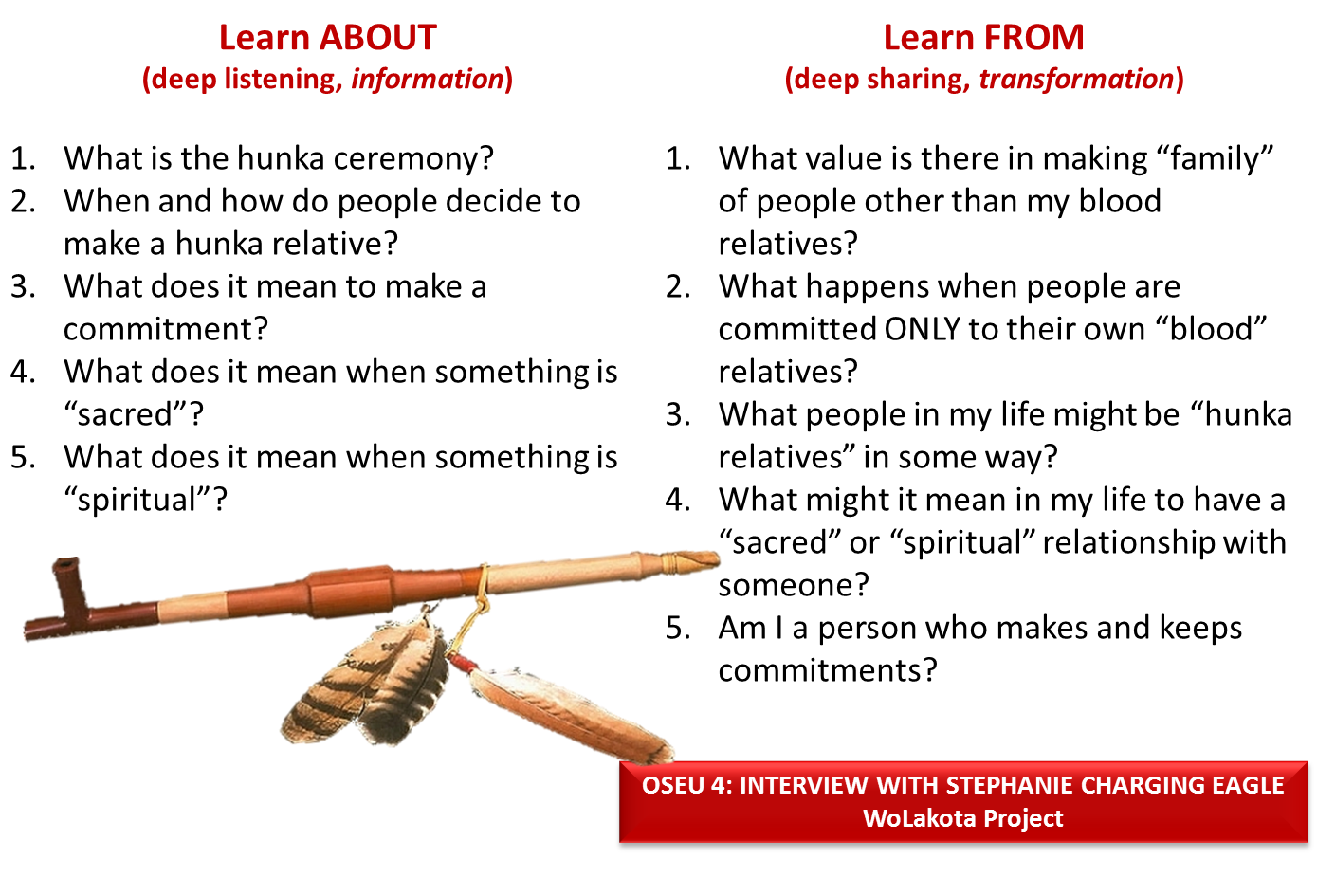
Learn About questions
What is the hunka ceremony?
When and how do people decide to make a hunka relative?
What does it mean to make a commitment?
What does it mean when something is “sacred”?
What does it mean when something is “spiritual”?
Learn From questions
What value is there in making “family” of people other than my blood relatives?
What happens when people are committed ONLY to their own “blood” relatives?
What people in my life might be “hunka relatives” in some way?
What might it mean in my life to have a “sacred” or “spiritual” relationship with someone?
Am I a person who makes and keeps commitments?
Transcripts
Hunka Relatives - Stephanie Charging Eagle - OSEU #4
Watch this interview on YouTubeYou are in some way related to somebody, and that comes first before anything else. And by blood we are related. We do what we need to do with each other. You take care of each other, but when you take on a relative willingly and by choice, that relationship is even more sacred. It's even more of a commitment because now you're by choice, or by some circumstance, bringing a relative in to your [Lakota Word].
It was put to me, that if you make a relative through the Hunka ceremony, which is a ceremony which is very spiritual also, but when the commitment, I was told by my my father and my mother, is that if you bring in somebody into your family and make them a relative. If one is to get sick, if your sister over here, your blood sister is sick, and then the relative who may be a sister also is sick over here, who would you have to take care of first? And with the Hunka relationship, you go to the sister you brought into the family, because the sister here has your family there taking care of her.
So your first commitment, your commitment is to the sister over there, to the relative who you brought in to take care of them, because now they become more. That relationship is one that is very spiritual, but also one of commitment and and vice versa.
Resource text
Learn ABOUT Learn FROM
(deep listening, information) (deep sharing, transformation)
1. What is the hunka ceremony? 1. What value is there in making “family”
2. When and how do people decide to of people other than my blood
make a hunka relative? relatives?
3. What does it mean to make a 2. What happens when people are
commitment? committed ONLY to their own “blood”
4. What does it mean when something is relatives?
“sacred”? 3. What people in my life might be “hunka
5. What does it mean when something is relatives” in some way?
“spiritual”? 4. What might it mean in my life to have a
“sacred” or “spiritual” relationship with
someone?
5. Amla person who makes and keeps
commitments?
OSEU 4: INTERVIEW WITH STEPHANIE CHARGING EAGLE
WoLakota Project
From the current WoLakota source page:
Hunka Relatives
Stephanie Charging Eagle
Transcript
(deep listening, information)
(deep listening, information)
Some indexed text was extracted from scanned material. Check the original source for exact wording and spelling.
Source materials
Supplied transcript document. Text preserved as supplied; spellings and transcription uncertainties have not been corrected.
Additional source transcripts
Hunka Relatives
Hunka Relatives - Stephanie Charging Eagle - OSEU #4
You are in some way related to somebody, and that comes first before anything else. And by blood we are related. We do what we need to do with each other. You take care of each other, but when you take on a relative willingly and by choice, that relationship is even more sacred. It's even more of a commitment because now you're by choice, or by some circumstance, bringing a relative in to your [Lakota Word].
It was put to me, that if you make a relative through the Hunka ceremony, which is a ceremony which is very spiritual also, but when the commitment, I was told by my my father and my mother, is that if you bring in somebody into your family and make them a relative. If one is to get sick, if your sister over here, your blood sister is sick, and then the relative who may be a sister also is sick over here, who would you have to take care of first? And with the Hunka relationship, you go to the sister you brought into the family, because the sister here has your family there taking care of her.
So your first commitment, your commitment is to the sister over there, to the relative who you brought in to take care of them, because now they become more. That relationship is one that is very spiritual, but also one of commitment and and vice versa.