Interview · South Dakota · Lydia Whirlwind Soldier · OSEU 2
Themes: Identity & belonging, Education & learning, Values & generosity, Culture & continuity, Listening & observation, Children & young people
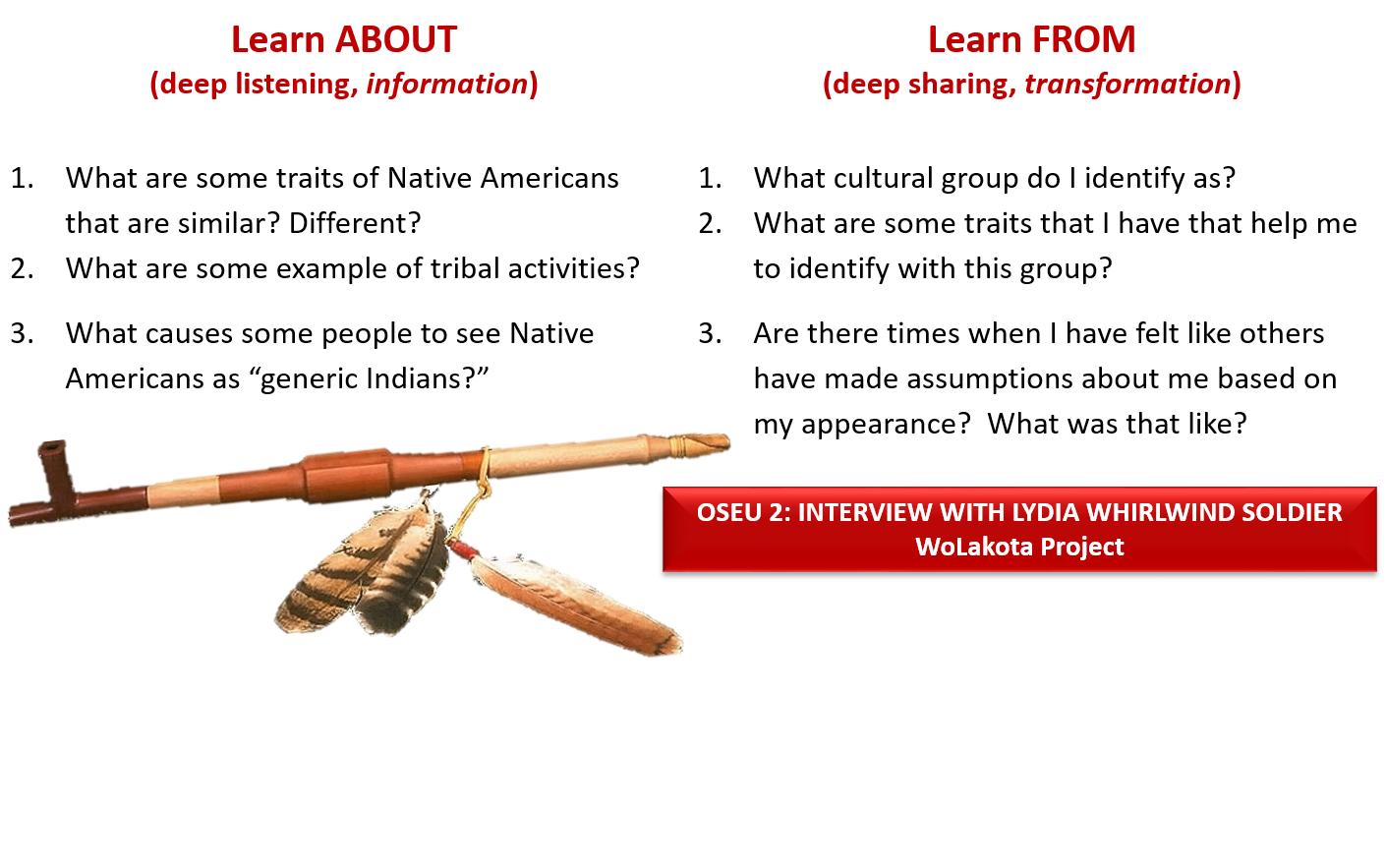
Learn About questions
(deep listening, information)
1. What are some traits of Native Americans
that are similar? Different?
2. What are some example of tribal activities?
3. What causes some people to see Native
Americans as “generic Indians?”
Learn From questions
(deep sharing, transformation)
What cultural group do | identify as?
What are some traits that | have that help me
to identify with this group?
3. Are there times when | have felt like others
have made assumptions about me based on
my appearance? What was that like?
Transcripts
There Is No Generic Indian - Lydia Whirlwind Soldier - OSEU #2
Watch this interview on YouTubeMany tribes…we all have distinct differences. As individuals, we also have distinct traits. We’re individuals. Many times, Native Americans are judged by what you do. That makes it very hard on our children because they are labeled.
And when they go into the educational system, sometimes they are already labeled. They are mostly derogatory labels. We want people to really look at our children, look at our people as individuals. We are proud that we belong to a nation of people. We are proud of that. We take a lot of pride in it.
We really participate in our tribal activities to show that we are a part of that group. But, we are still individuals and there is no generic Indian. Some people think that we all look alike. Really I don’t think we do. Even our physical appearance…they all expect us to all have long black hair…straight hair…and other physical attributes. But we all have individual differences…in our personalities…in our physical appearance…in our personalities.
Hopefully, when the teachers look at our children, they will look at them as individuals and not as a generic Indian.
Resource text
Learn ABOUT Learn FROM
(deep listening, information) (deep sharing, transformation)
1. What are some traits of Native Americans 1. What cultural group do | identify as?
that are similar? Different? 2. What are some traits that | have that help me
2. What are some example of tribal activities? to identify with this group?
3. What causes some people to see Native 3. Are there times when | have felt like others
Americans as “generic Indians?” have made assumptions about me based on
my appearance? What was that like?
, OSEU 2: INTERVIEW WITH LYDIA WHIRLWIND SOLDIER
\ ae WoLakota Project
From the current WoLakota source page:
There Is No Generic Indian
Lydia Whirlwind Soldier
Transcript
(deep listening, information)
(deep listening, transformation)
Source alignments
The current website repeats questions from the Pearl Kennedy-Colombe interview. The original Lydia Whirlwind Soldier question page is retained for this interview.
Some indexed text was extracted from scanned material. Check the original source for exact wording and spelling.
Source materials
Supplied transcript document. Text preserved as supplied; spellings and transcription uncertainties have not been corrected.
Additional source transcripts
There Is No Generic Indian
There Is No Generic Indian - Lydia Whirlwind Soldier -
OSEU #2
Many tribes…we all have distinct differences. As individuals, we also have distinct traits.
We’re individuals. Many times, Native Americans are judged by what you do. That
makes it very hard on our children because they are labeled.
And when they go into the educational system, sometimes they are already labeled.
They are mostly derogatory labels. We want people to really look at our children, look at
our people as individuals. We are proud that we belong to a nation of people. We are
proud of that. We take a lot of pride in it.
We really participate in our tribal activities to show that we are a part of that group. But,
we are still individuals and there is no generic Indian. Some people think that we all look
alike. Really I don’t think we do. Even our physical appearance…they all expect us to all
have long black hair…straight hair…and other physical attributes. But we all have
individual differences…in our personalities…in our physical appearance…in our
personalities.
Hopefully, when the teachers look at our children, they will look at them as individuals
and not as a generic Indian.