Interview · South Dakota · Faith Spotted Eagle · OSEU 2
Themes: Kinship & family, Storytelling & oral tradition, Education & learning, Healing & resilience, Spirituality & ceremony, Values & generosity, Culture & continuity, Listening & observation, Children & young people, Intergenerational learning
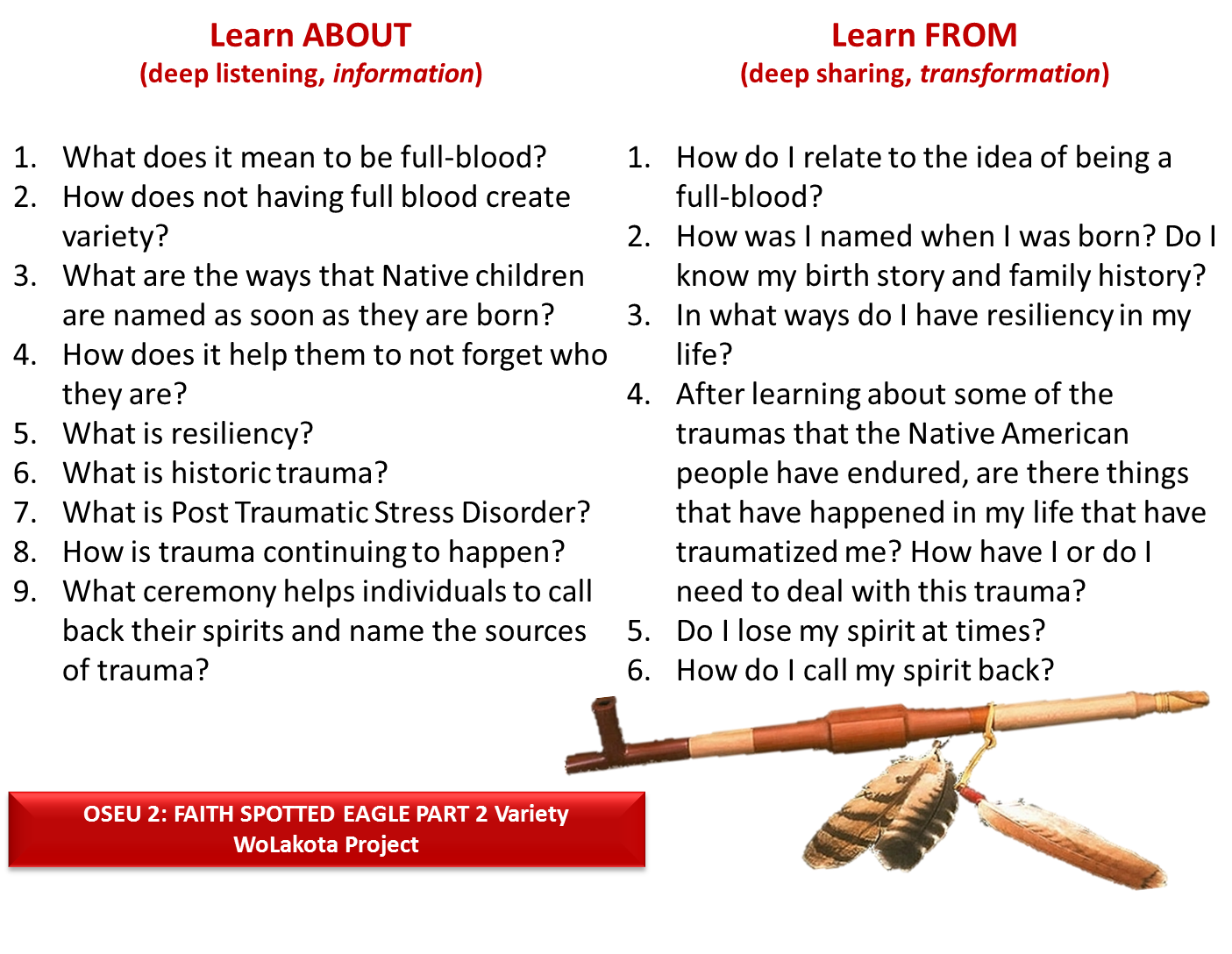
Learn About questions
What does it mean to be full-blooded?
How does not having full blood create variety?
What are the ways that Native children are named as soon as they are born?
How does it help them not forget who they are?
What is resiliency?
What is historic trauma?
What is Post Traumatic Stress Disorder?
How is trauma continuing to happen?
What ceremony helps individuals to call back their spirits and name the sources of trauma?
Learn From questions
How do I relate to the idea of being a full-blood?
How was I named when I was born? do I know my birth story and family history?
In what ways do I have resiliency in my life?
After learning about some of the traumas that Native American people have endured, are there things that have happened in my life that have traumatized me? How have I or do I need to deal with this trauma?
Do I lose my spirit at times?
How do I call my spirit back?
Transcripts
Variety, Naming & Ceremony - Faith Spotted Eagle - OSEU #2
Watch this interview on YouTubeSo the variety…many of our people are…in this day and age…are not full blood. So that mean that we have…myself, for example…I have…I come from French ancestry on my father’s side, and I come from a family called the LAKOTA LAST NAME family. My grandmother’s name was Julia LAKOTA LAST NAME. And so, we can trace our ancestry on that side back to France. And so, there’s a sense that one day I’d like to go to France. I haven’t been there yet. And so, I’m sixty-four so I’m working on that.
Hopefully I can get my way over there. And of course my children are part Irish too. And I think that the difference between saying that and being Dakota is that we have had the…despite the oppression that we’ve suffered over the years, we’ve been able to go underground and hang on to our cultural ways. And thank goodness for that because…when I travel…in my travels and training…I sense a…what’s the word for it…feeling of sadness among other ethnic groups that have lost their culture…like the Irish that have come here…the English that have come here… and they say, “I don’t know. I don’t know who my grandma was or I don’t know.” So, to me, that’s like a…it’s an unknown. So then when they say that I feel compassion for them because I can sense their sadness. But that’s our resiliency because from the minute that you’re born as a native child, you say…first of all…you say who your people are…”I’m a LAKOTA WORDS.” And my Dakota…I am a Dakota. My ina is…my LAKOTA WORD…my LAKOTA WORD…my grandmother…so you state all the way down the line who you are. In doing that, it’s making sure that the young ones don’t forget who they come from.
And then on the other side of the coin, it’s to tell the kids who they’re related to so they don’t marry their cousins. So it’s like…I don’t know how many times my daughter says that…rolling her eyes…”Oh no. That’s my cousin.” Because essentially we are almost related to everybody. And so, the choice is that you almost have to marry outside of your tribe anymore because everybody is related. And then, one more point I think about the resiliency is that we’ve come to understanding in recent years of something called “historical trauma.” History meaning that it is happened over and over throughout history. Trauma meaning that an event occurs that is beyond the coping ability of people’s physical body. And so, when that happens, you go to the spirit level where sometimes a spirit leaves from that individual. And so, they walk through life not really being present and full-spirited. And so, what replaces that is a sense of anger and sadness and discouragement…and all of those things. And so, in the process of historical trauma, when you don’t know where that anger is coming from, because the anger is a cover emotion, then there’s a tendency to get rageful and angry which is the workshops on rage that I do. And we’ve come to understand that actually has taken a form of what we call PTSD, Post-Traumatic Stress Disorder. And so…and the only way to walk out of that…is to call your spirit back…which is a traditional ceremony that we have…and to begin to name those things that are causing the trauma. And the trauma did not happen a long time ago. It’s continuing to happen now as we speak. So, we’ve got this big old stack of trauma that keeps happening and happening. And then, we’re getting more proficient at it because we understand it now. And before the war was so present, physically, that we didn’t have time…the guns were going off…and we’re not thinking, “Ok, what’s happening right now.” Now we can do that. We can say, “Ok, why am I so angry?” And then I can go put my finger on that and say “Oh yeah, that’s what it is.”
Resource text
won an
OSEU 2: FAITH SPOTTED EAGLE PART 2 Variety
WoLakota Project
From the current WoLakota source page:
Variety, Naming & Ceremony
Faith Spotted Eagle
Transcript
(deep listening, information)
(deep listening, transformation)
Some indexed text was extracted from scanned material. Check the original source for exact wording and spelling.
Source materials
Supplied transcript document. Text preserved as supplied; spellings and transcription uncertainties have not been corrected.
Additional source transcripts
Variety, Naming & Ceremony
Variety, Naming & Ceremony - Faith Spotted Eagle - OSEU #2
So the variety…many of our people are…in this day and age…are not full blood. So that mean that we have…myself, for example…I have…I come from French ancestry on my father’s side, and I come from a family called the LAKOTA LAST NAME family. My grandmother’s name was Julia LAKOTA LAST NAME. And so, we can trace our ancestry on that side back to France. And so, there’s a sense that one day I’d like to go to France. I haven’t been there yet. And so, I’m sixty-four so I’m working on that. Hopefully I can get my way over there. And of course my children are part Irish too. And I think that the difference between saying that and being Dakota is that we have had the…despite the oppression that we’ve suffered over the years, we’ve been able to go underground and hang on to our cultural ways. And thank goodness for that because…when I travel…in my travels and training…I sense a…what’s the word for it…feeling of sadness among other ethnic groups that have lost their culture…like the Irish that have come here…the English that have come here… and they say, “I don’t know. I don’t know who my grandma was or I don’t know.” So, to me, that’s like a…it’s an unknown. So then when they say that I feel compassion for them because I can sense their sadness. But that’s our resiliency because from the minute that you’re born as a native child, you say…first of all…you say who your people are…”I’m a LAKOTA WORDS.” And my Dakota…I am a Dakota. My ina is…my LAKOTA WORD…my LAKOTA WORD…my grandmother…so you state all the way down the line who you are. In doing that, it’s making sure that the young ones don’t forget who they come from.
Faith Spotted Eagle: [00:02:00] And then on the other side of the coin, it’s to tell the kids who they’re related to so they don’t marry their cousins. So it’s like…I don’t know how many times my daughter says that…rolling her eyes…”Oh no. That’s my cousin.” Because essentially we are almost related to everybody. And so, the choice is that you almost have to marry outside of your tribe anymore because everybody is related. And then, one more point I think about the resiliency is that we’ve come to understanding in recent years of something called “historical trauma.” History meaning that it is happened over and over throughout history. Trauma meaning that an event occurs that is beyond the coping ability of people’s physical body. And so, when that happens, you go to the spirit level where sometimes a spirit leaves from that individual. And so, they walk through life not really being present and full-spirited. And so, what replaces that is a sense of anger and sadness and discouragement…and all of those things. And so, in the process of historical trauma, when you don’t know where that anger is coming from, because the anger is a cover emotion, then there’s a tendency to get rageful and angry which is the workshops on rage that I do. And we’ve come to understand that actually has taken a form of what we call PTSD, Post-Traumatic Stress Disorder. And so…and the only way to walk out of that…is to call your spirit back…which is a traditional ceremony that we have…and to begin to name those things that are causing the trauma. And the trauma did not happen a long time ago. It’s continuing to happen now as we speak. So, we’ve got this big old stack of trauma that keeps happening and happening. And then, we’re getting more proficient at it because we understand it now. And before the war was so present, physically, that we didn’t
Faith Spotted Eagle: [00:04:00] have time…the guns were going off…and we’re not thinking, “Ok, what’s happening right now.” Now we can do that. We can say, “Ok, why am I so angry?” And then I can go put my finger on that and say “Oh yeah, that’s what it is.”