Interview · South Dakota · Stephanie Charging Eagle · OSEU 3
Themes: Land & stewardship, Kinship & family, Education & learning, Values & generosity, Economy & livelihoods, Listening & observation
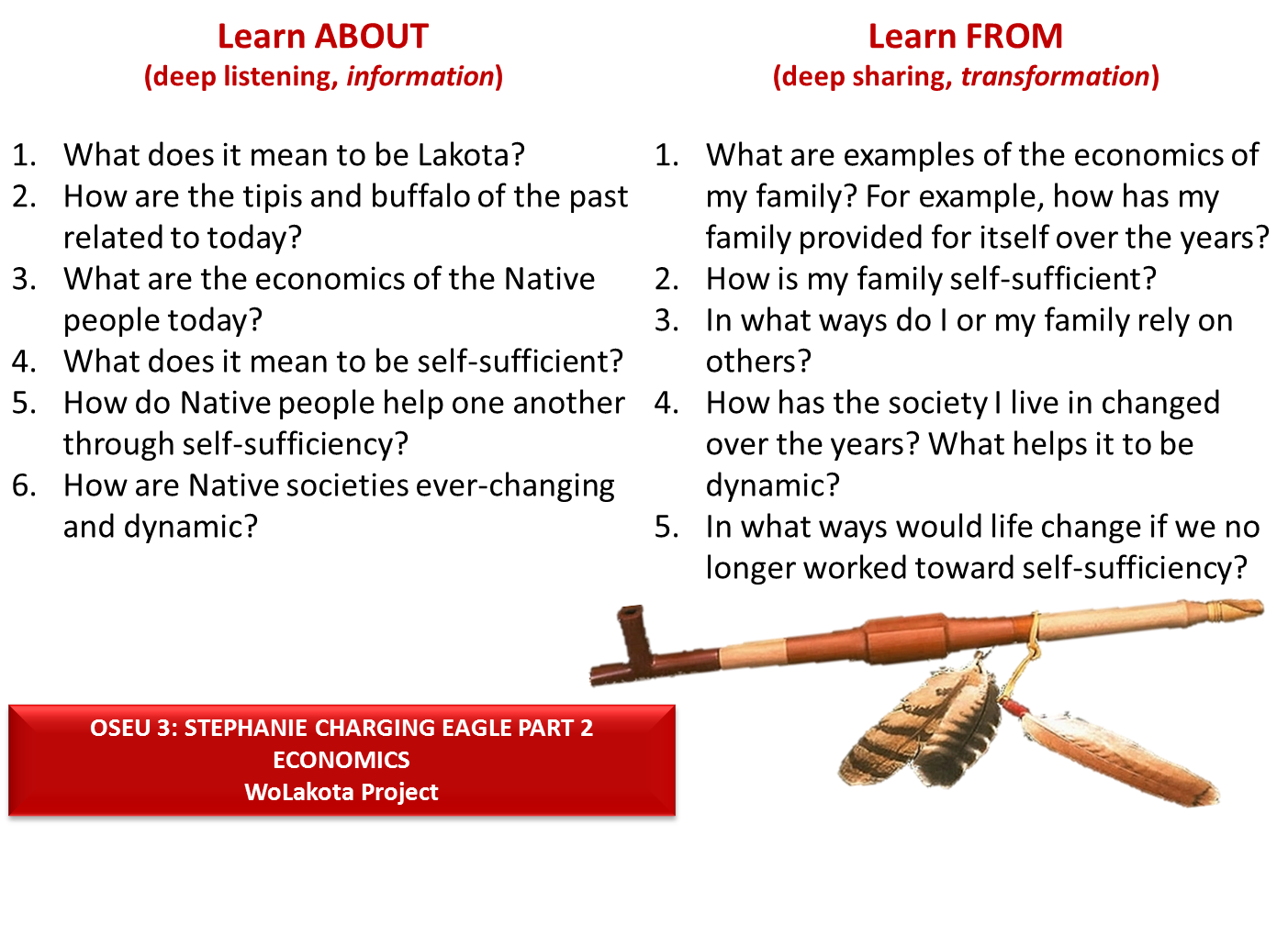
Learn About questions
What does it mean to be Lakota?
How are the tipis and buffalo of the past related to today?
What are the economics of the Native people today?
What does it mean to be self-sufficient?
How do Native people help on another through self-sufficiency?
How are Native societies ever-changing and dynamic?
Learn From questions
What are examples of the economics of my family? For example, how has my family provided for itself over the years?
How is my family self-sufficient?
In what ways do I or my family rely on others?
How as the society I live in changed over the years? What helps it to be dynamic?
In what ways would life change if we no longer worked toward self-sufficiency?
Transcripts
Lakota Economics - Stephanie Charging Eagle - OSEU #3
Watch this interview on YouTubeAnd economics, you know…when people talk about…some of them get a little carried away…and they say, “Well, we can’t be Lakotas because we don’t live in tipis or have buffaloes anymore.” And I’m like, “That’s not the concept.” The concept is that, economically, we had the buffalo. And that buffalo…we honored the spirit of the buffalo. We took care of it. We only took what we needed, just like the land. But now, we don’t have the buffalo, but we still have economics. So today, the buffalo no longer exists as our economy…or the main state of our economy. So what is? For many of us, it’s working. To be able to work, you have to acquire skills, education…whatever it takes for that. And so, now the concept of economics…self-sufficiency of every individual so they can help their family…their tiospaye…is still brought forward. The concept is still very much there. We are self-sufficient. But we make ourselves self-sufficient so that we can still help each other. And that is the concept of how you bring forward the concepts, the philosophy, to an ever-changing, dynamic society.
Resource text
bP
OSEU 3: STEPHANIE CHARGING EAGLE PART 2
ECONOMICS
WolLakota Project
From the current WoLakota source page:
Lakota Economics
Stephanie Charging Eagle
Transcript
(deep listening, information)
(deep listening, transformation)
Some indexed text was extracted from scanned material. Check the original source for exact wording and spelling.
Source materials
Supplied transcript document. Text preserved as supplied; spellings and transcription uncertainties have not been corrected.
Additional source transcripts
Lakota Economics
Lakota Economics - Stephanie Charging Eagle -
OSEU #3
And economics, you know…when people talk about…some of them get a little carried
away…and they say, “Well, we can’t be Lakotas because we don’t live in tipis or have
buffaloes anymore.” And I’m like, “That’s not the concept.” The concept is that,
economically, we had the buffalo. And that buffalo…we honored the spirit of the buffalo.
We took care of it. We only took what we needed, just like the land. But now, we don’t
have the buffalo, but we still have economics. So today, the buffalo no longer exists as
our economy…or the main state of our economy. So what is? For many of us, it’s
working. To be able to work, you have to acquire skills, education…whatever it takes for
that. And so, now the concept of economics…self-sufficiency of every individual so they
can help their family…their tiospaye…is still brought forward. The concept is still very
much there. We are self-sufficient. But we make ourselves self-sufficient so that we can
still help each other. And that is the concept of how you bring forward the concepts, the
philosophy, to an ever-changing, dynamic society.