Interview · North Dakota · South Dakota · Gladys Hawk · OSEU 5 · NDNAEU 2
Themes: Language & revitalization, Kinship & family, Storytelling & oral tradition, Education & learning, Spirituality & ceremony, Values & generosity, Listening & observation, Intergenerational learning
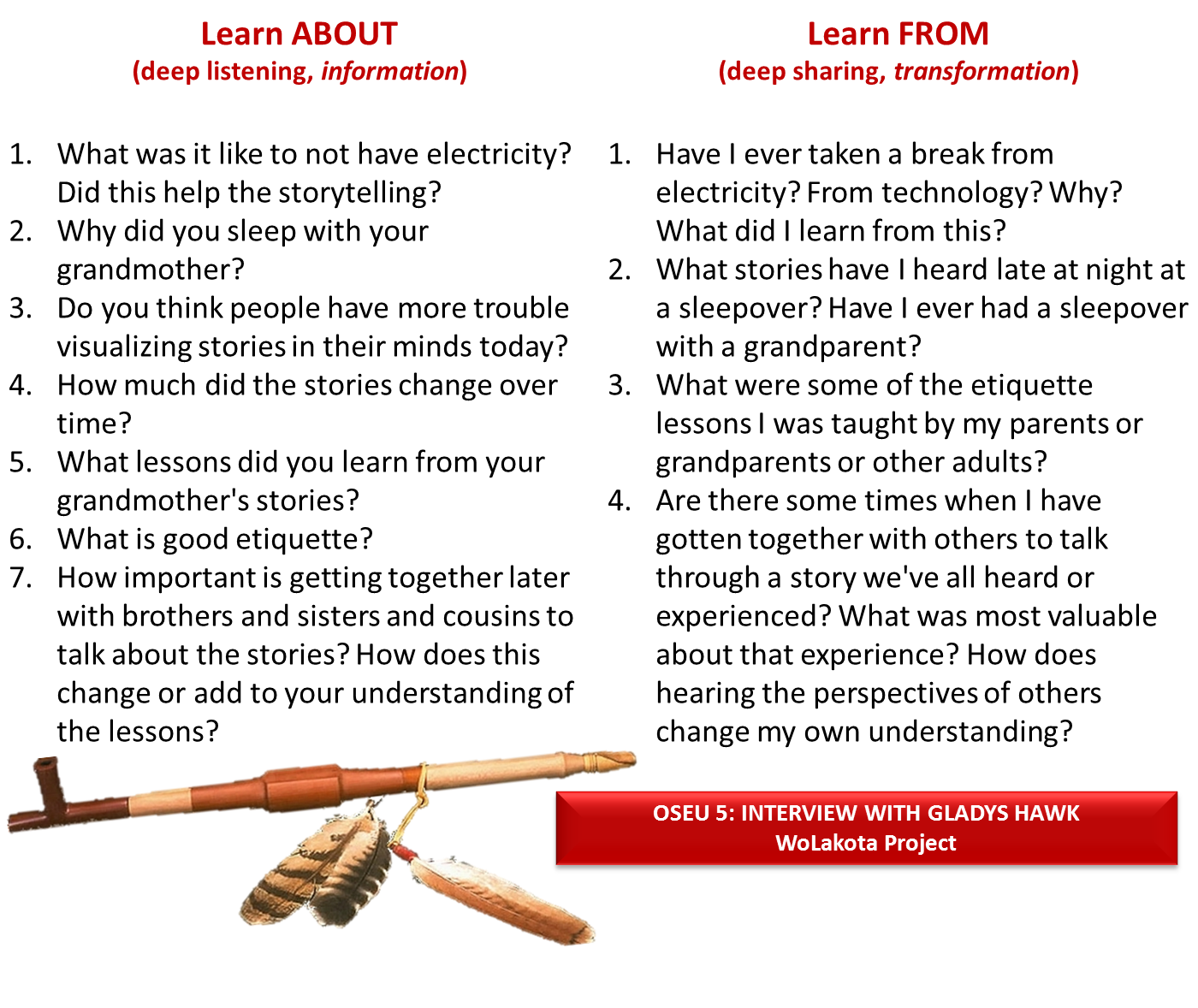
Learn About questions
1. What was it like to not have electricity? Did this help the storytelling?
2. Why did you sleep with your grandmother?
3. Do you think people have more trouble visualizing stories in their minds today?
4. How much did the stories change over time?
5. What lessons did you learn from your grandmother’s stories?
6. What is good etiquette?
7. How important is getting together later with brothers and sisters and cousins to talk about the stories? How does this change or add to your understanding of the lessons?
Learn From questions
1. Have I ever taken a break from electricity? From Technology? Why? What did I learn from this?
2. What stories have I heard late at night at a sleepover? Have I ever had a sleepover with a grandparent?
3. What were some of the etiquette lessons I was taught by my parents or grandparents or other adults?
4. Are there some times when I have gotten together with others to talk through a story we’ve all heard or experienced? What was most valuable about that experience? How does hearing the perspectives of others change my own understanding?
Transcripts
Grandmother’s Stories - Gladys Hawk - OSEU 5
Watch this interview on YouTubeIn the evenings, when we had our evening prayers, then of course, you know, the lamplight and all that, you know, we didn't have electricity like this. Then they would sit at the table and smoke their pipe. My grandma had her own pipe, grandpa had his. And they would have evening prayer first, and then they would socialize just by smoking, talking about things for the day. And then my grandmother would tell me, okay, you know, now it's time for your bedtime. And I would sleep with her.
So she would put me to bed and then she'd start telling me stories that, I mean, your imagination can just run wild when you hear it in your language, you know, it's just like watching TV, the cartoons, it just grabs your attention. Well, it's the same thing, but it was in my mind. And because of the way that she would talk and her expressions, you know, her tone of voice or all of that, it makes the story come alive, so to speak. And so I would just be so mesmerized just listening to her talk about these stories that she told me.
And usually, just at the end, you know, you're just all tense and waiting for something bad to happen. And so, and then translating it, she'd say, and that's why I want you to be good. She said, don't be like this one in the story. I think, hopefully, that the history of how they were raised, they heard these stories and on down the line, maybe not in the same words, you know, the verbatim, the way that she told me, maybe she heard it in a different way, but she's telling it to me at my level of learning.
And so I think that stories are handed down through time just for that purpose. There is a purpose to everything, as you know, or, you know, to me anyway, that's the way I understand it. We have to listen to what our elders have to say, because usually they're teaching us something. It's how you look at it, how you understand it, that you may not understand it right away, but all of a sudden, oh, yeah, that's what he meant, you know, or that's what she meant. Those are things that are there.
Stories are basically probably the foundation of good etiquette, good behavior, and good standing of people, of how they're raised. I would put it like that, because stories are going to always be with us.
Resource text
OSEU 5: INTERVIEW WITH GLADYS HAWK
; WoLakota Project
“Sy
From the current WoLakota source page:
Grandmother’s Stories
Gladys Hawk
Transcript
(deep listening, information)
(deep listening, transformation)
Teachings of Our Elders resource text:
NDNAEU Alignment:
Some indexed text was extracted from scanned material. Check the original source for exact wording and spelling.
Source materials
Supplied transcript document. Text preserved as supplied; spellings and transcription uncertainties have not been corrected.
Additional source transcripts
Grandmother’s Stories
Grandmother’s Stories - Gladys Hawk - OSEU 5
In the evenings, when we had our evening prayers, then of course, you know, the
lamplight and all that, you know, we didn't have electricity like this. Then they would sit
at the table and smoke their pipe. My grandma had her own pipe, grandpa had his. And
they would have evening prayer first, and then they would socialize just by smoking,
talking about things for the day. And then my grandmother would tell me, okay, you
know, now it's time for your bedtime. And I would sleep with her.
So she would put me to bed and then she'd start telling me stories that, I mean, your
imagination can just run wild when you hear it in your language, you know, it's just like
watching TV, the cartoons, it just grabs your attention. Well, it's the same thing, but it
was in my mind. And because of the way that she would talk and her expressions, you
know, her tone of voice or all of that, it makes the story come alive, so to speak. And so
I would just be so mesmerized just listening to her talk about these stories that she told
me.
And usually, just at the end, you know, you're just all tense and waiting for something
bad to happen. And so, and then translating it, she'd say, and that's why I want you to
be good. She said, don't be like this one in the story. I think, hopefully, that the history of
how they were raised, they heard these stories and on down the line, maybe not in the
same words, you know, the verbatim, the way that she told me, maybe she heard it in a
different way, but she's telling it to me at my level of learning.
And so I think that stories are handed down through time just for that purpose. There is
a purpose to everything, as you know, or, you know, to me anyway, that's the way I
understand it. We have to listen to what our elders have to say, because usually they're
teaching us something. It's how you look at it, how you understand it, that you may not
understand it right away, but all of a sudden, oh, yeah, that's what he meant, you know,
or that's what she meant. Those are things that are there.
Stories are basically probably the foundation of good etiquette, good behavior, and good
standing of people, of how they're raised. I would put it like that, because stories are
going to always be with us.