Interview · South Dakota · Joseph Marshall III · OSEU 5
Themes: Kinship & family, Identity & belonging, Storytelling & oral tradition, Education & learning, Values & generosity, Listening & observation, Intergenerational learning
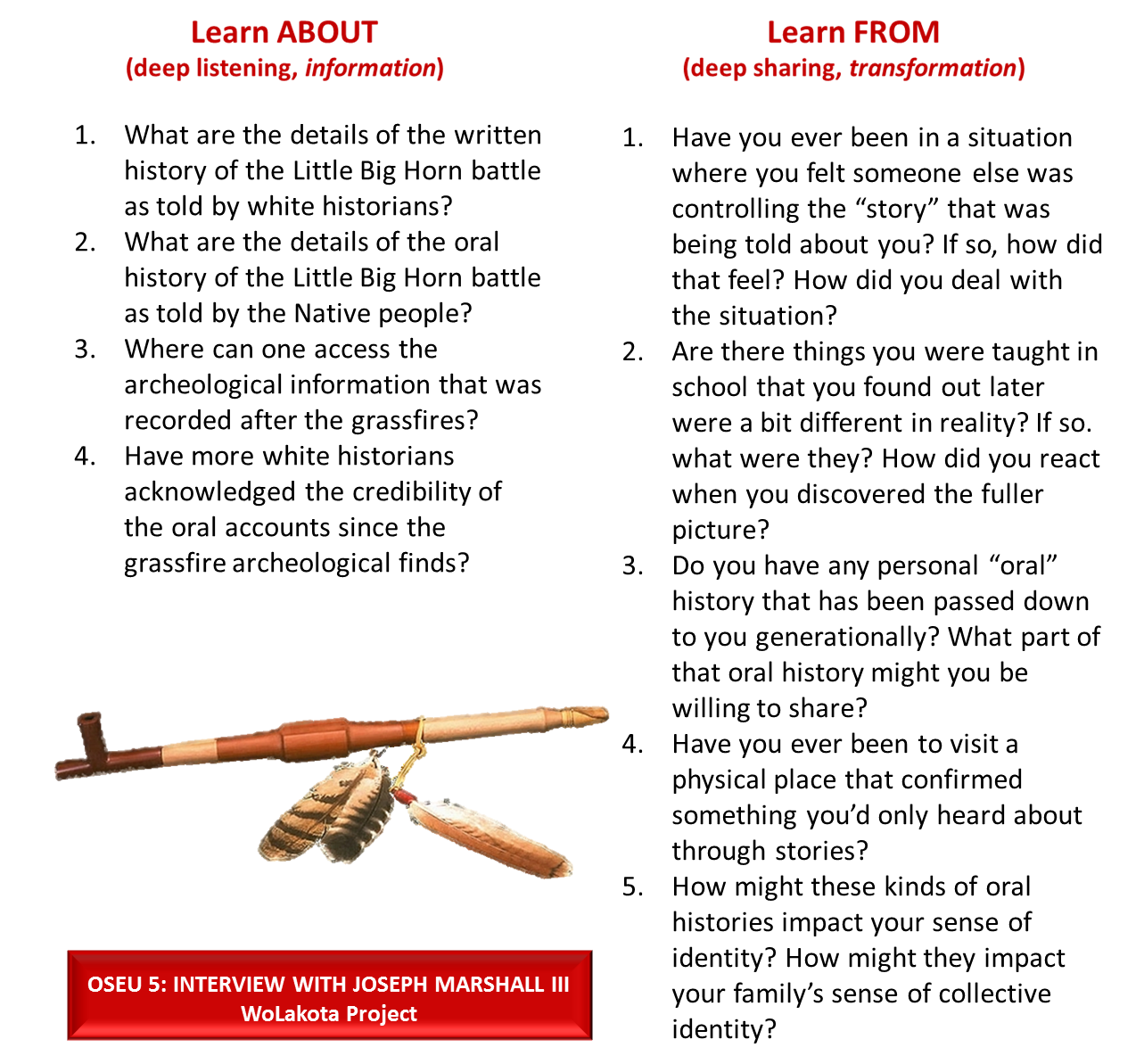
Learn About questions
What are the details of the written history of the Little Big Horn battle as told by white historians?
What are the details of the oral history of the Little Big Horn battle as told by the Native people?
Where can one access the archeological information that was recorded after the grassfires?
Have more white historians acknowledged the credibility of the oral accounts since the grassfire archeological finds?
Learn From questions
Have you ever been ina situation where you felt someone else was controlling the “story” that was being told about you? If so, how did that feel? How did you deal with the situation?
Are there things you were taught in school that you found out later were a bit different in reality? If so, what were they? How did you react when you discovered the fuller picture?
Do you have any personal “oral” history that has been passed down to you generationally? What part of that oral history might you be willing to share?
Have you ever been to visit a physical place that confirmed something you’d only heard about through stories?
How might these kinds of oral histories impact your sense of identity? How might they impact your family’s sense of collective identity?
Transcripts
Who Gets to Tell the Story - Joseph Marshall III - OSEU 5
Watch this interview on YouTubeAnd it gets back to who's in control. It's that simple. Who gets to write the books, who gets to tell the stories now, that's called our history. And I think a good example is something that happened at the Little Bighorn Battlefield in 1983, 1984. Up to that point, the white historians had a tendency, a strong tendency, to go along with or discount some of the oral stories that our side told about how the battle progressed and how it came, you know, how it ended.
The famous last stand where Custer and the 7th Cavalry went out with a blaze of glory, both guns blazing as it were. In 83 and 84, there were grass fires that went through that area. And officially, there's only two sites that are designated, one on the far south and one on the north side where the visitor center is and then there's a site on the bluffs above the river. And if you've ever been there, the river just meanders and it's flat river bottom on one side and big hills on the other side. But the grass fire went through there.
And what it did was uncover a lot of metal artifacts, belt buckles, boot buckles, shell casings, round lead balls, all kinds of things. And archaeologists went in there and cataloged every one of those things. And there were hundreds of them, maybe even thousands. And they located, they carefully recorded what each one was, where it was, and they spent a lot of time doing that. And then they identified what each of those artifacts were.
An incoming round ball was usually an Indian, from an Indian weapon, because the cavalry was using a specific kind of weapon that could be easily identifiable. So they could tell what might have been an outgoing fire and incoming fire at any given area. And as they did their research and as they correlated all that information and then compared it to the military version of the battle and the Lakota Cheyenne version of the battle, they found out that the artifact distribution coincided more, much more, with the Lakota Cheyenne version of the battle.
And it really gave that oral story, that oral sense of our way we're keeping our stories and our history much more credibility in our eyes. It's still an uphill struggle, but it's, you know, no system is infallible. But it was still, it still worked, because we, you know, that discovery of the artifacts just affirmed what our ancestors have been telling us all these years. So oral history is important.
I mean, it should still be an important part of the process, and now it should be, start with the family, saying, okay, this is who we are as your parents, and this is who your grandparents are on both sides. Doesn't matter how you feel about them or whatever, this is who we are. This is where we came from. This is what they did for a living. They were in the Army, they were in the Navy, whatever they did, they were school teachers, whatever.
Go back as far as you can, because that's the easiest way to give that child that sense of identity and that footing so that you can walk with that knowledge all the time. And that's where oral history can really, really serve a purpose. It's not just for the collective, it's more for the individual, or should be.
Resource text
Self-Timing Version with Learn From Questions included:
OSEU 5: INTERVIEW WITH JOSEPH MARSHALL III
WoLakota Project
From the current WoLakota source page:
Who Gets to Tell the Story?
Joseph Marshall III
Transcript
(deep listening, information)
(deep listening, transformation)
Some indexed text was extracted from scanned material. Check the original source for exact wording and spelling.
Source materials
Supplied transcript document. Text preserved as supplied; spellings and transcription uncertainties have not been corrected.